

Across Cultures and Canvases: Vincent Mcindoe’s Luminous Vision
By Reeti Roy ||
I met Vincent by sheer accident – the kind of serendipity that only travel seems able to organize. A taxi in Seoul had dropped me at the wrong location, somewhere I could not recognize, and while trying to make sense of the unfamiliar street names, I stepped into the nearest building to gather myself. It turned out to be a small, sunlit gallery. I had planned to walk straight back out, but a single painting on the far wall pulled me in. It depicted the game of cricket with a kind of tender humor, the stance of the batsman caught in mid-motion, the ball suspended as if time itself had paused to admire it. Cricket is so inseparable from my childhood in India that encountering it in Korea felt almost uncanny. It made me instantly curious about the artist who created it.
As I stood there studying the work, Vincent appeared beside me, soft spoken, warm, and slightly amused that someone recognized the subject so quickly. We began to talk and what should have been a brief exchange unfolded into a long, generous conversation. He told me about his influences and the way he holds multiple cultures in dialogue as he paints. I shared how strange and lovely it felt to find a piece of home in a place I had arrived at by mistake. The randomness of the moment, the quiet intimacy of the gallery, and the unexpected familiarity of that cricket scene stayed with me long after I left. This piece grew out of that encounter, born from a wrong turn, an open door, and a painting that reminded me that art often finds us precisely when we are lost.
Born in Brantford, Canada, in 1962, Mcindoe is a contemporary artist whose practice moves fluidly between fine art and illustration, shaped by a life lived across continents. Educated at the Ontario College of Art and Design (1981–1985), and earlier in England and Scotland, Mcindoe developed a rigorous technical foundation alongside a deep sensitivity to painterly tradition. He began his career as an illustrator, working with major international clients including Time, Allure, BMW, and Marvel Studios – an experience that honed his precision, narrative instinct, and stylistic versatility.
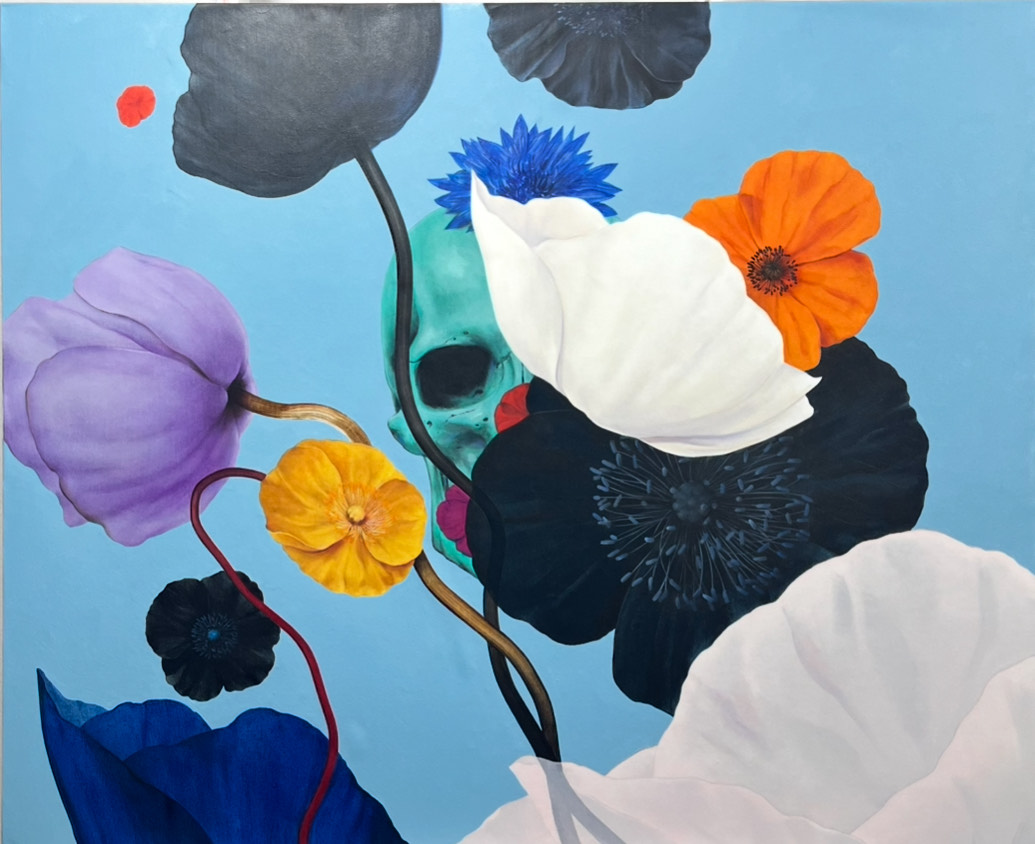
Now based in South Korea, Mcindoe’s fine-art practice draws on a wide range of influences, including Bauhaus graphic principles, the Belle Époque, and early Korean and Chinese painting traditions. His work is marked by bold composition, rich color, and a quiet emotional resonance, often engaging themes of memory, nostalgia, love, loss, and interior life.
Interview with Vincent Mcindoe
Reeti Roy (RR): How have your Canadian roots influenced your art, and what has living in South Korea brought to your creative perspective?
Vincent Mcindoe: My Canadian roots have always informed my practice. Growing up in Canada, I was surrounded by strong traditions of landscape painting, which had a lasting impact on me from an early age. That foundation naturally led to an interest in contemporary artists such as Jean-Paul Riopelle, who became a major influence. Living in South Korea has not altered my creative perspective so much as deepened it. The pace of life here has given me more time for reflection, sustained studio work, and far fewer distractions.
RR: Could you share how your education shaped your early artistic endeavors?
Vincent Mcindoe: My education played a critical role in shaping my artistic direction. Early on, I studied in England and Scotland, where a few key schools were instrumental – particularly in introducing me to oil painting at a young stage. After returning to Canada, I spent a significant period influenced by my mother’s disciplined approach to drawing and her strong work ethic. I later attended the Ontario College of Art, which proved to be truly transformative. It was an immersive environment that exposed me to the full breadth of artistic ideas, practices, and possibilities.
RR: Your work spans both fine art and commercial illustration. How do you balance these two worlds, and do they inform each other?
Vincent Mcindoe: My practice spans both commercial and fine art, and I find genuine satisfaction in working across these two spheres. Commercial art gave me a strong technical foundation and a sense of discipline that continues to inform my studio practice. I manage this balance by responding to commercial projects as they arise, while dedicating my remaining time to gallery-focused work. Painting for exhibitions remains my primary focus, but commercial assignments keep my practice energized, sharpen my time management, and reinforce precision and discipline.
RR: Which of your exhibitions stands out most to you, and why?
Vincent Mcindoe: I’ve participated in many exhibitions, but KIAF Seoul stands out most consistently due to the overall quality of the fair. Held annually, KIAF brings together top international and Korean artists, and I find it invaluable to spend time there – slowly and attentively – taking in the work.
RR: You’ve mentioned that daily experiences influence your art. How does this manifest in your work?
Vincent Mcindoe: Art is not something separate from my life; it is a way of life. I’m constantly observing, collecting impressions, and drawing from everyday experiences: family, friendships, and daily events. These fragments of emotion and experience are reassembled in my work through a deeply personal lens.
RR: How did you develop your painterly style and use of pastiche?
Vincent Mcindoe: My painterly approach to illustration and use of pastiche emerged naturally from the demands of commercial work. There was a need to work fluently across many styles, and I developed the technical ability to do so – whether referencing Van Gogh, Da Vinci, or highly detailed, airbrushed realism. Given enough time, I’m able to work convincingly in a wide range of styles.
RR: How do graphic influences shape your work?
Vincent Mcindoe: My graphic sensibility is heavily influenced by Bauhaus principles and the Belle Époque. This influence is particularly evident in my fine art practice, where strong composition, bold color, and deep blacks play a crucial role. These graphic elements are central to my visual language and working process.
RR: How do multicultural experiences influence your art?
Vincent Mcindoe: Living in Korea has naturally introduced a multicultural dimension into my work. Both viewers and I have noticed subtle echoes of early Korean and Chinese painting traditions – particularly in my use of line and brushwork – filtering into my practice over time.
RR: How do you think about color and composition?
Vincent Mcindoe: Color and composition are deeply personal choices for me. I don’t consciously feel influenced in one direction or another; these decisions come intuitively.
RR: Can you share a personal experience that shaped your artistic direction?
Vincent Mcindoe: My work often serves as a record of where I’ve been. During the time I lived in Greece for a year and a half, for example, the influence of that place became quite pronounced – both visually and emotionally – resulting in work that felt more introspective and reflective.
RR: What emotions do you hope to evoke in viewers?
Vincent Mcindoe: I aim for my work to invite engagement. I frequently draw on a sense of nostalgia to establish an emotional connection with the viewer, and more often than not, that connection comes through.
RR: Is there a medium you feel most connected to?
Vincent Mcindoe: I primarily work with oil paint and rarely stray far from it. I’m deeply connected to the medium – the texture, physicality, and depth of color – and it remains central to my practice.
RR: How does it feel to see your work resonate more widely?
Vincent Mcindoe: Lately, my work has been resonating more strongly, and I’ve noticed a growing level of interest. While that provides encouragement and momentum, my drive has always been internal. I’m constantly working, regardless of external response.
RR: How have different countries shaped your artistic identity?
Vincent Mcindoe: Although I’ve worked in only a few different countries, my core working methods haven’t changed. That said, living in Korea has created a stronger personal connection than I can easily explain. I genuinely enjoy being here and feel grounded in the environment.
RR: Are you exploring new mediums or directions?
Vincent Mcindoe: I’m always pushing my work forward. Illustration continues to energize me – it carries more pressure, but I enjoy that challenge. Recently, I’ve been experimenting with new materials, including glass and small sculptural works using copper wire embedded into Jeju stone. Some experiments succeed, others don’t, but that process is essential.
RR: Are there new galleries or art fairs you aspire to?
Vincent Mcindoe: For now, I’m content focusing locally, though I recognize the need to expand further. I’m beginning to look more seriously at participating in additional international art fairs.
RR: What dream collaborations or projects do you envision?
Vincent Mcindoe: In terms of illustration, I’ve accomplished most of the brand collaborations I once aspired to. Looking ahead, I’m drawn to larger, more experiential projects – ideally for global brands – that incorporate architectural elements, three-dimensional design, or animation.
RR: What upcoming projects excite you most?
Vincent Mcindoe: One of the most exciting projects I’m currently involved in is a collaboration with a Korean company that has given me considerable creative freedom. They support experimentation – printing on glass, testing unconventional techniques – and accept that not everything will succeed. That openness has led to some promising and unexpected results.
RR: How do you sustain your passion and work ethic?
Vincent Mcindoe: Yes, my relationship with my work borders on obsessive. I tend to work long hours, often late into the night, and I have to be mindful of maintaining balance – eating well, sleeping, and taking care of myself. The work is consuming, but it’s also deeply fulfilling.
The journey from a wrong turn in Seoul to this deep dive into Vincent Mcindoe’s practice is a testament to the quiet power of art to bridge cultural distances and create unexpected points of connection. His work – a vibrant and incisive dialogue between introspection, technique, and the subtle graphic echoes – invites viewers to pause and recognize universal emotions within the framework of his highly personal canvases. Through the discipline of his commercial background and the reflective freedom of his visual art, Mcindoe reminds us that some of the most profound discoveries, whether in life or on canvas, often begin with a moment of happenstance or serendipity.
Relevant Links
- Vincent Mcindoe website: https://vincemcindoe. wixsite.com/artist
- ARTN Edition: https://artnedition.com/search/ result/?q=VINCENT
- Print Bakery: https://www.printbakery.com/product/ list.html?cate_no=232&sort_method=3&page=14& srsltid=AfmBOooLXuGc2zUAf-RO92AzUVl5 CKCh_ceDWS9qzO2OBxXi9aQXD_2U
The Author
Reeti Roy is a writer, cultural commentator, and creative entrepreneur whose work explores memory, art, identity, and social justice. She holds a BA in English literature from Jadavpur University and an MSc in social anthropology from the London School of Economics. Her essays and criticism have appeared in numerous publications, including Korean media. In September 2025, she had several international engagements in South Korea, including as keynote speaker at KOTE, Insa-dong, and at the Yeosu Egg Gallery.
Cover Photo courtesy of Vincent Mcindoe.