





Book Review: A Fine Balance
Reviewed by Michael Attard ||
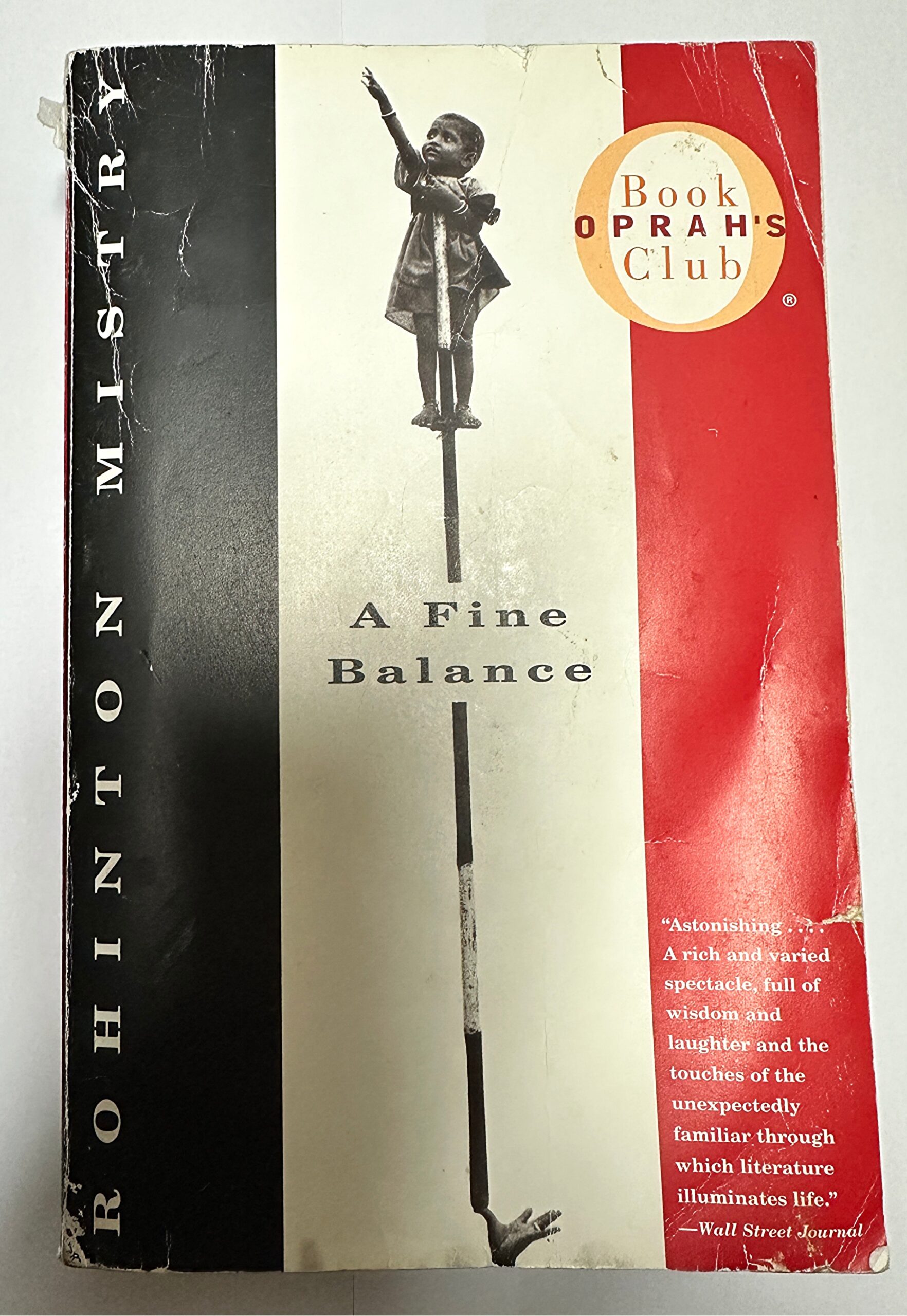
- A Fine Balance
- By Rohinton Mistry
- 603 pages, Vantage, 1995
The story takes place in India, beginning in the years immediately prior to Indian independence from Britain in 1947 and ends in 1984, shortly after the assassination of India’s prime minister Indira Gandi. The book is fiction but is a scathing critique of Indian politics and culture during those years. Characters are trapped within the horrors of injustice and the repugnant stickiness of the superstitious Indian caste system. Rohinton Mistry does not use his author’s prerogative to include poetic justice within his story. Instead, he has chosen to leave us soiled by atrocities and imbibed with the total despair of the characters’ souls.
At the start, there is hope. A Hindu father and member of the lower caste, the “untouchables,” has sent his two sons to live and train to be tailors with a Muslim friend named Ashraf. The father hopes that his sons will be able to break free from the unending cycle of misery and humiliation. Everyone knew that this rejection of “the occupation preordained for his present incarnation” was dangerous, but the father went ahead with his plan. For a time, their life situation does improve. Eventually the younger son, Narayan, returns to his village and becomes a spokesman for the untouchables. He marries, has a family, and sends his son, Om, to live and train as a tailor with his brother, Ishvar, and the family’s Muslim friend. But Narayan is brutally murdered after he complains about not being allowed to vote. Subsequently, his parents, wife, and two daughters are also murdered, burned alive in their home. After this, “Ashraf kept the shop closed, crushed by the helplessness he felt.” He and his wife “did not dare console Om or Ishvar – what words were there for such a loss, and for an injustice so immense? The best they could do was weep with them.”
Throughout the book the author employs no euphemisms. There is no softening of the brutality to appease the weak senses of the reader. The writer allows the monstrous acts to scream.
Also, as the story begins, Dina is a young girl, under her older brother’s care, after the death of her father. She has an independent spirit but not much good luck. As she grows up and struggles to support herself, she meets Ishvar and Om, the uncle and nephew tailors. The three of them enter into a business arrangement, where, especially in the beginning, there is plenty of mistrust. But it allows them to stay one step ahead of poverty. Much of the underlying story revolves around the evolving respect they develop for each other, born from unindoctrinated human decency.
A fourth character is Maneck, a 17-year-old student who comes to live in Dina’s home as a boarder. He and Om are about the same age and become friends. Their distinctively different backgrounds should have precluded any type of friendship, but the innocent spirit of their youth fills the moat between them.
There is a wealth of other characters who are well developed by the author. Depending upon who they are, they elicit feelings of affection, suspicion, pity, fear, or loathing. But they are all pragmatic in the ways they play the cards that life has dealt them. The characters have a genuineness that keeps the story rolling along for all 600 pages.
The four main characters are searching for a better life and are willing to be honest and hard-working to achieve their goals. But a corrupted and heartless system stymies them on all fronts. At Maneck’s university, “their president promised that, one by one, they would weed out all the evils of the campus: nepotism in staff hiring, bribery for admissions, sale of examination papers, special privileges for politicians’ families… The list was long but the rot went deep.” But virtually nothing ever got done, other than the murder of student protestors, like Maneck’s good friend.
The uncle and nephew tailors always fared worse. From being rounded up for political rallies, forced labor, and sterilization to the flattening of their slum home, their resilience is a testament to the human spirit. The author captures human nature’s innate will to live and the ability to support the psych with humor. On one particular day, the tailors had invited Manack to their home for dinner. But then came the demolition, causing Om to laugh “mirthlessly about telling him the dinner was off – cancelled due to the unexpected disappearance of their house.”
Generally, the writing is prosaic, which is quite appropriate for the story. But the author regularly illustrates his talent for seeing the world in different dimensions. Immediately after the tailors had become homeless, their work began to suffer. Dina noticed this. “The stitches were no longer articulated gracefully in long, elegant sentences but spat out fitfully, like phlegm from congested lungs.”
As the characters separate to go their own ways, temporarily they think, there is a rekindling of hope that all might end well. But here it seems, the title, A Fine Balance, comes into play. When things are finely balanced, it only takes a small event to upset the order of things. As such, there never really is the attainment of a climax. Conflict is not resolved, and there certainly is no dramatic turning point where goals are achieved. The characters and the reader are left where they have fallen to.
Some reviewers have criticized the author’s wide judgement of Indian society as too negative. On the contrary, I say the author has fully captured the complexity of human experience. When injustice robs the soul of hope, it is not possible to repair the despair.
The Reviewer
Michael Attard is a Canadian citizen but has lived in Gwangju for over twenty years. He has taught English as a second language in academies and within the public school system. He is officially retired and spends time reading, writing, hiking, and spending time with friends.
Cover Photo: Cover of A Fine Balance. (Attard)