




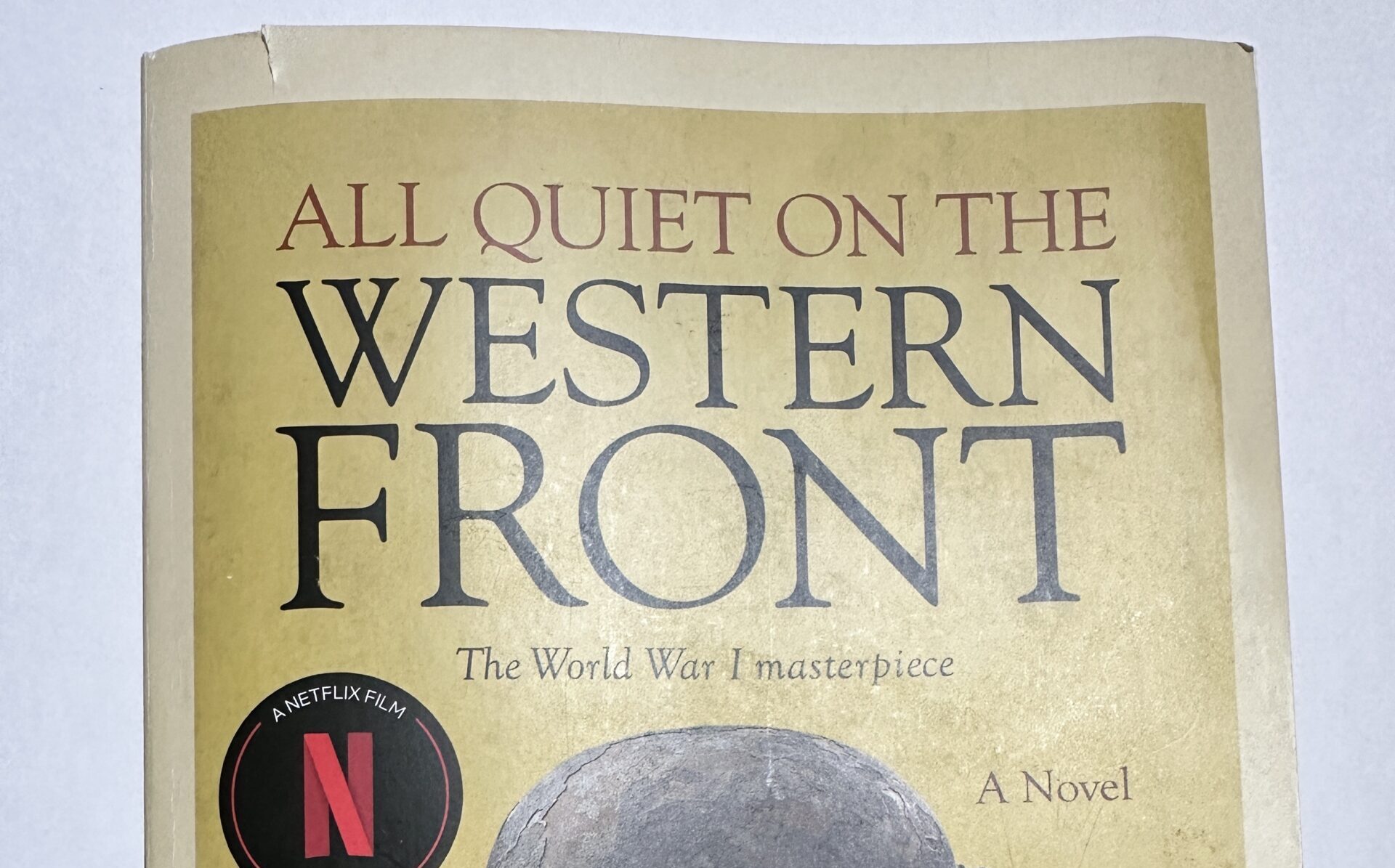
Book Review: All Quiet on the Western Front
Reviewed by Michael Attard
All Quiet on the Western Front
By Erich Maria Remarque
240 pages, Random House, 1996 (Originally 1929)
ISBN-10: 0449911497; ISBN-13: 978-0449911495
On the dedication page, author Erich Maria Remarque has written: “This book is to be neither an accusation nor a confession, and least of all an adventure, for death is not an adventure to those who stand face to face with it. It will try simply to tell of a generation of men who, even though they may have escaped shells, were destroyed by the war.” In essence this statement is a summary of the novel, All Quiet on the Western Front. The fiction is set during World War One, 1914–1918, and describes the trench warfare along the French–German border, referred to by the Germans as “the Western Front.”
The men were under the age of twenty, and while they knew little of the true causes of the war, they followed the patriotic advice of their elders and volunteered for the military. There was little they could do to resist the peer pressure: “Even one’s parents were ready with the word ‘coward.’”
The story is told by Paul Baumer and follows him and a few of his school friends. A strong theme developed early and maintained until the very end is the unbreakable bond of comradeship. In the beginning, the regiment has just been moved back from the actual front line in order to rest and regroup. There is a sense of easiness surrounding them. Paul says, “These are wonderfully care-free hours.” They can still hear the fighting coming from the front, but “bumblebees droning by quite drown it.” And there is plenty of food for once. But then we are given a sterile number hinting at an inauspicious future. There is extra food because recently 70 men out of the group of 150 were killed. An obsession for good food is another theme.
Death is never far removed from all they see, do, and think. Three men go to visit a wounded schoolmate. He has lost a leg. They try to cheer him up, but “anybody can see that he will never come out of this place.” The young men try to understand the strictness of their training. They agree that there must be discipline. But the “conception of the Fatherland … resolved itself into a renunciation of personality.”
The author integrates themes and ideas alternating from the matter-of-fact movements to and from the front to the horrors and desecration of bodies witnessed, all while the young men try simultaneously to simply stay alive and comprehend the meaning of it all. During a gas attack, acutely aware of the danger, they “breathe as lightly as possible.” The mind, fearful and in self-preservation mode, remembers “the awful sights in the hospital: the gas patients who in day-long suffocation cough up their burnt lungs in clots.”
The mental and psychological wounds are no less forgiving, and this is the main theme. Many of the young men simply break. In the trench, they are short of water and overrun with rats, and the bombardment does not let up. Paul recounts, “By midday what I expected happens. One of the recruits has a fit…. Grinding his teeth and opening and shutting his fists…protruding eyes, we know them too well.”
There are some lighter moments, such as when the young men meet three French girls. Their two countries are at war, but the natural priorities of youth cannot be defeated by any army. This is a touching episode that sharply shines an uplifting light upon the human spirit and exposes the absurdity of war. But this is a short reprieve, and they are quickly thrust back into the world of terror. For all of the men, “terror can be endured so long as a man simply ducks – but it kills, if a man thinks about it.”
On leave, Paul goes home. He is a drastically changed person. He is “paralyzed, and against my will the tears run down my cheeks.” He knows that he should be happy to be home, “but a sense of strangeness will not leave me.” For Paul, the people at home know nothing of the war. He longs for the idealism of not so long ago, but it seems light years away.
For a time, they are stationed next to a Russian prisoner camp. “It is strange to see these enemies of ours so close up.” The Russians are supposed to be the hateful foe. Paul’s humanism allows him to see the men trapped in the obscenity of war. He looks at them and sees “the suffering of the creature, the awful melancholy of life and the pitilessness of men.”
The author has given us a personal account of the war. He has not tried to explain, praise, condemn, or entertain. Simply, he is telling a story too often told, hoping perhaps that we do not forget a lost generation of men.
The Author
Michael Attard is a Canadian citizen but has lived in Gwangju for over twenty years. He has taught English as a second language in academies and within the public school system. He is officially retired and spends time reading, writing, hiking, and spending time with friends.
Cover Photograph by Michael Attard.