





Book Review: Around the World on a Bicycle
By Michael Attard
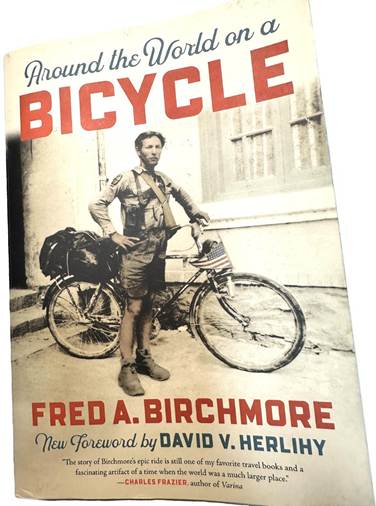
- Around the World on a Bicycle By Fred A. Birchmore
- University of Georgia Press, 2020 (Original 1939)
- ISBN-10: 0820357286; ISBN-13: 978-0820357287
Around the World on a Bicycle is more than a young man’s memoir covering almost two years of his life. It is an exotic
adventure over mountains, across deserts, and through jungles by an extremely determined individual with a lust for life rarely seen. The book is a travelogue, written in parts in visionary language, matching the descriptions of the best of writers. It is of significance that the book was originally published in 1939. The honesty of youth is bestowed upon the reader, free of bias or prejudice. The quest began in the summer of 1935.
It is appropriate to refer to the author, Fred Birchmore, as protagonist and hero. Monsoon rains, sand storms, wild animals, snakes, malarial mosquitoes, and humans all appear as antagonistic forces forever creating conflict and seemingly impossible challenges. Additionally, the author’s insights and wisdom edify the reader of any generation.
It would be amiss to not give credit to the author’s trusted bicycle. While this may seem strange, the reader will see that there was a magical relationship between man and machine. In fact, the author went as far as to name his bicycle Bucephalus, after Alexander the Great’s horse. The bicycle, was a Reinhardt bicycle built in 1935 and purchased by the author in Gotha, Germany.
When the journey began, he had no idea that he would travel about 25,000 miles, or 40,000 kilometers, on his trusted steed and be gone for so long. He was a foreign student in Cologne, Germany, and it was summer vacation. Thus, off he pedaled through Italy, France, England, Ireland, Norway and more. He did dismount his bicycle to climb both the Matterhorn in Switzerland and Germany’s highest peak, Zugspitz. He was a little confused climbing the latter, when two different signs pointed in different directions. To him both routes looked the same, “namely, straight up.”
In the 1930s, the Italians were not offering Americans the most amiable of welcomes. At one point, he was detained by Italian soldiers as a possible spy. They let him go, but three different hotels refused him accommodation. He finally found a tavern across the border in Yugoslavia for the night. This was a far cry from the receptions in Ireland, where he was greeted by strangers as a “Prodigal son.”
He returned to Italy and boarded a freighter for Egypt. Shortly thereafter he writes, “I caught my first glimpse of the Sahara, rolling like a great yellow sea, in striking contrast to the green vegetation of the Delta of the Nile.” And this was not all he caught sight of. At that time, the construction of the Nile dam at Aswan meant that the holy island of Philae was partially submerged. He decided to swim out to the island. “But when several uninvited guests in the form of crocodiles met me halfway, I decided that it would be just as well for me to return to shore.”
Egypt was the turning point in the story. While sleeping outdoors, he was robbed of his money and passport. After a week of hoping that the police might find his passport, he gave up. Then, by the time he received a new passport, it was too late for him to get back to Cologne for the start of the new semester. “I now, for the first time, decided to make my trip around the world on a bicycle.” Eager to be on his way, he headed off across the Sinai Desert, dismissing the warning that it was experiencing the worst storm in three years. At one point, he says, “Frantically, I tore rags from my shirt and stuffed them in my ears before the driving sand had time to burst the ear drums.” But regret wasn’t in his nature. As he said at one point, “The follies of youth are the manna upon which the dreams of old age feed.”
Later, crossing the Syrian Desert, his mind did not change. He tells us, “My lips cracked so greatly that blood oozed from gashes which opened afresh every time I moved my mouth.” He continues, “Life is a path of roses, but to appreciate the roses, one must willingly accept the thorns too.”
In Persia, he was invited to the home of a professor. Their conversation was interrupted by female laughter, which embarrassed the host, but at the same time revealed the author’s “disappointment at not meeting the other members of this Moslem family.” This led his host to bestow a great honor upon his wives by allowing them to be in his presence. First, the three wives were told to dress for this reception. This took an hour, and thus our author says, “I naturally expected to find them almost drowned beneath the folds of gold and silver embroidered silken robes and shawls, totally concealing their persons from view.” As expected, the women were masked, but this only “seemed to emphasize the almost stark nudity of the rest of their bodies, which were bare of clothing.”
Back on his bicycle, he describes the beauty of what he sees: “The mountain slopes of this region were sparklingly green as if showers of emerald paint had freshly fallen from the sky.” But the 18,000-foot (5,400-meter) ranges of Afghanistan were not as kindly. “I had scaled many peaks, but never … had my nose bled because of altitude.” Then in a fall, two ribs over his heart were fractured. Next, his passport is taken from him, but he stole it back at night and escaped.
None of the above could break our author’s spirit. He refers us to a Confucian saying: “Whatever cannot be overcome must be endured.” But he enlightens us: “The secret of the saying is not in seeing how much can be endured but how much can be overcome to keep from having to endure anything!”
In India and Burma, snakes were a constant problem. As the monsoon rains flushed the small, as well as thick and lengthy, reptiles from the jungle onto the road, he had to continually swerve around the creatures. At times, there were so many or they were so long that he drove right over them, lifting his legs high in order to avoid their strikes. One gruesome incident occurred when a cobra struck at him, missed, but caught its head in the spokes of his fast-moving rear wheel.
He had avoided malaria until almost the end of this grand adventure. The trials and tribulations were wearing him down. “The mud seemed a horrible live thing clinging to my legs and wrapping around Bucephalus’ wheels, with the sickening suction of octopus tentacles.” But our hero would survive to complete the circumnavigation of the globe by bicycle and boat. He claimed to have achieved what no other person had ever done, let alone think possible. Fred Birchmore was to have other adventures, but finally at the age of 100, he passed away.
The Author
Michael Attard is a Canadian citizen but has lived in Gwangju for over twenty years. He has taught English as a second language in academies and within the public school system. He is officially retired and spends time reading, writing, hiking, and spending time with friends.
Cover Photo: Michael’s copy of Around the World on a Bicycle.