





Book Review: Being Mortal
Reviewed by Michael Attard
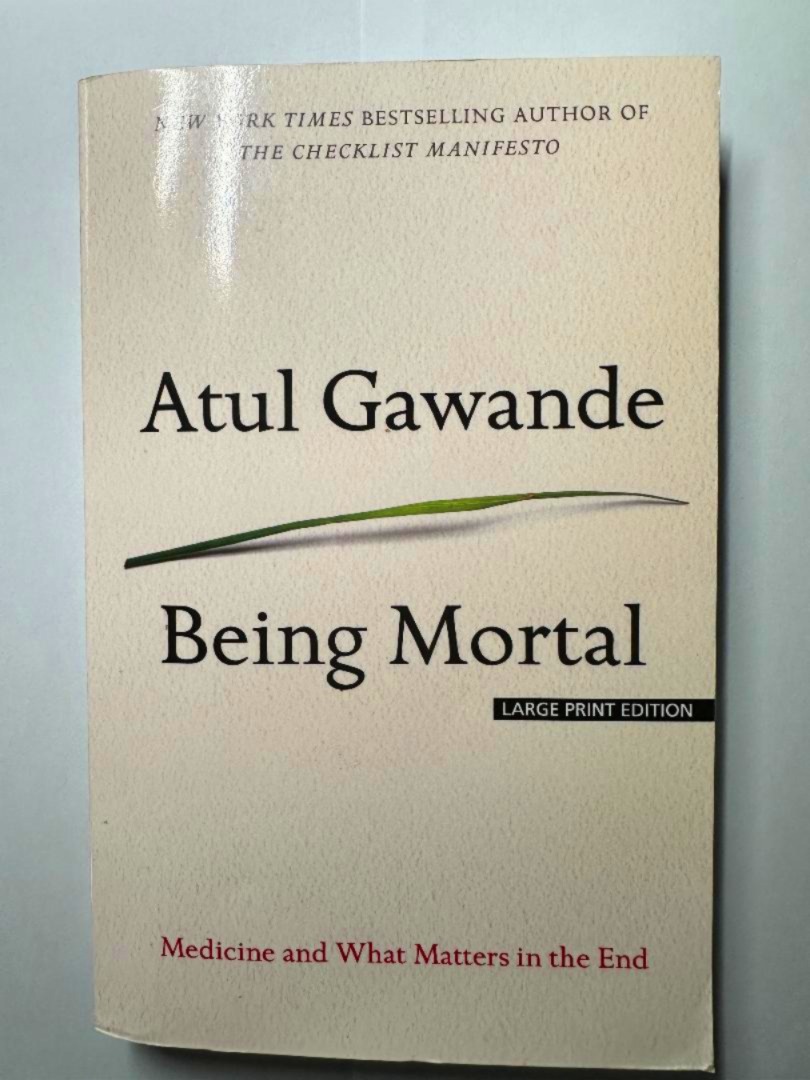
- Being Mortal: Medicine and What Matters in the End By Atul Gawande
- 304 pages, Metropolitan Books, 2014
- ISBN-10: 9780805095159; ISBN-13: 978-0805095159
From the beginning of time, humankind has understood that mortality is part of our nature. And for thousands of years, except for the last couple of centuries, death was often like falling off a cliff. Whether a person was young or old, they could appear healthy one day, and then be dead a couple of days later. As modern science progressed, the graph of death became less precipitous. Doctors equipped with drugs and new surgical methods could keep us alive longer, even if it was a bumpy ride to death. But nowadays, many of those bumps of varying degrees of health have been smoothed out. The end of life, and the road to inexorable death, for many, has become a slow fade.
The issue at hand, which the author, Doctor Atul Gawande addresses, is modern medical practice’s failure to adapt its care to those living longer along a slow route of diminishing abilities. He argues that doctors with a focus on survival are actually often working against the well-being of patients. Older people are not getting the care they require. He attributes a great deal of this to training, or perhaps more apt, lack of training. With regard to his personal experience, he relates, “Our textbooks had almost nothing on aging or frailty or dying.” Thus, in order to confront this issue, he has written this book. He states, “This is a book about the modern experience of mortality … how medicine has changed the experience and how it hasn’t, … where our ideas about how to deal with our finitude have got the reality wrong.” He goes on to ask, “What if there are better approaches?”
The book is replete with true stories of elderly individuals combined with accounts of how pioneers in the field of elderly care have made progress toward the enhancement of individuals’ well-being. One way in which the author highlights his points is to break down the timeline moving toward mortality. In the first chapter, entitled “The Independent Self,” he points out that social changes have altered the way older people see themselves, but this has happened without the medical profession responding accordingly. The old and elderly, just like other cohorts of society, value the independent self. If the medical profession fails to recognize the need to respect the independent self, then the well- being of the individual will suffer. Perhaps the most salient anecdotal refrain illustrating lack of respect – even in the nicest of nursing homes – is the complaint “It just isn’t home.” And how can it feel like home, when the door is always open, nurses and staff walk in without knocking and a daily regimen of eating and sleeping is always exact to the minute?
The author provides interesting historical context that elucidates the evolution of elderly care. He gives us a fair assessment of the challenges and refrains from attributing blame to anyone for lack of progress. Throughout the book, he is not pointing his finger at anyone but rather is attempting to show a better way. Unfortunately, some of the past implementations in elderly care weigh heavily upon our ability to change. For example, while nursing homes were miles ahead of early 20th-century poorhouses, they were not built and run with the well-being of the people who lived there as a priority. Rather, “They were created to clear out hospital beds.”
The concept of assisted living has been a boon to the improvement of the elderly’s well-being. In part of the book, the author follows the end years of a man named Lou. Lou had passed from independence to dependence to a stage of assistance. For Lou and others, assisted living allowed him to accept – even if reluctantly – his dependence. Furthermore, there was a bonus for the family as they were freed from an “agonized responsibility.” The author refers us to various studies aimed at improving well- being through assisted living. Results included self-reporting of greater satisfaction with their lives, improved cognitive functioning, the use of fewer prescription drugs, and fewer trips to the hospital.
The author tells us the story of Bill Thomas, a pioneer and hero in the evolution of nursing home reform. Bill had grown up believing in self-sufficiency, and when he became the medical director of a nursing home, everything he saw within those walls contradicted his notion of self-sufficiency. He wanted to attack the three plagues of nursing homes: boredom, loneliness, and helplessness. Artificial plants were replaced with living plants. A couple of cats and dogs were brought into the home, and everyone got a parakeet. Of course, not everything went smoothly, but in the end, the well-being of the residents had been greatly improved. Cultural inertia had been overcome.
The latter parts of the book direct us toward the final point of our mortality. Chapter 6 is entitled “Letting Go,” and Chapter 7 is “Hard Conversations.” Even with an emphasis on well- being, we may not be able to escape the question: “When should we try to fix and when should we not?” The conversation then moves to hospice care. This is also referred to as palliative care, an interdisciplinary caregiving approach with the purpose of optimizing quality of life while mitigating suffering with respect to terminal illness. Here, a clear take-away is a reminder that “people with serious illness have priorities besides simply prolonging their lives … concerns include, avoiding suffering, strengthening relationships with family and friends, being mentally aware, not being a burden on others, and achieving a sense that their life is complete.”
There is an alternative to withering away, dying alone and broken in an institution. Modern medicine has done an amazing job of staving off death, but we are well beyond the time of making well-being a co-partner in the evolution of longevity.
The Reviewer
Michael Attard is a Canadian citizen but has lived in Gwangju for over twenty years. He has taught English as a second language in academies and within the public school system. He is officially retired and spends time reading, writing, hiking, and spending time with friends.
Cover Photo: Atul Gawande’s Being Mortal. (Michael Attard)