






Book Review: Han Kang’s Greek Lessons
Reviewed by Michael Attard ||
- Greek Lessons: A Novel
- By Han Kang (Deborah Smith & e. yaewon, Trans.)
- 192 pages, Hogarth, 2023
Han Kang began her writing career in the 1990s as a poet. In 2024, she won the Nobel Prize for Literature. She is the first Korean writer and the eighteenth woman to achieve the award. The Nobel committee stated that she was given the honor in recognition of “her intense poetic prose that confronts historical traumas and exposes the fragility of human life.” Her novel Greek Lessons was published in South Korea in 2011. The English-language release was in April 2023.
The reader is never given a name for the woman in the story. We can determine her age as late thirties or early forties by the fact that she has an eight-year-old son. But through divorce, she has lost primary custody of the boy. It becomes clear that this traumatic privation is fundamental in her loss of speech. And to stress the point, it needs to be plainly stated that her muteness is not by her own volition; there is a real psychological/physiological condition rooted in her trauma. And even deeper, she thinks, it deduces down to “the question of whether she really had any claim to existence.”
Nevertheless, the woman is a strong character; she wants to change her situation. “She has chosen to learn ancient Greek … because she wants to regain language of her own volition.” But why, specifically, Greek? For the woman, Ancient Greek is a dead but perfect language. She cannot speak the language of life and intimacy. When the silence had taken hold of her, “she no longer thought in language. She moved without language and understood without language – as it had been before she learned to speak.”
It appears that the woman has some apprehension about the capacity or potency of any language. In the second chapter, titled “Silence,” the nature of words opposite in meaning seem to shock her with overwhelming sensory stimuli. “Even the most nondescript phrase outlined completeness and incompleteness, truth and lies, beauty and ugliness, with the cold clarity of ice.” Her struggle appears to be an attempt at crafting a delicate equilibrium.
The teacher giving the Greek lessons is a man, somewhere in his late thirties. His personal struggles and trauma are more easily understood. He has a genetic disorder, and he has been slowly but inexorably going blind for many years. As of yet, with thick lenses, he can get by, but just barely. He knows that the woman is not deaf, her muteness is not misunderstood. He accepts her silence. They both know that their respective losses do not eliminate personal life and its meaning.
The man has other issues besides his blindness. He was born in Korea but spent seventeen years of his youth in Germany. Now, living in Korea for the last three years, he has not fully acculturated. He says, “To be honest, there are times when I feel envious watching the students. Of their certainty, their unwavering firmness, perhaps – something only those whose life, language, and culture have never been broken in two.”
In my opinion, the teacher is not a strong character. He tells us a lot about the past, but does appear unaccepting of the present, and unwilling to prepare for the future. A close friend bluntly told him, “If I were you, I’d learn Braille ahead of time, to be prepared. And get used to walking around outside with a white cane. I’d get a wonderful, well-trained retriever…” He says that this “privately injured me.”
“He knows that the woman is not deaf, her muteness is not misunderstood.”
For most of the story, there is virtually no social exchange between the man and the woman. It is not until a minor accident leaves the teacher’s glasses broken that the reader gains a sense of human contact. He talks, she listens, and she helps him. And then the story ends.
Are the man and woman tragic characters? I don’t think so. They have their flaws, but admirable qualities are less obvious. True, fate has dealt them suffering, but I can’t see what they have overcome or come to recognize. On the other hand, we have an insightful portrayal of the human condition, fragile and lonely. After all, the story of life need not always be one of recovery. So much of life is about possibility.
The Reviewer
Michael Attard is a Canadian citizen but has lived in Gwangju for over twenty years. He has taught English as a second language in academies and within the public school system. He is officially retired and spends time reading, writing, hiking, and spending time with friends.
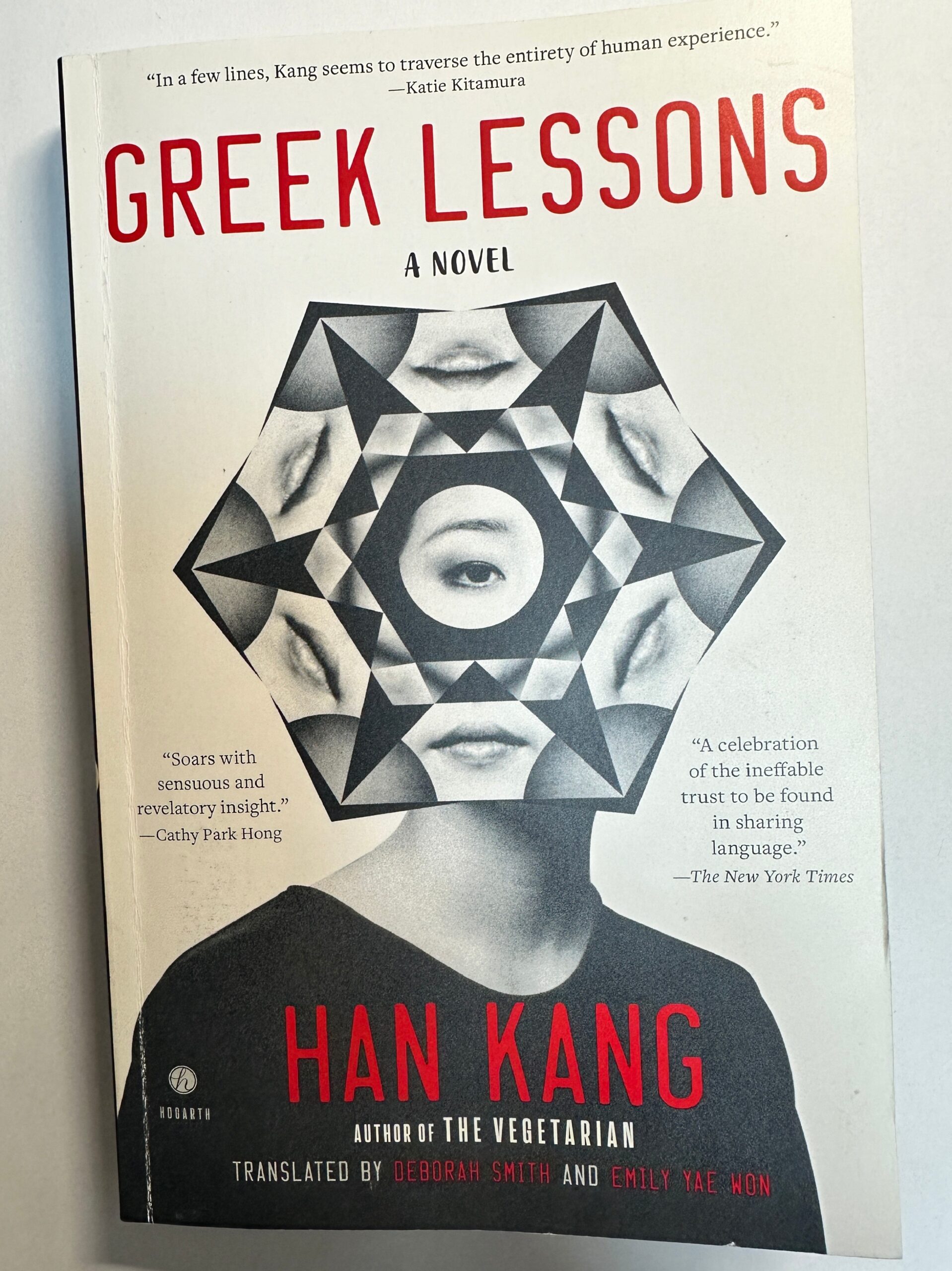
Cover Photo: Cover of Greek Lessons. (Attard)