



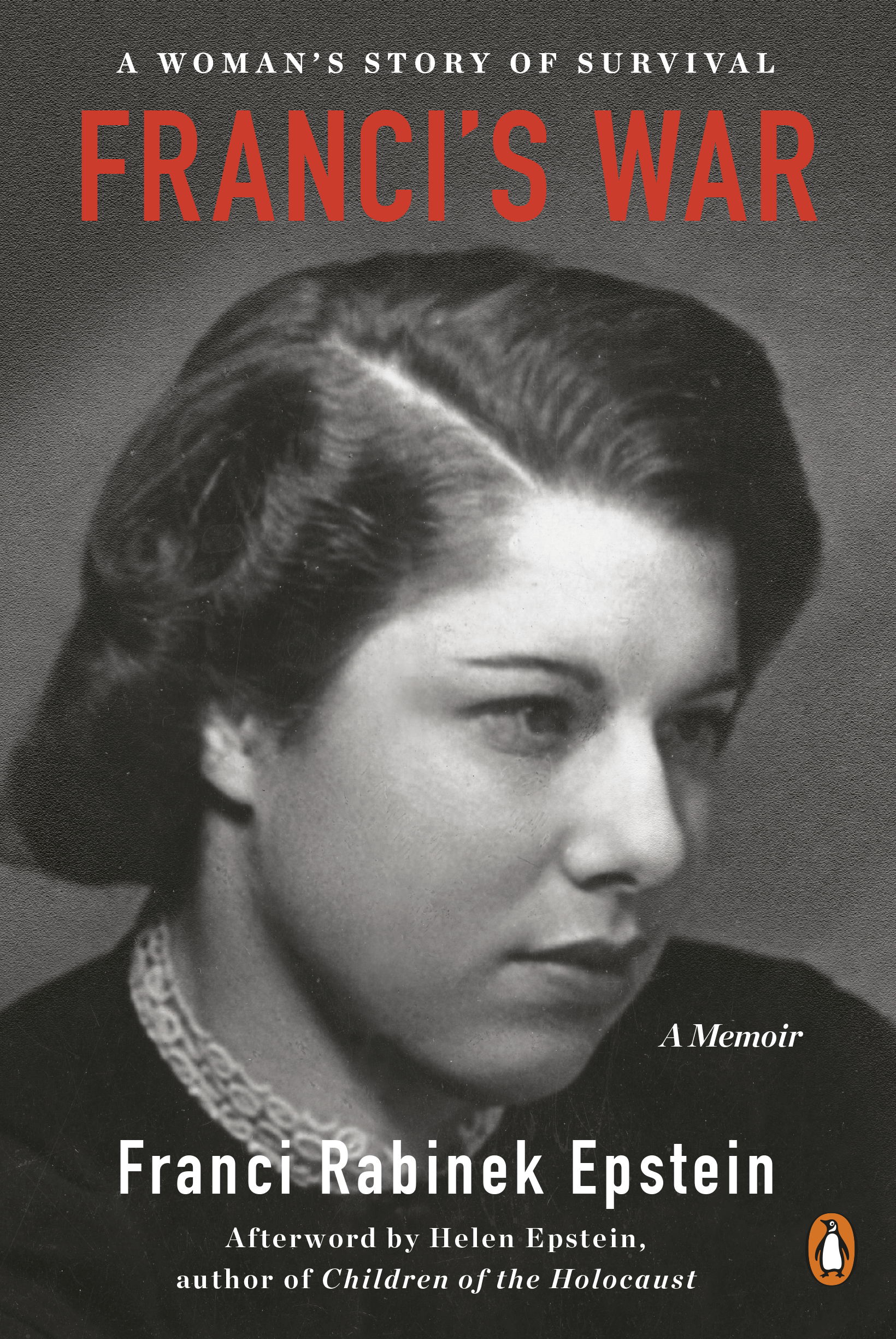
Franci’s War: A Woman’s Story of Survival – Book Review, April 2025
Reviewed by Michael Attard
- Franci’s War: A Woman’s Story of Survival By Franci Rabinek Epstein
- 272 Pages, Penguin Books, 2020
- ISBN: 9780143135579
The book is a memoir from World War II Holocaust survivor Franci Rabinek Epstein. Her story mostly relates what happened to her during a three-year period from 1942 to 1945. The book was first published in 2020 by her three children. Franci’s story may not entirely be unique, but that only highlights the scope of the man-made tragedy. It is a story sometimes told with lack of apparent emotion, yet underlying this muted voice is the pain of truth, and the necessity of psychological self- preservation.
What stands out about Franci is her keen sense of what was happening around her. This enabled her to make quick and correct decisions, at least most of the time. She never feared making a choice, and an inner strength enabled her to follow a moral path through mine fields of perverse morality.
The horror began in September, 1942, when at the age of twenty-two, Franci and her parents were deported from Prague, in what was then, Czechoslovakia. Like many, her family were non-practicing Jews. Her father had converted to Catholicism, and believed in assimilation. Her mother was agnostic, and Franci considered herself to be a Czechoslovakian citizen, baptized Catholic. By this time the family was familiar with life under Nazi rule, but certainly not accepting. They had previously been arrested and held for a short time in 1939. Their dress-making business had been taken from them. Why then had the family stayed? Franci explains: “Not even the Jews were immune to the incessant barrage of the Nazi propaganda machine.”
Franci was separated from her parents but sent to the same camp as her husband Joe. She was assigned as a nurse’s assistant. Dysentery and typhoid were raging. Eventually she was sent to a workshop “which produced cheap cotton dresses for the Germans.” She writes of making friends and says, “Life could be pleasant, even amusing at times.” From a reader’s perspective, the first part of the book does not fall in line with what one might expect from a Holocaust memoir.
She does, however, refer to the environment as “suffocating.” With respect to religion, she states that “as a child, I had been totally captivated by the mysticism of the Catholic ritual; now I was suspicious of Mrs. T and other converts who were able to keep their faith intact in spite of the absurdity of the situation.”
Franci was sent to Auschwitz. There were wires and dogs, watch towers, and SS men everywhere. Franci was breaking. “A very strange sensation took hold of me, I stared down at my tattooed arm … it slowly detached itself and became two arms.” Franci had lost herself; she had become only her tattoo, A4116.
In June 1944, many of the prisoners were going to be sent to work camps. They were ordered to strip and to put their clothes over their left arm. “A parade began in single file A pattern emerged: the group on the left were clearly intended for the chimneys.” Each woman was asked a short series of questions. Franci was asked, “Profession?” She responded, “Electrician” and was told to move to the right. “It wasn’t an outright lie…. Her father was an electrical engineer.”
Franci was next sent to a camp near Hamburg, Germany. Life was difficult there with nightly bombardment. The work mainly involved the clearing of rubble, “a circumstance that afforded more opportunity to organize – a euphemism for steal.” The war was not going well for the Germans. The women began to hope. Together they took imaginary walks through their home town of Prague. “The most popular and lush fantasy was of sitting in a hot bath.”
“The year 1945 started with a letdown. The winter was grim, the sick line grew longer every morning, and there was the first death of pneumonia.” Interestingly, from a reader’s perspective, there is a subtle but palpable change in the book. The telling and description morph into tangible physical pain, psychological scarring, and existential assault. Gone, is the casual air of novelty. The human agony of loss, long suppressed beneath the denial of inhumanity, comes to the fore in the author’s words.
They were loaded into freight cars and moved again. “Some sort of death dance seemed to be in progress, with one of the living dragging a dead one by the feet toward the mass graves.” In this new location, the women looked for their old friends, but one “could not recognize anybody. These were only skeletons covered with a gray parchment-like skin, and eyes sunk deep in their sockets…. There was no need for gas chambers now.”
Then miraculously, it must have seemed, a tank was seen coming down the middle of the road. “The British were finally here.” It was a long and slow process, but A4116 eventually dissolved and Franci reappeared. The following fifty pages explain how Franci tried to rebuild her life in the short term. It certainly was not an easy task. She says, “I was incapable of responding to the kindness and concern of people, yet desperately lost without their company.
The last twenty pages of the narrative are an “Afterword,” written by Franci’s daughter. I suppose that, as much as can be expected, the chronicle has a happy ending. Franci wanted her story told, but her account is not just about what happened to her and those around her. Rather, the book recounts a journey by millions through a gruesome time in human history. It is a wandering of endurance that, when shared, can hopefully enlighten us to acknowledge a shared humanity.
The Author
Michael Attard is a Canadian citizen but has lived in Gwangju for over twenty years. He has taught English as a second language in academies and within the public school system. He is officially retired and spends time reading, writing, hiking, and spending time with friends.