

Creative Writing: Love, Loss, and a Snickers Bar in Seoul
By Reeti Roy
Thunderstorms crashed outside, and because of a cloudburst, our garden looked like a pond. Two live fish had entered my bedroom – a first in all my years of existence. I carried what I could to my grandmother’s room, a space I hadn’t stepped into in two years. The room smelled of old books, of dust carried through decades, of memories stacked like the neat rows of gods on her shelves. Among them were jars of guava jelly, carefully labelled and lined up as if in devotion, made by women whose craft and labor she quietly championed. A lone Ganesh, a laughing Buddha, and a Mario Miranda painting I had brought her from Goa watched over the collection, each object holding a story, a memory, a laugh, or a prayer. She collected and preserved these remnants of the past, holding them with the same care she held her memories, her principles, her quiet acts of generosity. The rain was a mirror of the memories that surged back, pressing against the corners of the room, reminding me of what I had lost.
I remembered how, on ordinary days, I would be busily going about my work downstairs, and when I visited her, she would ask me to stay a bit longer. “Stay for a little while longer.” It was almost as if she was calling me to chat about her own day, to hear about mine, to tether our lives together with these small moments. Those pauses now feel impossibly long. Her last words haunted me: “I want to see a naat jamai!” I had laughed then, masking the ache inside me, and told her I didn’t think I’d ever meet someone who could love me as I needed to be loved. Now, her absence felt like the floodwaters themselves, relentless, impossible to escape.
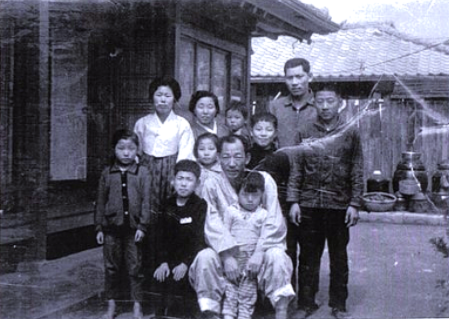
As I sifted through her papers, I found a photograph of my brother, my sister, and me, my hands tightly clasping hers. The edges of the photo were worn, the colors softened by years of light and handling. I remembered the story behind it: In West Bengal, we have an aiburobhaat, a celebration before a young woman’s marriage. With no groom in sight, I had once convinced her to throw me a grand birthday party, inviting all our extended relatives, letting it become my replacement aiburobhaat. Some relatives were amused, some astounded, but Boo acquiesced with her characteristic quiet generosity, smiling as if to say, you may bend tradition but not the heart behind it. That memory lingered in the room with me, a thread connecting past laughter to the ache of absence. Her absence, Boo’s, hovered in the corners of my vision, pressing gently on every decision, every interaction, every imagined future.
On her shelf, I found Taslima Nasreen’s Nirbachito Column. I opened it almost hesitantly, as if touching the pages might make her disappear more completely. Among the lines that struck me was one that made me smile, nod, and ache all at once:
মেয়েরা যারা লেখে, সাধারণের মধ্যে তাদের
ধারণা আছে যে তারা লিখছে, নিশ্চয়ই তাদের জীবনে বড় কোনো দুর্ঘটনা ঘটছে।
(Girls who write are often assumed, in ordinary life, to be experiencing some great upheaval as they write.)
I cackled at the bold assertion. How many times had I been told to keep my opinions to myself? And yet, Jinwoo liked being around me for exactly that, for being “quick-witted and intelligent” – his words, not mine. It reminded me that even in upheaval, expression – like memory – can be a lifeline.
And then there was Jinwoo, the same one I had shared ssanghwa-cha (a medicinal tea) with in Seoul. In the grandest gesture I had ever made for a boy, I boldly gave him the most ginormous Snickers bar I could find at a convenience store.
I joked about being his noona, since I was older by a couple of years, and we talked for hours and hours. He told me about his father and the scars from his childhood; I told him about my long-term relationship ending. Both of us talked about our preference for emotional stability over mercurial attraction. And yet, even in grief, even across oceans, moments of joy and curiosity found their way into my days.
In the dead of the night, under the pale moon and the light from a nearby shop window, I noticed something I hadn’t recognized before after knowing him for over ten days: He was undeniably handsome. Dekhteo bhalo, porashonayo bhalo. I could almost hear her cackling from somewhere nearby, her sharp laugh echoing in memory: Ei cheletai bhalo. Over the years, she had suggested countless candidates for me, each one meticulously evaluated, none ever becoming her naat jamai. Yet here, in this quiet Seoul street, I felt the same stamp of approval she would have bestowed, playful, teasing, entirely hers. Boo, a name I had affectionately given my grandmother, would have approved wholeheartedly.
I felt safe with Jinwoo, seen, understood, and unjudged. If he were Bengali, he would unironically have been a lokkhi chele. When I asked about Korean language schools, I expected a few links. Instead, he reached out to a friend and compiled every relevant course – thoughtful, precise, impossibly attentive.
Jinwoo, in a parallel universe, I would introduce you to phuchkas, take you to see all the thakurs during pujo, introduce you to Old Monk, have you steeped in the knowledge of student politics in Bengal, write cheesy love songs and poetry for you. In a parallel universe, we would raise children, maybe a chicken and a goat, maybe we would live away from the city. Maybe you would still mock me for confusing balgeun saram (밝은 사람, bright person), with ppalgan saram (빨간 사람, “red person”) And in another life, as Waymond Wang said in Everything Everywhere All at Once, maybe we would just be doing taxes and laundry together, and that would be enough. All of it would be different, and all of it impossible in this life, yet I held it tenderly, as one holds a fragile dream.
Maybe we would fight a lot, and make up even harder. Maybe we would have the same ease with which we talked that evening. Maybe you would take out your umbrella for me every day in the rains. The day I left Seoul and texted you, I playfully joked, “Even the weather gods are crying,” to which you said, “Every person in Seoul is crying.” When I told you your scars and wounds are not your fault, you quoted Good Will Hunting. I told you it was one of my favorite films growing up, one I had watched with my brother. I told you I was feeling sad to leave this time, to which you said, “It’s a good thing, right, the memories and connection we shared will remain deeply entrenched in my heart.”
The flood outside mirrored the storm inside me. Grief is not something you overcome, it is a tide you learn to navigate, carrying the ones you have lost and the connections that matter in the way you carry love – carefully, tenderly, always aware of absence. Grief is love with no place to go. Survival and remembering, survival and opening my heart despite knowing how much it could hurt. And somewhere in that storm, in the quiet echo of the Kolkata rain, Boo, my grandmother, remained, present in memory, in love, carried into each moment I lived.
Bilingual Glossary
- naat jamai – grandson
- dekhteo bhalo – also good-looking
- porashonayo bhalo – good at studies
- Ei cheletai bhalo. – This boy is good.
- lokkhi chele – well-mannered boy
- phuchka – a street food snack
- thakurs – Hindu dieties
- pujo – Hindu ritual
The Author
Reeti Roy is a writer, cultural commentator, and creative entrepreneur whose work explores memory, art, identity, and social justice. She holds a BA in English literature from Jadavpur University and an MSc in social anthropology from the London School of Economics. Her essays and criticism have appeared in numerous publications, including Korean media. In September 2025, she had several international engagements in South Korea, including as keynote speaker at KOTE, Insa-dong, and at the Yeosu Egg Gallery.
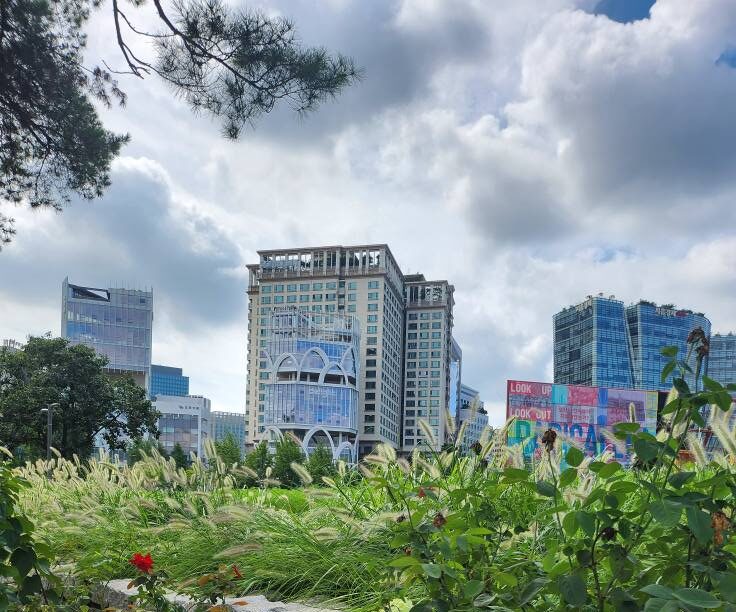
Cover Photo: A bright day while I was in Seoul. (Reeti Roy)