



Essay: The Keeper of the Scars – Observing Light and Shadows
By Reeti Roy ||
The flight from Incheon to Changi was a slow-motion shedding. By the time the plane descended over the sprawl of salt marshes, banking into the thick, charcoal-scented Calcutta air – the kind that doesn’t just surround you but inhabits you – I had left everything behind. I carried the silence of my life in Seoul like a bruised fruit, tucked between layers in my suitcase, hoping the humidity would not undo it.
In Seoul, I had lived in an oktap-bang (옥탑방, rooftop studio), a glass-walled box perched atop a traditional teahouse in Seochon. To get home, I would pass the scent of steeping ginger and scorched buckwheat, climbing a narrow wooden staircase that groaned under the weight of secrets. From the rooftop, I could see the gray-tiled roofs stretching toward the jagged silhouette of Bugak-san. The ancient stone of the fortress wall traced the spine of the mountain like a sentinel – a reminder that even the earth was guarded, held behind a line.
Jinwoo and I practiced an “almost love” with geometric precision. In those hours, the city lights below blurred into a second sky, and we existed in our own orbit. His eyes mirrored the cold Seoul stars as he dissected the architecture of his own constraints.
Even a dignified love, when it has nowhere to settle, becomes dead weight. It is a garden you can admire but cannot enter. You build walls around your own heart to preserve the view and to protect yourself from unseen thorns, lest they tear your veins.
I remember the first time he looked out from that rooftop toward the mountain. He seemed almost absurd there, sharp in his charcoal suit against the weathered wood and herb-scented air. He stood silently until life began to fray at the edges, enough for me to see the person beneath the carefully composed exterior.
“Life leaves marks,” he said, staring at the neon reflection in the window below. “You just learn to inhabit the ruins.”
Then came the cat.
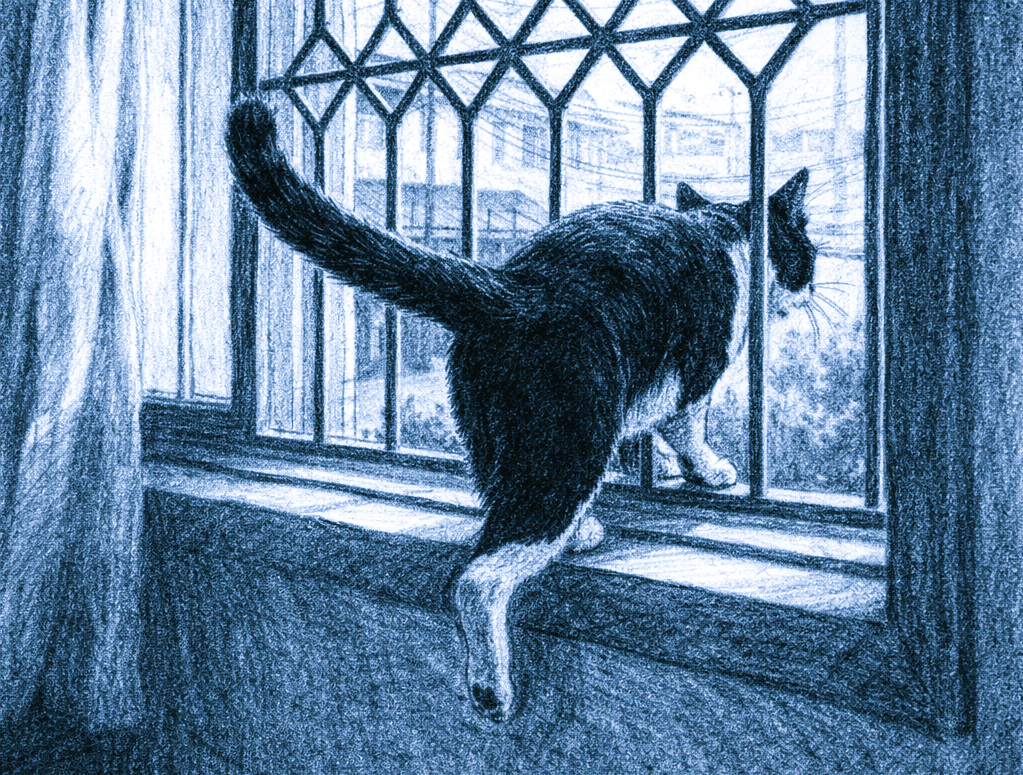
He was a tuxedo shorthair, black-and-white, a formal presence whose life had already been mapped by old violences – a shredded ear, a hairless ridge running across his flank like a jagged tectonic plate. Three houses down, they called him Finesse, his Sunday name – a version the world could accept.
When he appeared on my balcony in Calcutta, he became Phanush (fire lantern). A hollow, flickering light, drifting on the heat of his own survival. He came not for what was easy but for the quiet presence that allowed him to exist as he was – fragile, flickering, incomplete.
In being their sanctuary, I did not find peace. I found a crack. The “almost love” and the corners of our lives are not failures; they are high-order sanctuaries. They are the spaces where truth can be ugly, where the mind can rest without performing “fine.” In Seoul, I had deceived myself, believing recognition without claiming was the highest form of intimacy. In the humid streets of Calcutta, the lie fell apart. To care for someone alongside the life that already claims them is to become the Keeper of the Scars. I was the space where Jinwoo’s invisible fractures could ache openly. I was the place where Phanush could flicker. I was the quiet, unfurnished corner of a life already full.
One night, the cat moved restlessly in his sleep. I reached for a Snickers bar. I thought about Jinwoo, likely at a distant dinner table, performing composure. The longing was not for chocolate. It was for witnessing and holding space – an understanding, a care that required nothing but presence.
I stayed still. “To love a thing is to let it remain unbroken in your presence,” I whispered. To hold Phanush would deny him his own sky. To claim Jinwoo would force him into a mask he did not need to wear. I ate the chocolate and watched. The sovereign eyes of Phanush acknowledged the unspoken pact. Then he drifted into the Calcutta night – a paper lantern returning to a life that knew only Finesse.
Days later, my mind betrayed me with clarity: a gallery opening in Seoul. Jinwoo stood beside a woman whose smile formed a closed circle.
Beautiful, composed. Her hand rested in quiet claim. He appeared complete. Finesse.
Down the lane, a familiar call echoed. “Beral, beral, tumi kothay gele?” (Cat, cat, where’d you go?)
Phanush stirred in the chair, then gave a long, sovereign look – a silent agreement. He would return to his ceramic bowl. He would return to being whole. Then he vanished through the grille.
I looked at the empty chair. My heart remained cracked, but light filtered through the break. I was not a secret or a mistake. I was the sanctuary where the light was right, where scars – visible and hidden – could finally breathe. I was the one who saw the wreckage and called it a sky. I was the Keeper of the Scars, and the Watcher of the Stars. In this city, in this heat, it felt more than enough.
The Author
Reeti Roy is a writer and cultural observer based in India. She explores human connections, urban life, and cross-cultural experiences through essays, travel writing, and personal narratives, often weaving in themes of sanctuary, observation, and emotional landscapes.
Cover Photo: Phanush – The Tuxedo (GN with OpenAI)