


Movie Review: I Can Speak – A Survivor’s Testimony
By Farrukh Anique ||
During the Second World War, Japanese soldiers abducted large numbers of underage girls from Korea, China, the Philippines, Taiwan, and other places, forcing them to satisfy the sexual demands of the military. History has come to know these ill-fated girls as “comfort women.” In Korean, they are called wian-bu (위안부). I Can Speak is the story of one such victim, written with inspiration drawn from the real-life figure Lee Yong-soo.
Lee Yong-soo was born in 1928. At just sixteen, she was kidnapped from a riverbank and taken to Taiwan. There, she, along with many other girls, was subjected not only to repeated sexual assault, but also to arbitrary physical torture inflicted at will by Japanese soldiers. Lee Yong-soo has said she was preyed upon by multiple soldiers in a single day, and that even illness or menstruation did not spare her. When the war ended and she finally returned home, her own family could not recognize her. Somewhere within herself, she kept blaming herself for what had been done to her, and those deep psychological wounds slowly stripped her of her sense of identity. She never married and lived a life marked by solitude.
In 1992, another victim, another wian-bu, shared her story on television. Hearing it gave Lee Yong-soo courage. At sixty-four, she found the strength, for the first time, to bring her own story before the world. She said, “I felt I was nothing. I never spoke about it, and no one ever asked me about it. Before I heard that woman speak on TV, it was as if I didn’t even exist.”
After that, Lee Yong-soo was invited widely to conferences and public forums. On major stages across the world, she recounted the atrocities committed not only against her, but against countless other girls. She demanded that Japan’s Prime Minister Abe face the survivors with a clear, unambiguous apology. Abe did offer words of “apologies and remorse” in official phrasing, yet his politics repeatedly strained against the fuller truth, questioning coercion and narrowing responsibility in ways that left many survivors feeling unheard.
The film draws its core material from the lives of Lee Yong-soo and many other comfort women, though it also adds fictional color, something the medium demands. The central character is an elderly woman named Na Ok-bun: a grandmotherly figure who, at an age meant for mischief and laughter, witnessed darkness beyond what you or I can easily imagine. Those shadows reshaped her from within, to the point that she seemed to forget how to express love. She wished well for everyone around her, yet the bitterness poured into her by a tormented past would not loosen its grip. And so, in her neighborhood, she became known as a sharp-tongued, prickly old woman, ending up painfully alone.
At the age of seventy, she sets out on a journey to learn English. She explains that a translator once twisted a comfort woman’s words, presenting them as if the girls had gone there willingly for money. After hearing this, she makes a vow: She will learn English, so that if life ever gives her a chance to speak, she will deliver her truth in her own words, without anyone cutting, reshaping, or stealing her meaning.
All that labor, all that late-blooming resolve, finally earns her what history once denied her: a stage big enough for the world to hear. She stands there, composed, dignified, and unmistakably brave, and meets the gaze of those who wronged her, or at least of those who still insist on defending them. In that moment, she is no longer speaking only for herself. She becomes the voice of the girls who never got the chance, and she forces the world to look directly at what was done.
When the film turns serious, the direction leans into performance-forward staging: tighter close-ups, longer holds on faces, and more restrained blocking. The camera becomes less playful and more “listening,” which puts maximum load on Na Moon Hee, the lead actress’ micro-expressions and vocal control. This structural pivot can feel engineered rather than seamless, but the craft choice is coherent: Make the viewer feel the floor drop out the moment Park Min-jae, her English teacher and friend – and perhaps the audience as well – understands what’s really at stake.
Many scenes are so charged with emotion that anyone with a living heart could be brought to tears. Two moments, seemingly simple, stayed with me.
In one scene, Na sits at her mother’s grave, asking for permission: “Mother, I promised you I would never tell anyone this secret. But now the time has come to break that promise. Forgive me.” That scene brims with unvarnished feeling – nothing forced, nothing performed for effect, just raw emotion delivered cleanly and true. The frightened, shame-struck child within her, once sheltered by a mother’s careful love, stands on the edge of growing up at last. But before she can step forward, there is one last thing she must do. That scene isn’t about an apology to her mother; it is a farewell to that little girl she has carried for so long.
In another scene, Na Ok-bun’s closest friend confronts her with quiet anguish: “You never told me. All these years, you carried this pain alone.” The friend collapses into her arms, sobbing. For a long while she cries alone; Na’s eyes remain dry, sealed shut by something older than words. And then, suddenly, a dam breaks: The knot she had tied, at her mother’s urging, around her grief snaps at last, and she begins to weep uncontrollably. That was simple yet very powerful.
Even if a child narrowly escapes a single catastrophe, that moment can imprint itself on their personality for life. Now imagine a thirteen-year-old girl, enduring that catastrophe not once but many times a day, for years, and then spending an entire lifetime unable even to utter it aloud. How many shards of her identity must that have left behind?
If you want a very brief glimpse of the horrors and atrocities wars carry in their wake, this film is a good watch.
The Author
Farrukh Anique is a PhD student immersed in mechanical engineering at Chonnam National University. Originally from Pakistan, he’s not all about gears and equations though. He’s got a real love for the performing arts, culture, literature, and languages. He is an amateur theater actor, a short-story writer, and he speaks five languages. In his spare time, he dives into Korean culture and history, soaking up the vibrant traditions and stories that spark his curiosity. Oh, and he absolutely loves strawberries.
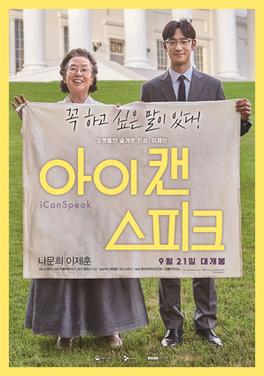
Cover Photo: Official poster for I Can Speak. (Lotte Entertainment / Little Big Pictures)