



“Earth in Crisis, SOS”: Special Exhibition at the National Science Museum
By Chung Hyunhwa ||
In our November issue, I introduced the Gwangju National Science Museum and at the time learned that there would be a special climate and endangerment exhibition – “Earth in Crisis, SOS” – to be held from November 28 to March 2. I knew I would have to return to visit. It was a Saturday when a friend of my son’s visited from Busan. We all went.
The first part of the SOS exhibition, “The Approaching Sixth Mass Extinction,” displays how 80 percent of the earth’s species disappeared during each of the past five mass extinctions, alerting us to the sixth mass extinction crises we are now facing. You can also see a specimen of a Dodo bird, which has disappeared forever due to the greed of humans.
The next part of the exhibition, “The Climate System and Global Warming,” shows how today’s rapid climate change is related to the greenhouse gases that we release. You can visually see where we are in terms of global warming through its various displays.
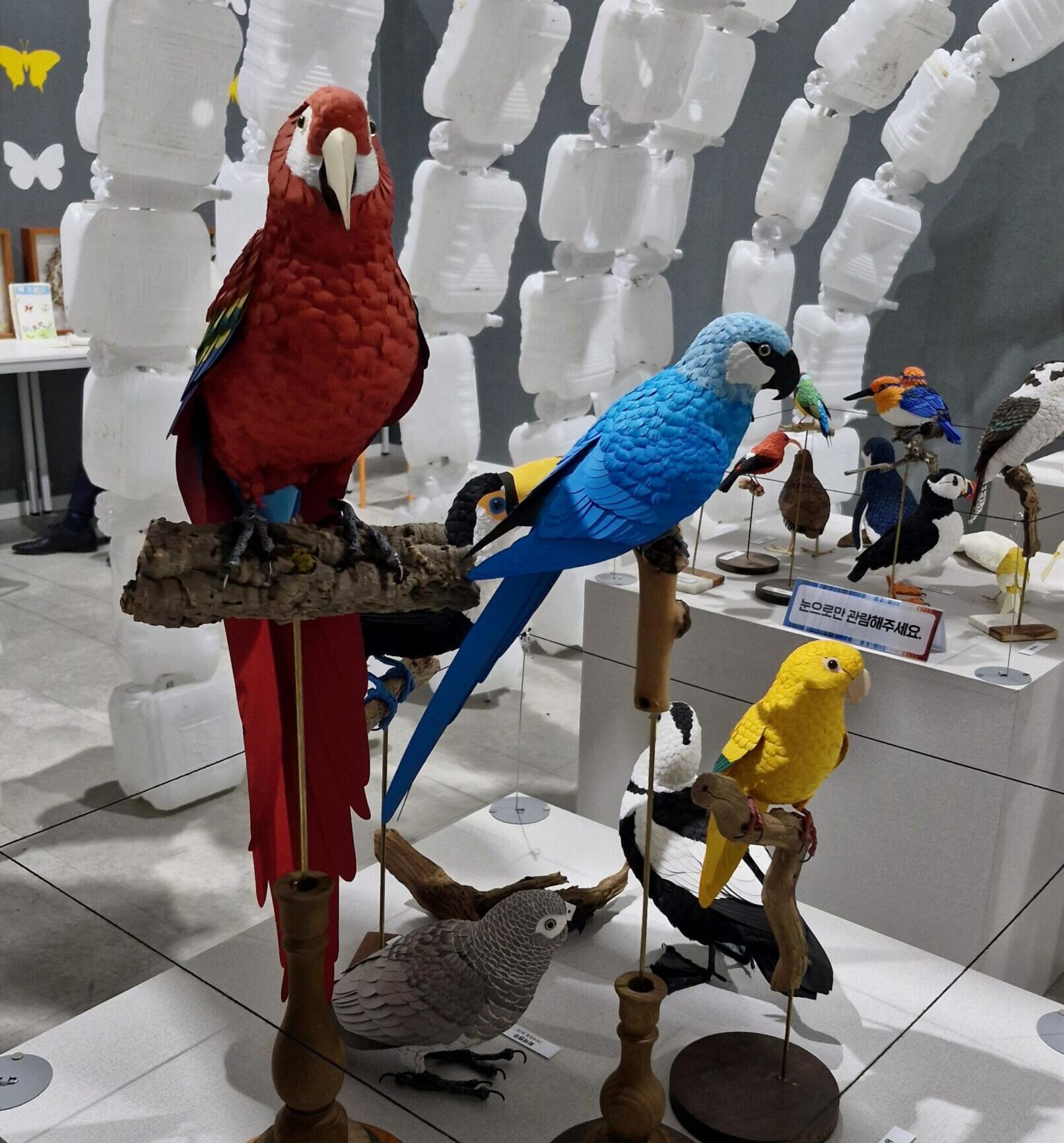
The third part, “The Endangered Biotic Variety,” is rather artistic. You can see 37 specimens of natural treasures and endangered wild animals. There is also a display by paper artist Lee Jaehyeok. He created an incredibly realistic and beautiful display of endangered birds, sending us a strong message of which amazing creatures we could lose when we blindly follow economic logic alone, without recognizing other precious values. His birds are astonishingly realistic, so I was tempted to touch them to check if their feathers were really made only of paper. They made a very strong impression on me because I am a bird lover as well.
The last section of the exhibition is titled “The Sustainable Earth” to show hope and solutions. It highlights how tidal mudflats, such as those Korea has on the west coast, could act as “carbon reservoirs” to absorb greenhouse gases. In one corner, there is a food store experience section one should not miss. If you get a basket, put in the foods you usually buy, and check out at the counter, you can see if you will have those food items in 2050. None of the foods I usually get were available in the future. I thought it was one of the best experiential displays in the exhibition to make you realize what the actual reality will be if we don’t do anything about climate change.
One display that you cannot just pass by is a 1.8-meter-diameter earth globe with four projectors projecting onto it. You can spin the earth with the controller yourself, and check the climate phenomena with one of your fingers. It is really cool.
According to Director Lee Jeong-gu during an interview with CBS, the exhibition was designed not only to deliver scientific facts but also to let visitors really feel the climate change on the earth with their five senses. He also would like to stress that the extinction of animals could affect the existence of the human race due to the ecological imbalance that it would cause. So, we should not forget that it is not just about preserving the environment – it has to do with our own survival.
The exhibition runs until the 2nd of March, so there is still time to go and see it. My overall impression was that I could see the effort made to deliver the unavoidable facts through beautiful artistic displays. I hope that more people, especially families with kids, can go and check it out. Tickets to the special exhibition are 6,000 won, and 8,000 won for the triple package that includes the regular exhibitions as well.
Additionally, on this visit, I had a chance to check out the Space 360 special theater to watch two short movies. The theater itself was a big hollow globe, and the audience watched from the bridge in its center. The entire inner side of the globe was the screen, so you could watch a whale pass over you as if you were deep inside the ocean while your eyes followed it overhead, or you could see a herd of running dinosaurs rushing overhead. I thought it was absorbing and as enjoyable as any IMAX movie would be. I recommend Space 360 not only to families with kids but also to adult science lovers. It is one of the rare, surreally happy moments that 3,000 won can bring you. I absolutely recommend it. I envied the children there because I didn’t have this opportunity when young, but fortunately it served to awaken the child inside of me.
The Author
Chung Hyunhwa, a native of Gwangju, recently worked for a local horticultural company. She led the international eco-hike group Gwangju Hikers at the GIC in 2020 and 2021. Previously, she taught English at Yantai American School and Yantai Korean School in China and worked in school administration at Branksome Hall Asia in Jeju. She holds a master’s degree in TESOL from TCNJ in the U.S. and has a license to teach Korean. She loves plants, birds, and repurposing items creatively.
Cover Photo: Paper-art endangered bird species display by Lee Jaehyeok. (Chung Hyunhwa)