




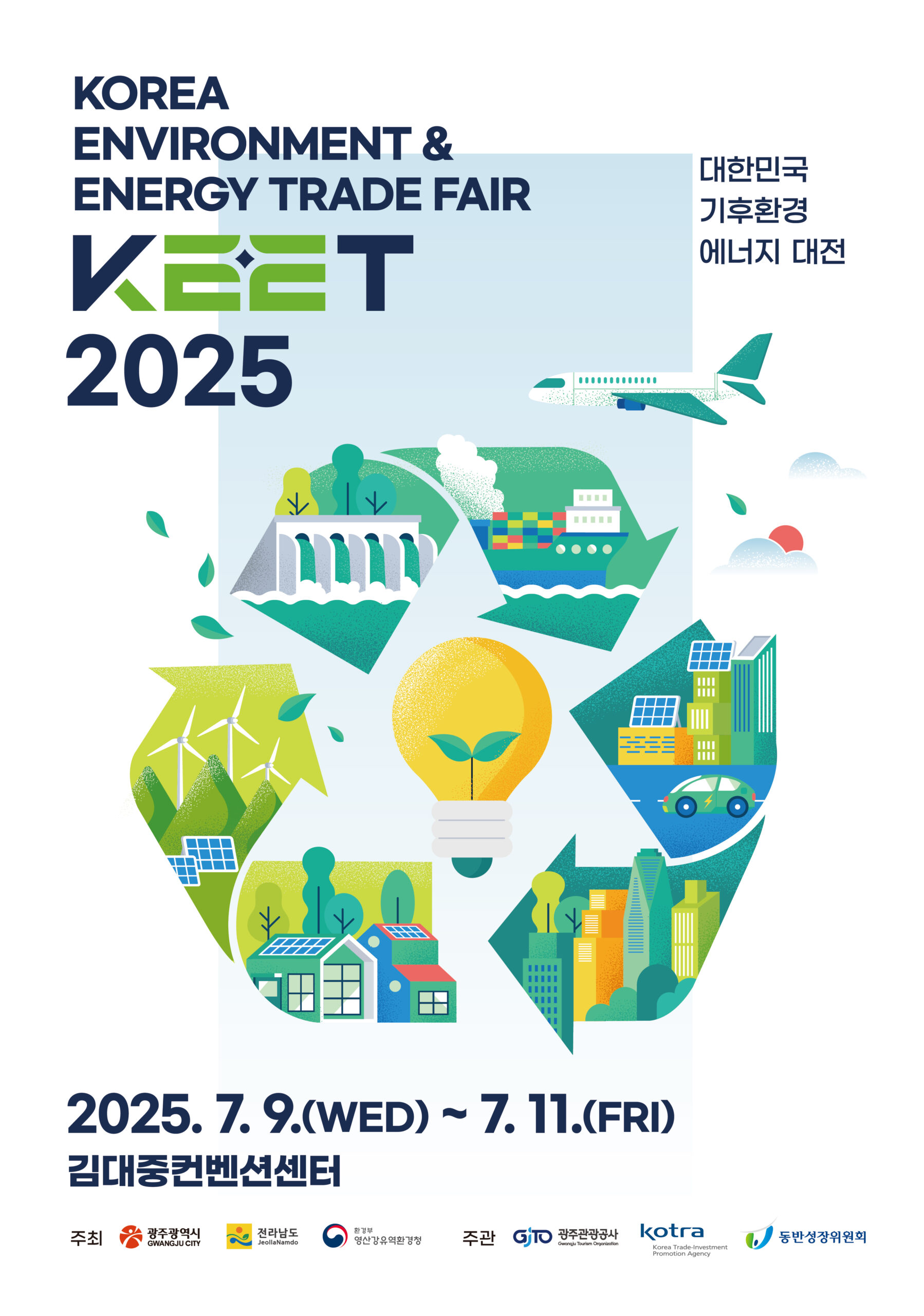
Exhibition: KEET 2025 – Korea Environment and Energy Trade Fair at KDJ
By Chung Hyunhwa
KEET 2025, the Korea Environment and Energy Trade Fair hosted by Gwangju Metropolitan City, Jeonnam Province, and the Yeongsan River Basin Environmental Office, was held for three days from July 9 at the KDJ Convention Center. The major categories of the exhibition were renewable energy, energy storage systems (ESS), smart grids, and various environmental technologies, including pollution control, waste management, recycling, and ESG (environmental, social, and governance) solutions.
I preregistered and got my name tag at the venue on arrival. I was glad to see that the name tags did not come in the usual transparent plastic holders, and also disposable cups were not allowed in an effort to promote a zero-waste mindset. I completed a survey at the entrance and earned a coffee coupon that I used later in the day to get my drink served in a reusable cup at the café inside. I know the city is running a reusable cup rental service for event holders on request to make it easier to go zero-waste.
When I entered, the first booth was that of a company called Kalsun, based in Naju Innovation City, which manufactures BIPV (building-integrated photovoltaics). I had read about BIPV before, but this was the first time I saw real BIPV products. The sample displayed was a clear glass wall tile that had a photovoltaic module inside. The tiles come in different colors and patterns to meet various aesthetic needs. The power generation efficiency is of course highest when they are transparent, but it is good to have such options. To promote BIPV systems, a weighting factor six times higher than that of conventional photovoltaic installations is granted for now, according to the staffer at the booth.
As for the photovoltaic category, another factory that attracted a lot of attention was a company named UEnergy, based in Naju and Suncheon, that displayed a foldable agricultural PV system. I had seen the folding PVs before and wondered why the panels faced in opposite directions, unlike conventional south-facing panels. I got the answer there: Agrivoltaic systems with adjustable solar panels are installed in an east–
west orientation to avoid energy concentration during midday peak hours and instead distribute electricity generation more evenly across the morning and evening. This can be one solution for the grid saturation in the south. Also, the adjustable design allows the control of sunlight just enough for growing crops, while also functioning as a shade screen to prevent burn damage on the plants during the summer.
Next, I saw a very attractive-looking booth: EcoPeace, a Gwangju-based company. It manufactures solar-powered leisure boats and water purification robots, which are already in operation in rivers and reservoirs. This is a great solution to remove harmful algal bloom and preserve water quality. The solar boat did not have so much of a purifying function because it focuses more on carrying people. I thought they were cool.
Another company based in Gwangju, Hogreen Air, was quite interesting as well. It started as an electronic drone company, but realizing electronic ones can be airborne for only a fairly short period of only 20–30 minutes, it pursued the adoption of hydrogen power for their drones. At the moment, it is focusing on manufacturing drones that can use hydrogen and collaborating with other companies for the hydrogen tanks or fuel cells. Hydrogen leaves only water during combustion, so if hydrogen is produced using renewable energy and can ensure safety, it will be used more widely due to its high energy density.
KERI’s (Korea Electrotechnology Research Institutes) Smartgrid headquarters in Gwangju was displaying its research projects, and one caught my eye. It was titled “Wireless Energy Transfer System for Lunar Exploration Rover.” Wireless energy transfer, especially in space, is one very important technology because if it becomes feasible, we may be able to bring in solar energy or any other energy generated from space to earth. We would have a very stable energy source 24 hours all year round. I was glad to see such research going on in Gwangju, too.
There were so many other intriguing technologies, such as super-alkaline water to replace industrial oil by Hightec, a plasma odor removing device by Samdo Environment, AI recycling collector machines and trash bag collecting devices by KIEcosystem, a multi-source inverter by ENPlus, a solar coal maker by YeHan to convert organic matter into coals using only sunlight, industrial odor control solutions by Ecofranc, cooling fog devices by Angaepin coolfog, and all-solid batteries by Dumu. Some were still in the middle of R&D, but nothing is achieved without beginning.
In addition to the exhibition, there was a separate space for trade meetings with the buyers from different countries. The scale of KEET was limited because most of the participating exhibitors were from Gwangju and Jeonnam, but it was a nice opportunity for the locally based companies associated with the above categories. Moreover, I was pleasantly surprised to learn that there were so many companies that envisioned the opportunities in the net-zero goal.
The exhibition also aligns with Gwangju’s industrial focuses on AI, environmental cars for the future, and smart energy. I am glad that these companies espouse the demands of the threatening-climate era and attempt to deal with those demands by using their own creative ideas. I hope for continued active support by the Gwangju city government.
The Author
Chung Hyunhwa, a native of Gwangju, recently worked for a horticultural company. She led the international eco-hike group Gwangju Hikers at the GIC in 2020 and 2021. Previously, she taught English at Yantai American School and Yantai Korean School in China and worked in school administration at Branksome Hall Asia in Jeju. She holds a master’s degree in TESOL from TCNJ in the U.S. and a license to teach Korean. She loves plants, birds, and repurposing items creatively.