

The Environment: More Nuclear Power Plants?
By Chung Hyunhwa ||
I technology is calling for massively higher electricity needs. The estimation for the electricity needed to run the data centers is skyrocketing in the statistics. Based on a recent survey, to read what people think about more nuclear power plants, the Ministry of Climate, Energy, and Environment announced that two more nuclear reactors and one SMR (small modular reactor) were planned. A lot of people were shocked at the speed of the decision made on such a serious and disputatious matter.
The Ministry has stated that the rigidity, the greatest problem of nuclear power, is being addressed through the development of flexible operation technology. Under current regulations, output reduction during periods of energy oversupply cannot exceed 20 percent and may not be carried out more than 20 times per year. According to the Ministry, however, technologies are under development that would allow as much as 30 percent output reduction by 2027 and even 50 percent reduction by 2032. At present, because of this rigidity and for safety reasons, nuclear power plants function as baseload power sources and operate at a fairly constant utilization rate in the mid-80 percent range of their full generation capacity.
South Korea’s share of renewable energy currently stands at around 10 percent, which is still low, and the government aims to raise it to 30 percent by 2030. If, as planned, 100 gigawatts of renewable energy capacity is added, along with two additional nuclear reactors and one SMR, preventing blackouts caused by oversupply will become a new and significant challenge. Flexible operation is a technology still under development, and there is not a commercially operating SMR worldwide, so the rapid decision the Ministry of Climate, Energy, and Environment made to expand nuclear power without sufficient social consensus is being criticized, especially for citing poorly designed surveys to create the impression that the majority of the public supports nuclear energy.
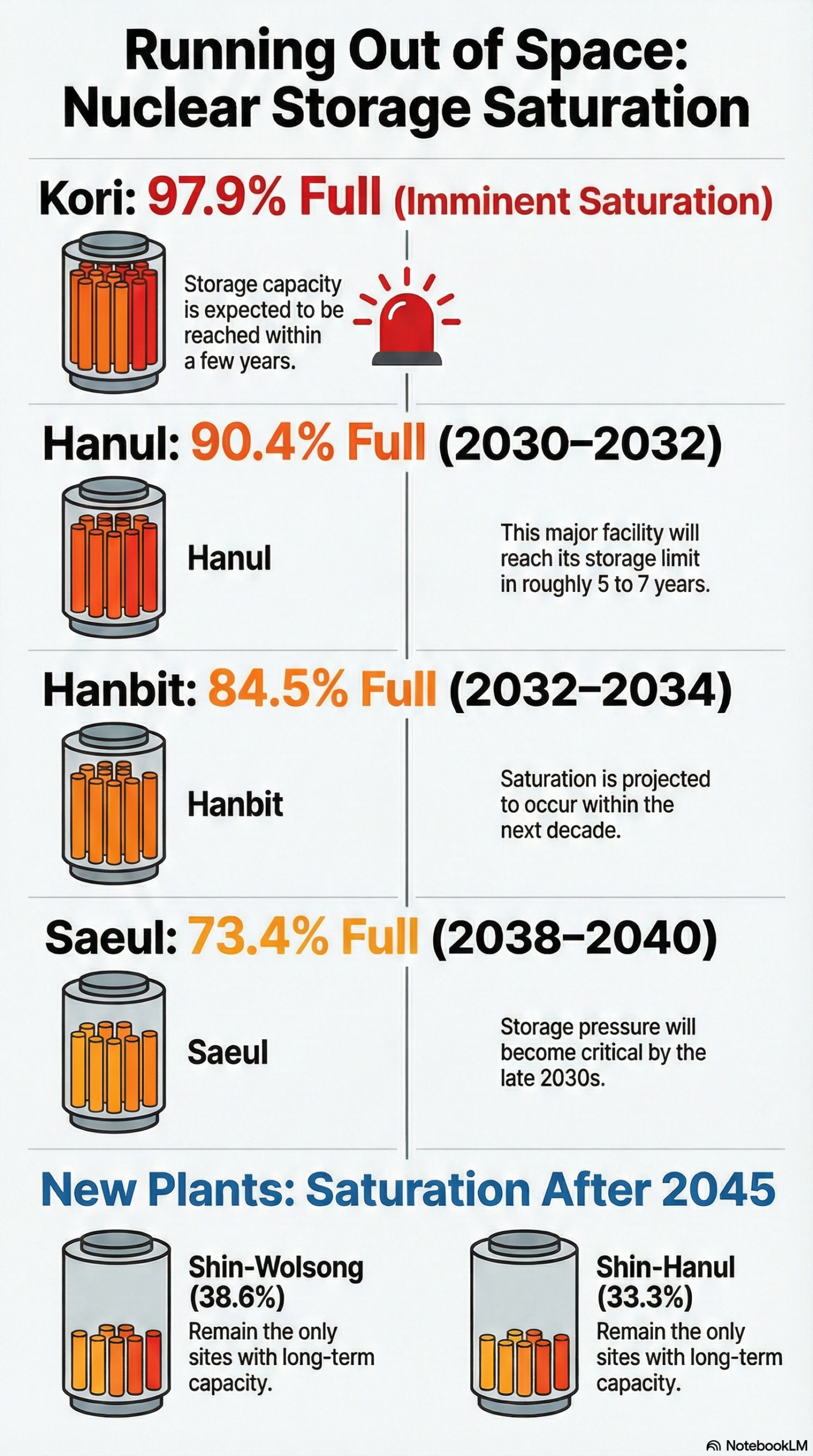
The primary reason I oppose additional nuclear power plants is the absence of permanent facilities for nuclear waste disposal, especially as interim storage sites are approaching their limits at some plants. Currently, the number of operating nuclear reactors stands at 94 in the United States, 58 in China, 56 in France, 29 in Russia, and 26 in South Korea. Yet remarkably, Finland is the only country that has built a permanent high-level radioactive waste repository. When reactor density is considered in relation to land area, South Korea ranks the highest by far. Shouldn’t Korea build a permanent disposal facility before proceeding with further nuclear plans? In an earlier article I wrote for the Gwangju News titled “Look Up? Or Don’t Look Up?” [July 2022], I likened the current situation to living in a house without a toilet. While technologies for recycling nuclear waste do exist, they are not effective enough to be considered true solutions.
The second reason is economic feasibility. Even if flexible operation technology is commercialized by 2038 – when 32 reactors, including newly built ones and refurbished aging plants, are expected to be in operation – the reality is that these expensive facilities would only be operating at reduced capacity, while operating at full capacity is safer and more cost-effective. This would inevitably raise the cost of electricity generated by nuclear power. SMRs, too, are more expensive than conventional nuclear reactors due to the lack of economies of scale. Nuclear power plants also take far longer to build than renewable energy facilities. Even if construction begins now without major issues, completion is not expected until around 2038. Meanwhile, AI technologies are advancing rapidly, and it is possible that the future energy demand could differ significantly from current projections.
The third reason is that all nuclear fuel must be imported, which means nuclear power does not contribute to energy self-sufficiency. This is a factor that can significantly affect national sovereignty, making it prudent to reduce reliance on such energy sources and instead prioritize power generation methods with lower import dependency. Some argue that renewable energy also depends heavily on China, but this is a fundamentally different issue. Korea possesses the relevant renewable energy technologies but cannot match the price competitiveness of Chinese products – a situation shared by countries worldwide. Nuclear fuel imports, however, are not a matter of technology but a sensitive geopolitical and diplomatic issue.
Finally, there is the issue of fairness. Local communities already resist renewable energy projects, feeling that they are being asked to make sacrifices for the electricity consumed in the major metropolitan areas. Is not the case of nuclear power plants even more serious, since nuclear power plants inherently carry potential radiation risks for those residing near the plants?
Someone once said that the metropolitan region is colonizing the provinces, and it is difficult to find a convincing rebuttal. While AI industries may represent the future and building the necessary infrastructure at the right time may be essential for Korea’s survival, do we have the right to ask anyone to sacrifice for that?
On February 5, 2026,154 civil society organizations declared an anti-nuclear campaign, stating that the government has failed in electricity demand management and has demonstrated incompetence in its industrial policy, while pushing nuclear power – the most dangerous and undemocratic form of energy generation – which constitutes structural violence by sacrificing local communities. These organizations demanded the immediate dismissal of the Minister of Climate, Energy, and Environment; the cancellation of plans for new nuclear power plants; and the establishment of a national power supply plan centered on the expansion of renewable energy and a decentralized, regionally distributed power system. The groups also called for direct dialogue with the president.
For all these reasons, I believe Korea should try harder to find alternate solutions before deciding to build more nuclear power plants. Even at this very moment, the efficiency of renewable energy is improving rapidly in general, and energy storage systems are rapidly diversifying in terms of technological options, becoming more widespread, more affordable, and safer to solve the intermittency and variability of renewable energy. In this sense, this plan for new nuclear power plants should be reconsidered. Haste may make waste.
The Author
Chung Hyunhwa, a native of Gwangju, recently worked for a local horticultural company. She led the international eco-hike group Gwangju Hikers at the GIC in 2020 and 2021. Previously, she taught English at Yantai American School and Yantai Korean School in China and worked in school administration at Branksome Hall Asia in Jeju. She holds a master’s degree in TESOL from TCNJ in the U.S. and is licensed to teach Korean. She loves plants, birds, and repurposing items creatively.
Cover Photo: Source: Korea Hydro and Nuclear Power, 2025, Q3. (GN with NotebookLM)