



Yellow Dust in the Age of Climate Change: What the Skies over Gwangju Tell Us
By Siddhant K. ||
The skies over Gwangju have always been a canvas of seasons: the crisp blue of autumn, the vibrant cherry blossoms of spring, the dramatic monsoon grays. But in recent years, a different hue has intruded more often, a hazy, ochre yellow that settles like a veil over the city. This is hwangsa, or “yellow dust,” a natural phenomenon that carries far more than sand from distant deserts. Today, it arrives with an urgent story about climate change, human vulnerability, and the quiet resilience of communities like ours.
Yellow dust, also known as “Asian dust,” begins thousands of kilometers away in the arid expanses of the Gobi Desert, Inner Mongolia, and other dry regions of China and Mongolia. Strong winds lift fine particles of soil, silt, and sand into the atmosphere, where they travel on prevailing westerlies across the continent. By the time they reach the Korean Peninsula, these plumes can blanket cities in a fine, yellowish haze that reduces visibility, coats everything in grit, and lingers for days. Satellite images capture the scale: vast rivers of dust stretching across borders, a reminder that nature knows no boundaries.
Historically, yellow dust has been documented since ancient times, records from the Silla Kingdom describe “dirt rain” as early as the second century. But modern industrialization, deforestation, and desertification have amplified its reach and frequency. The dust now often carries not just natural particles but also pollutants, heavy metals, and allergens from human activity.
For generations, yellow dust was a springtime visitor, peaking in March and April. Families in Gwangju would joke about the “yellow season” while stocking up on masks and keeping children indoors. But recent years tell a different story. In 2025, major dust events struck in March, with warnings issued as dust from the Gobi swept across the peninsula, pushing air quality to “very bad” levels in many regions. Even more striking, “winter yellow sand” has become more common. Once rare, these offseason incursions now appear during warmer-than-usual cold months. In early 2026, high levels of fine dust and yellow sand blanketed the country in January, linked by scientists to warmer conditions in Mongolia and northern China that allow dust to mobilize outside traditional seasons.
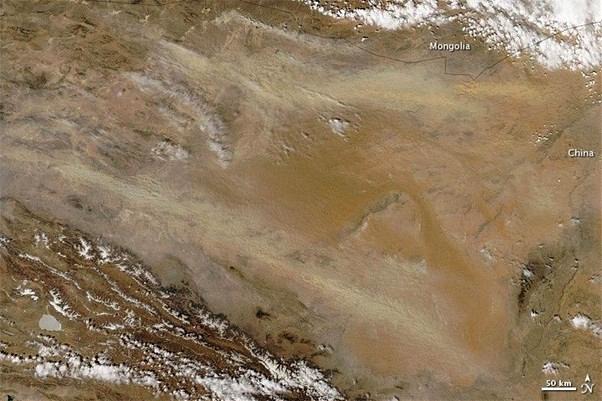
Gobi Desert dust storm. (NASA Science)
This shift aligns with broader climate trends: Rising temperatures weaken the cold air flows that once dispersed pollutants and extend the window for dust storms. Desertification in source regions, driven partly by changing precipitation and land use, feeds the cycle. While some long-term studies show a decline in overall dust frequency due to greening efforts in China, recent surges highlight how climate variability can override progress in the short term.
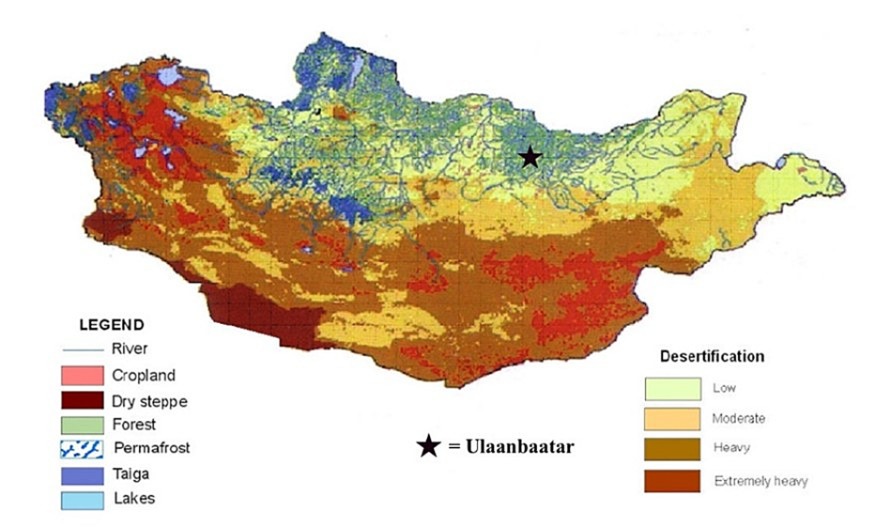
Levels of desertification across Mongolia. (J. Pike, 2012)
When yellow dust descends on Gwangju, it transforms daily life in subtle but profound ways. The air thickens, eyes sting, throats itch. Parents keep children away from playgrounds in Damyang or the parks along the Yeongsan River. Elderly residents, already managing respiratory conditions, feel the weight most acutely, hospital visits for asthma exacerbations rise. Outdoor markets quiet, soccer games are cancelled, and the city’s normally lively streets take on an eerie hush. The health impacts are well documented: Elevated PM10 and PM2.5 particles from dust can trigger respiratory illnesses, cardiovascular strain, and even long-term risks like lung cancer. Vulnerable groups – children, seniors, those with pre-existing conditions – face the highest burden. Mental health suffers too; the constant haze fosters anxiety and isolation, as people retreat indoors.
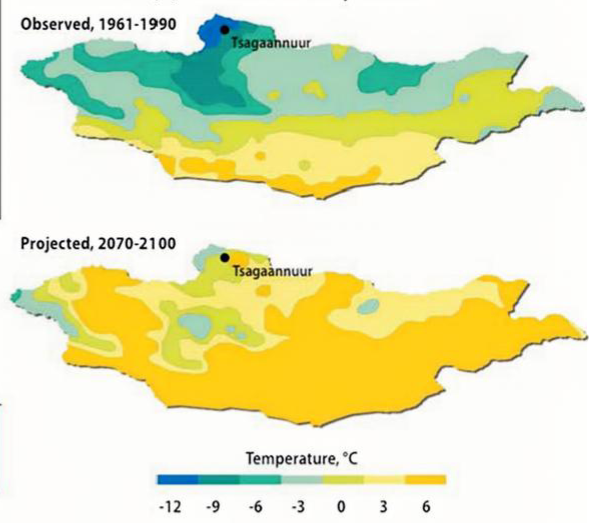
Mongolian temperature changes, observed and projected. (Han et al., 2021)
In Gwangju, where community bonds are strong, these events test that resilience. Families share tips on air purifiers, neighbors check on elders, and local pharmacies see lines for KF94 masks. Yet the frustration is palpable: Why must distant deserts and global warming dictate our children’s playtime or our grandparents’ comfort? Environmentally, the dust affects more than air. It deposits on crops, soil, and waterways, carrying pollutants that accumulate over time. In a region like Jeollanam-do, known for its agriculture, this adds another layer of worry for farmers already facing climate pressures.
The good news is that solutions exist. China has planted billions of trees to combat desertification, with South Korea supporting joint efforts. International cooperation on dust monitoring and emission reductions is growing. Locally, Gwangju residents can protect themselves with masks on bad days, use air quality apps, and advocate for cleaner energy policies. But the deeper answer lies in addressing climate change itself. Reducing greenhouse gases globally will help stabilize weather patterns and slow desert expansion. Every small action, energy conservation, supporting green initiatives, contributes.
As the dust settles, it leaves a reminder: We are connected across borders and generations. In Gwangju, under a yellow-tinged sky, we breathe the same air as herders in Mongolia and city dwellers in Beijing. Protecting that air means protecting each other. The phenomenon may be ancient, but its current intensity is a modern call to action, one we cannot ignore.
Reference
Han, J., Dai, H., & Gu, Z. (2021). Sandstorms and desertification in Mongolia, an example of future climate events: A review. Environmental Chemistry Letters, 19(6), 4063–4073.
The Author
Siddhant Kumar is a geochemical oceanographer and researcher at TMBL at the Gwangju Institute of Science and Technology (GIST). His work focuses on marine minerals, sediment chemistry, and paleoenvironmental change. He is passionate about communicating ocean science to broader communities in Korea.
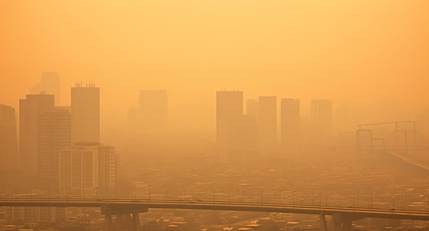
Cover Photo: Seoul shrouded in fine dust, 2017. (Pngtree.com)