


Gwangju and Torino: Friendship Cities
By Park Yeonju
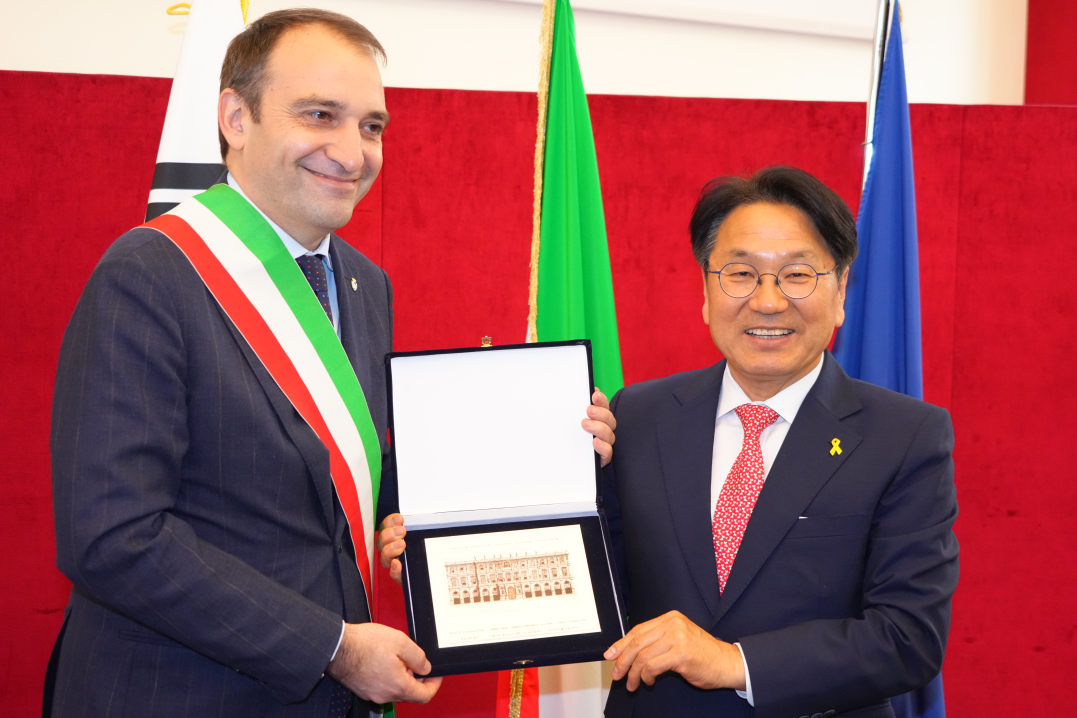
Located in northwestern Italy, the city of Torino is a central hub bordering France and Switzerland. It has been an important stronghold of the modern Italian Communist Party and a sacred site for the labor movement. It takes at least 14 hours to reach Torino from Korea, yet despite the distance, it shares many similarities with the city of Gwangju. Gwangju and Torino have been interacting for a long time. Their first friendship and cooperation agreement was signed in 2002, and although it expired in 2012, the two cities renewed their agreement in the first half of 2024. This renewal commemorated the 140th anniversary of diplomatic relations between Korea and Italy. Gwangju and Torino share various similarities in both city size and vision.
Gwangju has hosted numerous sports events. And with the World Archery Championships coming up this September, it continues to be a stage for international competitions. Similarly, Torino has consistently hosted international sporting events. In this regard, the two cities share the common characteristic of being hubs for global sports. In addition, Gwangju is the second- largest automobile-producing city in Korea. Its automotive industry traces its roots back to Asia Motors, a former affiliate of Kia Motors. Its first production model was the Fiat 124, whose manufacturing base was in Torino. This already close economic connection demonstrates the strength of their cooperative relationship.
The two cities have made significant progress in various fields, such as art and science, and through their friendship and cooperation agreement, they expect to create mutual synergy. The Gwangju Museum of Art and the Torino Museum of Art have also signed an agreement to exchange collections and promote exchanges in various areas. Many Koreans live in Torino, demonstrating that it is a city closely connected not only with Gwangju but also with Korea as a whole.
Torino, the center of Italy’s automobile industry, is also a city with strong assets in culture, art, and sports. Through its friendship and cooperation agreement with Torino, Gwangju Metropolitan City aims to promote mutual growth in various fields, such as the economy and culture, while strengthening its capacity for city diplomacy. Specifically, in the cultural field, the goal is to revitalize cooperation between cultural and tourism institutions, enhance activities such as festivals and exhibitions, and encourage the promotion of tourist attractions and programs. In the economic field, the focus is on fostering commercial and economic development through cooperation between economic organizations from both cities.
In addition, Torino plans to promote academic exchanges between students, professors, and universities, with the expectation of building broad and active exchanges with Gwangju.
In June, the city of Torino successfully concluded an artistic exchange with Chonnam National University. On June 5, a special exchange concert between Chonnam National University and the Giuseppe Verdi State Conservatory of Music of Torino, was held at the university’s College of Arts. The performance featured the Kreutzer Duo, affiliated with the Giuseppe Verdi Conservatory of Torino. The duo, composed of a violin major and a piano major, has won awards at prestigious competitions across Europe. In line with the Gwangju–Torino friendship agreement, this concert will serve as a starting point for inviting students from the College of Arts at Chonnam National University to perform in Torino. It will also help organize exchange programs and strengthen the capabilities of artists in the Gwangju area. This will foster genuine academic and artistic exchange.
Based on the friendship agreement renewed in 2024, Gwangju has been actively continuing exchanges. In addition to diversifying city diplomacy through the expansion of city-to- city relationships, it has visited Torino, Milan, and Venice in Italy to benchmark urban public design and promote the globalization of the Gwangju Biennale. As a notable example of past exchanges, a delegation from Torino participated in the Gwangju Design Biennale in 2005.
A Gwangju delegation also visited Torino’s Lingotto Building, a representative success case in public design improvement, to develop a cultural regeneration model that combines design with arts and culture. The Lingotto Building is a multi-purpose complex that was originally used as one of Fiat’s main automobile production plants. In the late 1980s, the plant was closed, and large-scale remodeling began in the 1990s. The successful redevelopment of the Lingotto Building is considered a leading example of urban regeneration, and Gwangju is using it as a benchmark for creating its own urban renewal model.
Italy is a country that showcases a rich past and present in arts and culture. Among its cities, Torino has shared a journey of more than 20 years with Gwangju. With their many similarities, the signing of the friendship agreement has built a bridge of exchange between the two cities. Gwangju is known as the capital of Korea’s democratization and as a cultural city, while Torino is one of Italy’s prominent cultural cities. Beyond cultural exchange, the two cities are expected to work together toward a shared future in various fields, such as artificial intelligence and climate crisis response.
The Author
Park Yeonju is an undergraduate at Chonnam National University, majoring in political science and diplomacy as well as Chinese language and literature. Her third major is international development cooperation studies. She was born and raised in Gwangju and wants to promote the colorfulness of the city that she has been a part of for so long.
Cover Photograph courtesy of Gwangju Metropolitan City.