






Gwangju Sinks in Rainwater: Flooding Strikes Second Time in Five Years
By Saqib Sharif
Amid a global spike in climate-induced disasters, Gwangju has once again succumbed to catastrophic flooding, this time in July 2025, highlighting the growing risk urban areas face worldwide. This year, devastating floods have wreaked havoc across continents: Central Texas endured one of its deadliest flash floods in history, leaving over 135 dead and sweeping campers off their feet; southern India’s Uttarakhand was hit by a flash flood following a cloudburst, killing at least 100 and leaving dozens missing; Pakistan suffered monsoon- driven floods causing more than 300 fatalities as rainfall surged 10–15 percent above normal due to climate change; Brazil’s Vale do Aço area was struck by deadly floods and landslides in January, displacing thousands; and in southern China, Typhoon Wutip triggered landslides and forced the evacuation of 70,000 people, inflicting over 1.81 billion yuan (US $253 million) in losses. According to the UN Office for Disaster Risk Reduction, over 12 million people globally have been affected by flooding so far this year.
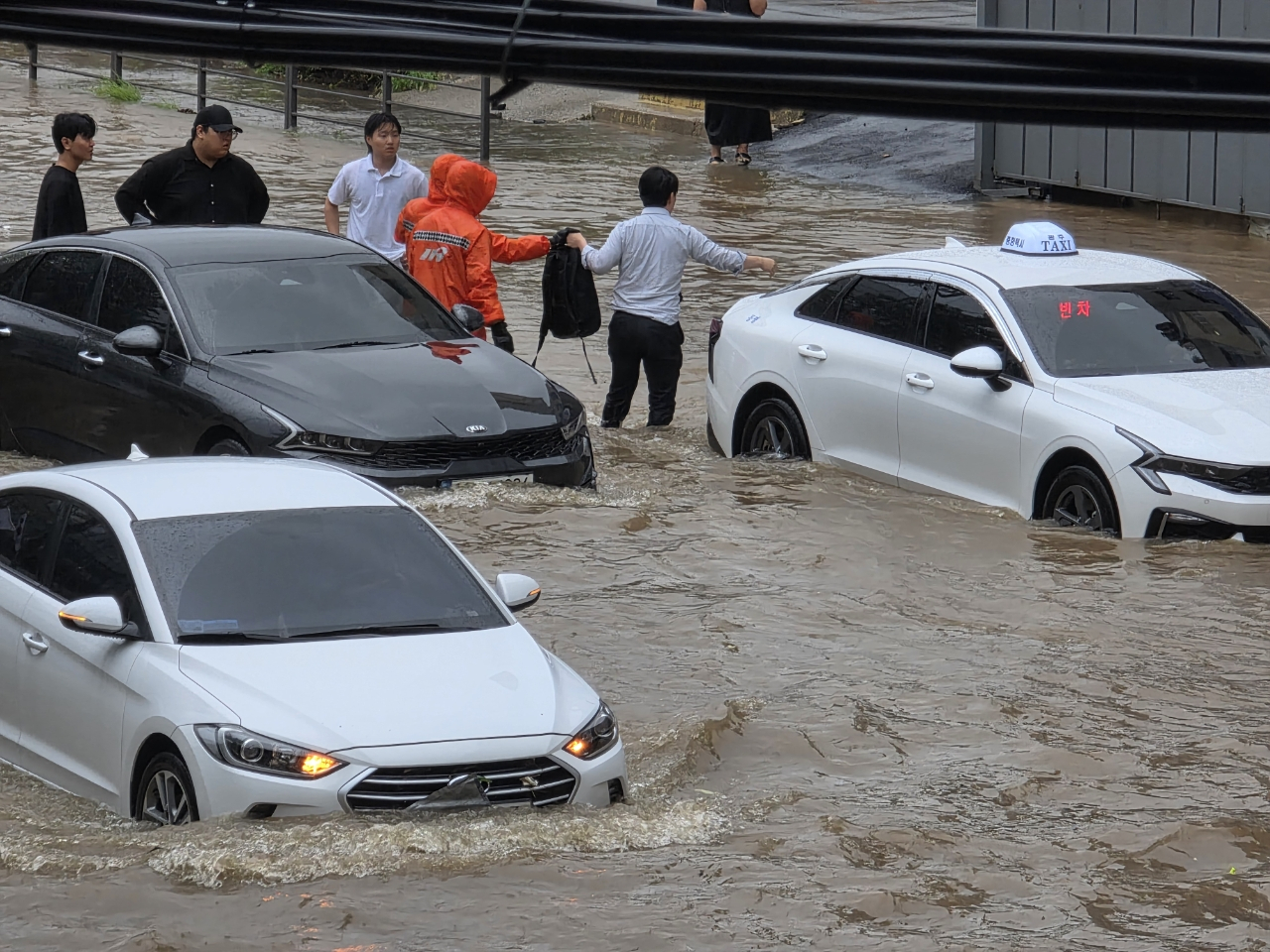
In Gwangju, the storm that struck on July 17, 2025, brought a record-breaking 426.4 mm of rain, submerging roads by Chonnam University and halting operations at more than ten stations on Subway Line 1, eerily repeating history from 2020, when Pyeong-dong Station was similarly flooded.
Alarming reports suggest that ongoing construction of Subway Line 2 near Sangmu Station also contributed to the disaster: rainwater may have infiltrated construction zones and flowed underground into Pyeong-dong Station, overwhelming its drainage systems. This failure underscores how subterranean infrastructure, when not integrated with urban flood planning, can aggravate crises.
In response, the Ministry of Environment has rolled out AI-driven flood alert systems in Gwangju. These systems merge real-time data on rainfall, dam discharge, and river levels to deliver 10-minute early warnings, alongside 3D flood mapping. Concurrently, Korea is expanding its network of high-precision rainfall radars, from two to nine nationwide, with one now deployed in Gwangju to bolster detection capabilities.
Nevertheless, technology is only part of the equation. Structural interventions such as upgrading drainage near the university, constructing retention basins, restoring natural waterways, and implementing permeable surfaces are critical. Experts estimate the combined cost of these measures could be in the range of 300– 600 billion won.
Complicating matters is Gwangju’s tight fiscal situation. The cost of Subway Line 2 has ballooned from an initial 1.9 trillion won to over 3.08 trillion won, a 61.7 percent increase. Two attempts at securing 2.6 trillion won in national matching funds have failed, placing heavy pressure on the city’s budget and raising concerns that critical flood resilience measures may be deprioritized.
As climate-related disasters become more frequent and more severe, Gwangju faces a critical juncture: The city must reconcile ambitious infrastructure development with robust climate adaptation. Without strengthened alignment between transit expansion, flood management, and fiscal planning, neighborhoods like Chonnam University risk being left exposed – and unprepared – for the next deluge.
Web Sources
- 2025 Vale do Aço floods. (2025, May 20). In Wikipedia. https://en.wikipedia.org/wiki/2025_Vale_do_Aço_ floods
- AP News. (2025, July 29). Pakistan’s deadly monsoon floods were worsened by global warming, study finds. https:// apnews.com/article/8426038b23b60579b810e4f3a7ef1095
- BBC. (2025, August). More than 100 missing after flash floods in India. https://www.bbc.com/news/ articles/cj3lxzpkn87o
- CarbonBrief. (2025). Floods killed 60 people after “year of rain in a week.” https://www.carbonbrief.org/china-briefing-7-august-2025-deadly-floods-industrial-cthulhu-higher-solar-forecast/
- LMT Online. (2025, July 20). Timeline: How the Texas Hill Country flash flood disaster unfolded. https://www.lmtonline.com/news/article/texas-hill- country-flash-flood-timeline-20759272.php
- MySanAntonio. (2025, July 28). Deadly floods prompt $20M flood alert system in San Antonio. https://www. mysanantonio.com/news/weather/article/san-antonio- flood-warning-system-20804649.php
- The Watchers. (2024, June). Severe flooding in southern Germany claims four lives, forces thousands to evacuate. https://watchers.news/2024/06/03/germany-flood-damage-fatalities-june-2024/
The Author
Saqib Sharif is a robotics engineer with a PhD in mechanical engineering, specializing in the design of smart healthcare devices and microrobots. With a strong background in medical technology and innovation, he is passionate about creating solutions that enhance smart healthcare. Dr. Sharif has been living in Gwangju for the past ten years. Currently, he serves as a senior researcher at Shinsung Tech Pvt. Ltd., Gwangju.
Cover Photo: Cars engulfed in floodwater in Buk-gu, Gwangju, on July 17. (Yonhap)