


Heading to Nature for Rest: The Mt. Mudeung Literary-Cultural Festival
By Park Yeonju
At an elevation of 1,187 meters, Mt. Mudeung is a strong and dependable mountain protecting Gwangju. It is a place where fresh air and the scent of nature are abundant. This is a UNESCO Global Geopark and a National Park of South Korea. The Mt. Mudeung Literary-Cultural Festival is hosted by Dong-gu, the district where Mt. Mudeung (aka Mudeung-san, 무등산) is located. Currently, Dong-gu is carrying out various programs under the slogan “Literary-Cultural City, Gwangju Dong-gu.” Going beyond merely emphasizing culture and literature, the district is focusing on the values of people and community in its administration, striving to implement the concept of a “people city.” By utilizing Dong-gu’s resources, it is proactively promoting activities among the citizens of Gwangju through a variety of literature- and culture-related programs.
The Mt. Mudeung Festival makes good use of the mountain, Dong-gu’s greatest asset. The Dong- gu Literary Walking Trail, featuring four walking courses with various themes and stories, and the Dong-gu Literary Hall, featuring books, movies, and food culture, can be experienced in one place. The Dong-gu Literary Hall, Book-Reading Dong- gu, and other open spaces for communication among citizens have been created to transform Dong-gu into a true literary-cultural city. This festival takes place at a time when the fresh energy of spring still lingers, at the cusp between spring’s end and the start of summer. Each year, the Mt. Mudeung Literary-Cultural Festival is held at Mt. Mudeung. This year May 31 and June 1 marked the third year of the festival, and it has become a major event of the district. Now, let’s revisit this year’s festival, which I enthusiastically participated in. Join me in heading out to nature for some rest, or “for:rest,” as the event promotes!
The way to the festival was not difficult to navigate. This was because shuttle buses were provided from Hak-dong to make it easier for citizens to enjoy the festival. Buses ran every hour between the Hak-dong Jeongsim Temple Entrance Station and the Mt. Mudeung Jeongsim Temple entrance, with several stops along the way, ensuring smooth travel without consuming much time. The shuttle buses operated from 10 a.m., when the festival began, and ran until around 6 p.m. This shuttle-bus service helped bring in many Gwangju citizens to the event.
As soon as I got off at the Jeongsim Temple entrance, a sign reading “UNESCO Global Geopark” caught my eye. It was a new experience to enjoy a festival where both literature and nature could be fully appreciated in a globally recognized park. Although the festival had just begun, many people were already bustling around early in the morning. We could gain plenty of information through Instagram in advance. After visitors walked around the booths and collected all five of the required booth stamps, they could receive festival goods as part of an ongoing event. I picked up a pamphlet at the operations center and began to fully enjoy the festival!
The main feature of the festival was that the event was separated into several zones, each with its own theme. The spacious Mt. Mudeung area, filled with the scent of grass, was divided to offer a variety of experiences. Major events were held at the main stage square, including the opening performance “May Play,” which portrayed Gwangju in May 1980, when the city became one family surviving on rice balls, and the Mt. Mudeung Youth Golden Bell.
The Dong-gu Travel Zone, in front of Munbinjeong Temple, was filled with booths from organizations located in Dong-gu. There were activities such as creating personalized fans through calligraphy hosted by the Lifelong Learning Center, woodblock printing experiences by the May Mudeungsan Stars at the house of poet Moon Byeong-ran, and upcycling experiences at the Dong-gu Literary Hall. Thanks to the citizen participation booths, it was a lively and engaging zone. The healthcare booth set up by the Dong-gu Health Center offered guidelines on food poisoning prevention, and there were booths utilizing local resources, such as those for the Gwangju Love Donation Program and the Chungjang Festival. It was a zone full of information and variety.
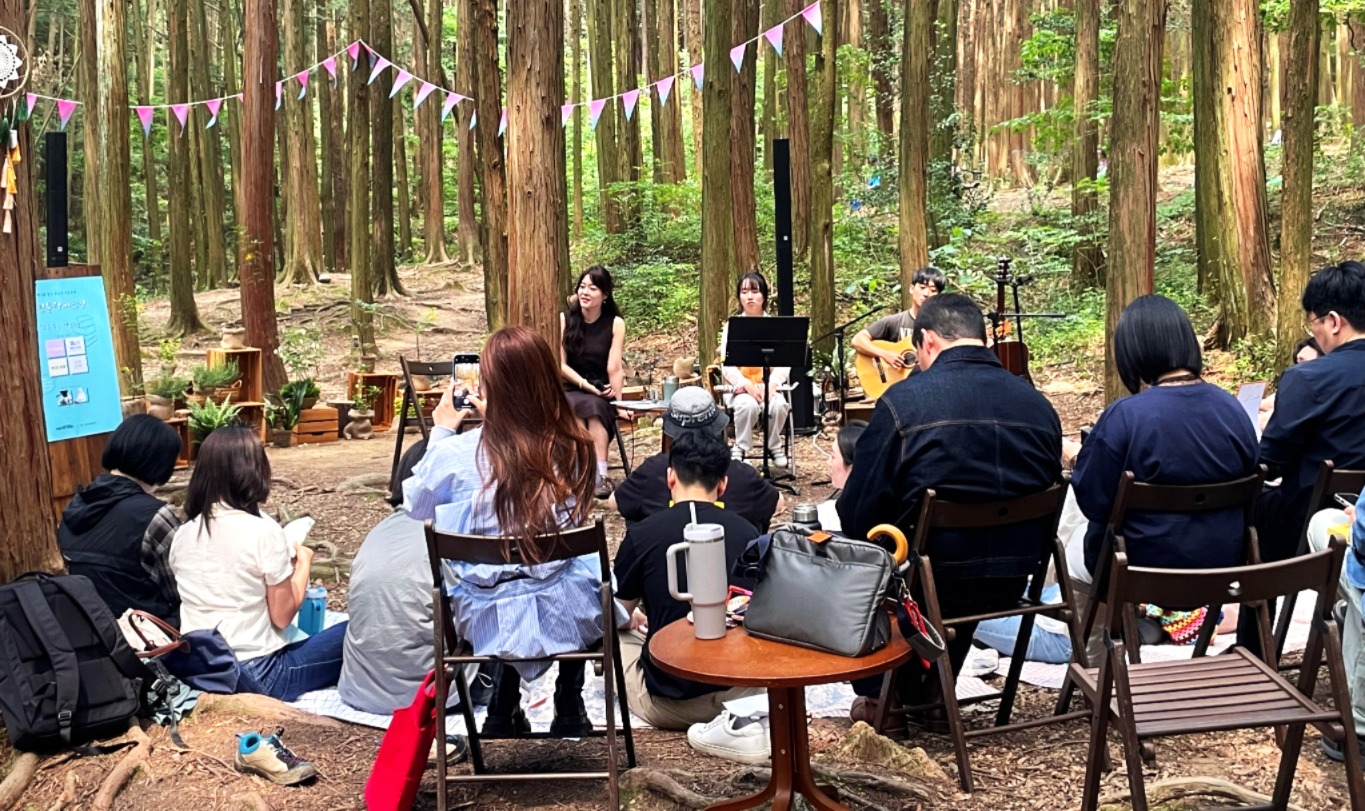
The Literary Pop-up Zone at the cypress forest was an area full of hidden gems, accompanied by the refreshing scent of phytoncides. Although I had visited Mt. Mudeung many times before, this was my first time to visit the cypress grove. It was a space where I could sit in a comfortable chair and fully enjoy the natural sounds in a wooded area filled with cypress trees. In the cypress grove, there were activities like the book camp and book talks with reading clubs from around Gwangju. Some citizens were also enjoying a relaxing weekend, having picnics with their families.
Isn’t the most healing sound the sound of nature? The “talk concert” took place in a peaceful atmosphere accompanied by the sounds of nature. While feeling the freshness of the grass, a warm and resonating author’s book talk was held. As part of the 2025 Dong-gu Academy Program, the “Book-Reading Dong-gu” author of the year was invited to enrich the event. Over the two days, the audience shared warm, humanistic knowledge. On the nearby lawn, an experience based on the Nobel Prize-winning author Han Kang was taking place. Participants wrote postcards to the author in the Forest of Contemplation, made up of passages from Han Kang’s books. Everyone wrote their own sentences in nature.
The “book-camping” among the cypress trees was a great time to soothe a tired mind in the midst of the city. Through onsite first-come, first-served registration, participants could receive a free book-camping packet. The package included a book by Lee Geum-i, the author selected as Dong- gu’s author of the year, organic juice and cookies, a notebook, and a pencil. It also came with a mat, making it possible to enjoy a perfect book- camping experience without needing to bring anything extra. The Sustainable Development Picnic was held amidst the freshness provided by nature through the book-camping packet.
To reduce the use of disposable items, the festival provided water in reusable cups. From A to Z, the festival aligned with nature, and its planning intentions were meaningful. It was a time to escape the busy sounds of the city and fully experience the sounds of birds and the wind in nature. Lying down and looking up at the sky, the sunlight streaming through the cypress branches calmed both my mind and body. Being able to focus solely on a book, away from the digital world of phones and computers, made for a refreshing weekend. It was a time to forget the things that usually occupy my thoughts and to heal in the warm embrace of the cypress trees.
At the Dong-gu Literary Hall booth, there was a free upcycling activity where citizens could make keychains from sea glass. It was an opportunity to recycle glass and seashells collected from the sea to create beautiful keychains. Through these materials that might have been carelessly discarded, I was able to craft my own unique piece and realize the value of resources. For the closing performance, there was an orchestra concert using recycled instruments. It was impressive to see resources from nature recycled again and echoing through the natural surroundings. The sounds of birds and wind blended harmoniously, wrapping Mt. Mudeung in a peaceful atmosphere.
On clear days, you can see the towering peak of Mt. Mudeung from all compass directions. The festival allowed me to deeply feel the energy and charm of the majestic mountain, which has always stood strong, protecting Gwangju. At the start of summer, many citizens gathered at Mt. Mudeung, bringing new vitality to the mountain. The festival was a time to experience the beauty of literature, the arts, and the unique joys of nature based on sustainable development. If you want to feel the comfort that nature offers in its purest form, head to Mt. Mudeung in Gwangju’s Dong-gu.
The Author
Park Yeonju is an undergraduate at Chonnam National University, majoring in political science and diplomacy as well as Chinese language and literature. Her third major is international development cooperation studies. She was born and raised in Gwangju and wants to promote the colorfulness of the city that she has been a part of for so long.
Cover Photo: A book talk in the cypress grove. (Park Yeonju)