

“I Can’t Hold On Any Longer” What the July 13 CNU Suicide Reveals About Korea’s Labs
A master’s degree researcher in CNU’s College of Engineering died on July 13, 2025. He left notes alleging pressure and mistreatment by superiors. One year after a foreign student’s death on the same campus, what has changed, and what has not?
“I can’t hold on any longer,” read the message that would echo through Chonnam National University’s halls in the days after a young student’s life was cut short. At 5:54 p.m. on July 13, 2025, campus security found a graduate researcher unresponsive near Dormitory 9 at Chonnam National University. Police soon confirmed what students feared. He had left multiple notes. In one digital memo, later shared by his family. He wrote, “I can’t hold on any longer” (더 이상 버틸 자신이 없다) and warned, “I hope others learn from me and aren’t gaslighted or made into sacrifices.” He named two senior lab members, telling them, “You are killing a person. Remember that.” (1, 2)
By July 16, the university suspendedtwo professors from duty and convened an investigation committee that included the Graduate School dean and the Human Rights Center chief. Investigators began collecting computers and project files. The case passed from a local station to the Gwangju Metropolitan Police. Yet for many students, the sense of déjà vu was overwhelming – just a year earlier, another student’s death had sparked promises of reform. This time, they wonder if anything will be different. (3, 4)
Timeline
July 13, 2025. 5:54 p.m., a CNU master’s-course researcher is found dead near Dormitory 9. Police open an inquiry. (1, 5)
July 16. CNU says it has excluded two professors from duty and launched an internal committee including the Graduate School and Human Rights Center. National outlets report that the notes cite pressure and mistreatment. (4)
July 18–22. Forensics begin on the student’s phone, laptop, and lab tablet. Gwangju police take the lead. (5)
Early August. Police start summoning named faculty and related witnesses. (7)
Status at Publication. Police and the university committee continue separate investigations, with materials seized from implicated labs. Results pending. (7)
What We Know
Multiple Korean outlets converged on the basic facts. The victim had finished his bachelor’s degree the prior August, then worked as a master’s- course researcher in the College of Engineering. He reportedly spent weekends handling research-project paperwork, accounting, and non-academic tasks. Messaging logs cited by reporters show supervisors pinging him at 3:50 a.m. and 1:32 a.m. during a week he traveled to Seoul for a job interview. (1, 2, 3)
The location and time are specific. Reporters place the discovery at Dormitory 9, 5:54 p.m., on a Sunday. The first internal step, according to CNU and national coverage, was to remove two professors from duty, then set up a committee anchored by the Graduate School and the Human Rights Center. Police escalated to a metropolitan unit. By late July and early August, investigators were imaging the student’s devices and summoning professors named in the notes. (3, 4, 5)
Patterns and Policy
CNU’s formal response in July 2025 came quickly, at least on paper. Two professors were sidelined, a cross-unit committee formed, and digital evidence gathered. (4)
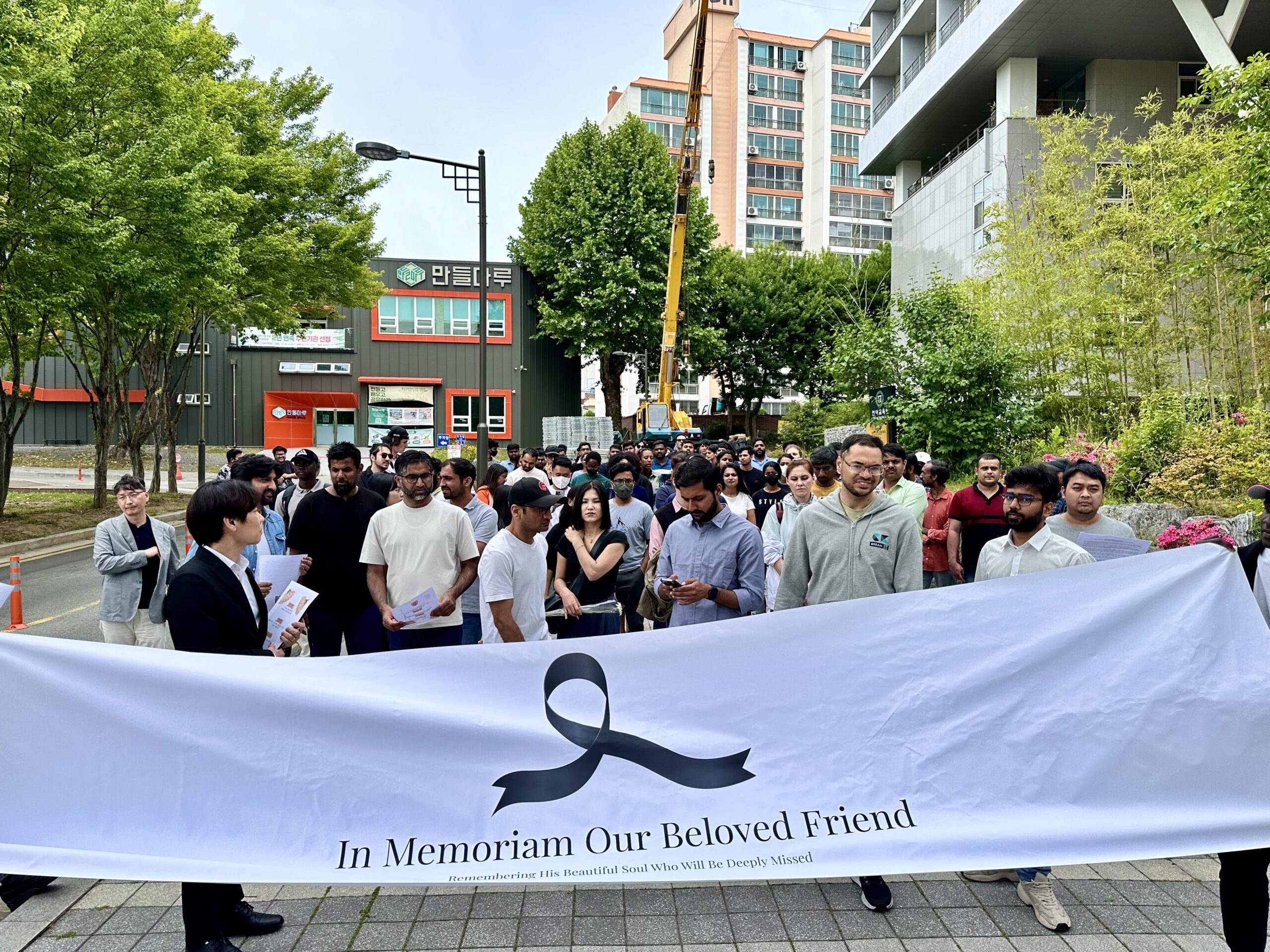
But pattern matters. In May 2024, a foreign student who had become the focus of campus gossip died in a CNU dormitory the day after a minor on-campus incident. International students held a memorial walk and petitioned leaders for clearer mental-health protocols and non-punitive support. Local broadcast coverage highlighted the lack of a consistent crisis manual for foreign students. (8, 9)
Across Korean campuses, grievance routes often center on human rights offices that provide counseling and recommendations. At CNU, the Human Rights Center lists intake, counseling, and reporting steps, and the Graduate School guidebook repeats those channels. Recommendations, however, do not necessarily bind departments, and the center’s past handling of cases has drawn criticism from civic groups and the press. (10, 11, 12, 13)
Elsewhere in Korea, some universities have tried to solve the enforcement gap with independent ombudspersons who mediate conflicts and nudge administrators to act. KAIST publicizes a president-affiliated ombudsperson office that accepts confidential complaints. Seoul National University operates an ombudsperson and an expanded Human Rights Center with a defined petition-to-remedy pathway. Those are not cure alls, as critics at SNU frequently point out, but they are attempts to separate complaint handling from departmental hierarchies. (14, 15, 16, 17)
Figure 1. CNU Grievance Flow, Public-Facing
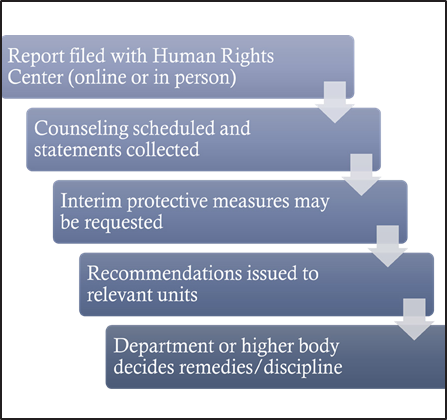
Source: CNU Human Rights Center, Graduate School guidebook. (10)
Culture and Power
Students talk about jangyu-yuseo (장유유서), the Korean norm that juniors must quietly follow what seniors say. In labs, it can harden into micro-hierarchies where doctoral seniors and postdocs act as gatekeepers, and master’s students carry invisible loads. Messages sent in the early morning can look like devotion to the project, until it looks like control. The victim’s notes, as relayed by national media, point directly to that line. (1)
A wider body of reporting describes graduate students as “student-workers,” subject to long hours, pressured to perform, yet outside formal labor protections. Surveys by research institutes and newspapers over the past decade paint a consistent picture, from heavy after-hours expectations to economic precarity, with unionization levels still low. (18)
In that climate, speaking up can feel like closing doors. Master’s students have tight graduation clocks. Doctoral students build reputations in networks their advisors help control. Even when universities advertise reporting lines, students weigh the risk that a quiet word from a professor will shadow them into the job market. SNU’s own public debate this spring, critical of its Human Rights Center’s practices, captured how skepticism grows when complaint systems lack visible teeth. (19)
Human Impact
In the week after the July 13 death, comment sections on Korean portals were filled with conflicting views. On Daum under early reports, some readers urged patience, arguing that investigations shouldrunbefore judgment. Others wrote about their own lab years, describing late- night messages and work that bled into personal errands. A smaller group defended professors as overworked, saying everyone in the chain suffers under grant cycles. These paraphrased reactions are drawn from comments attached to Daum and Naver postings of reports between July 16 and July 22. (3, 20)
Among CNU’s international students, last year’s memorial was not only about grief, it was about structure, from counseling access to anti-stigma messaging. Their petition asked for an independent channel to report abuse without fear of academic retaliation, and for staff training to spot students in crisis. KBS framed the gap bluntly, noting “a lack of consistent crisis protocols” for foreign students. (9)
Zooming out, official statistics do not break out “graduate students,” yet they show the pressure cooker around youth and young adults. Suicide has remained the leading cause of death for Korean teens for over a decade, and national suicide numbers stay stubbornly high. The latest government youth briefs and KOSIS dashboards are a sobering backdrop for any campus policy. (21, 22)
Comparative Lens
Korean campuses have wrestled with this for years. Some invested in neutral ombudspersons, published step-by-step complaint routes, and ran faculty training on power abuse and research ethics. KAIST’s ombudsperson sits near the presidency and takes confidential submissions. SNU’s ombudsperson is paired with an active Human Rights Center that publishes process diagrams and phone lines. Even there, journalists and student papers argue that recommendations too often stop short of enforceable orders. The lesson is not that a single office fixes culture, it is that clear authority and transparent metrics matter. (14, 16, 23, 24)
For CNU, the July case lands on top of a reputation bruised by earlier ethics controversies, including public disputes over how complaints were handled. That history will make the committee’s transparency, and any disciplinary follow-through, as important as the final findings. (12, 13)
Solutions and Accountability
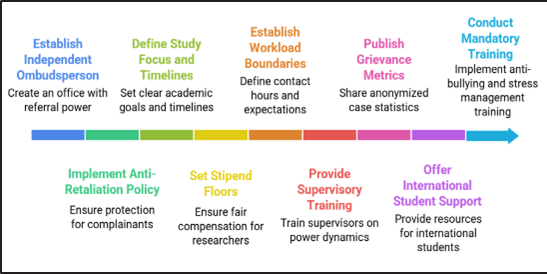
Many professors and departments already show what good mentorship looks like: open communication, fair expectations, and real guidance. But those bright spots are still too rare. To make them the norm, the following changes are essential:
- Independent ombudsperson with referral power. Move beyond counseling only. Establish an ombudsperson office that can demand timelines, trigger interim protections, and publish anonymized quarterly metrics on cases opened, resolved, and pending. KAIST and SNU provide domestic models that CNU can adapt. (14, 16)
- Anti-retaliation policy with teeth. Guarantee that research supervision, thesis evaluation, and recommendation letters cannot be wielded against complainants. Violations should carry specific sanctions and a right of appeal outside the department.
- Define study focus and enforce graduation timelines. Departments should ensure students are enrolled to complete their studies, not to work indefinitely as general lab labor. On admission, the professor, department, and student should agree in writing on a specific thesis topic and a realistic time frame for completing coursework, research, and thesis submission. This agreement should be reviewed annually. Professors who need support on unrelated projects should hire postdoctoral researchers or research staff, not divert students from their core thesis work.
- Stipend floors tied to policy reality. When the statutory minimum wage rises each year, labs cannot function on unpaid expectations. CNU should set a stipend floor for full-time graduate researchers and require departments to document compliance when accepting external grants. If a lab cannot provide a living wage (current minimum wage in South Korea is about 2.1 million won per month) or if the scholarship amount is not enough, students should be allowed to take part-time work alongside their research to survive. (25, 26, 27)
- Workload and messaging boundaries. Require lab charters that cap contact hours, define weekend expectations, and ban non- research errands. Messaging logs featured in this case show how boundaries blur without written rules. (3)
- Mandatory supervisory training. Before taking students, principle investigators and senior lab members should complete training on power dynamics, feedback, and mental-health referral. Retraining should be cyclical and tied to eligibility for grant overheads.
- Transparent grievance metrics. Publish anonymized case statistics each semester, including average days to interim protection and to final decision, and counts of faculty discipline. Numbers are not a cure, yet they make denial harder.
- International student support. Translate crisis protocols, run active outreach, and provide named staff who can navigate immigration, medical privacy, and counseling. Last year’s memorial and broadcast coverage were clear about this gap. (9)
- Mandatory anti-bullying, psychological hygiene, and stress-management training. Graduate students are already required to complete online anti–sexual abuse education modules. The same infrastructure could be used to deliver annual mandatory education on anti-bullying practices, psychological hygiene, and stress management. These trainings should cover recognizing toxic dynamics in labs, self-care techniques, and how to seek help without fear of retaliation.
Figure 2. Implementing Solutions and Accountability at CNU
Fact Box. What Has Changed Since Last Year’s Memorial?
Promised: Clearer crisis handling and an internal look at lab culture, according to petitions and campus statements reported at the time.
Implemented: In 2025, rapid suspension of two professors and setting up of an investigation committee with Graduate School and Human Rights Center participation.
Not Implemented: Visible stipend floors or a published anti-retaliation regime. No public evidence found.
Unknown: Whether CNU developed a dedicated ombudsperson function or released anonymized grievance metrics.
Resources Available
If you or someone around you needs support, Korea’s suicide prevention hotline is 1393, available 24 hours a day. Additional help includes 1588-9191 (LifeLine) and 1388 for youth counseling. Government and public pages list channels and availability. (28, 29, 30, 31)
Methodology Note
This article draws on Korean-language reporting from national and regional outlets, CNU institutional pages, and government statistics, accessed on August 10, 2025. All non-obvious claims are sourced inline. Public reactions are paraphrased from comment sections on Daum and Naver postings of the July 13 case between July 16 and July 22, 2025. Identifying details are not included. Some university policies were inferred from official pages, which may not reflect internal, non-public rules. Where evidence was incomplete, items are marked as “unknown.”
Sources
- https://www.khan.co.kr/article/
- https://www.ohmynews.com/NWS_Web/ View/at_pg.aspx?CNTN_CD=A0003149203
- https://v.daum.net/v/20250716182100499
- https://news.kbs.co.kr/news/pc/view/ view.do?ncd=8306189
- https://news.nate.com/view/20250716n35380
- https://v.daum.net/v/20250722192536508
- https://news.nate.com/view/20250808n24692
- https://www.ohmynews.com/NWS_Web/ View/at_pg.aspx?CNTN_CD=A0003060181
- https://www.youtube.com/ watch?v=hj6TfyWa4I8
- https://hrc.jnu.ac.kr/hrc/9035/subview.do
- https://webgs.jnu.ac.kr/Data/tmfiles/webgs/ download/pdf/2025-guide.pdf
- https://www.ohmynews.com/NWS_Web/View/at_pg.aspx?CNTN_CD=A0002662897
- https://antihakbul.jinbo.net/3592
- https://www.kaist.ac.kr/en/html/campus/053201.html
- https://herald.kaist.ac.kr/news/articleView. html?idxno=673
- https://hrc.snu.ac.kr/%EC%A0%88%EC%B0%A8%EC%95%88%EB%82%B4
- https://www.hani.co.kr/arti/society/society_ general/1193961.html
- https://m.dongascience.com/news.php?idx=26379
- https://www.hani.co.kr/arti/society/society_general/1193961.html
- https://n.news.naver.com/article/003/0013367200
- https://www.newsis.com/view/NISX20250623_0003223169
- https://kosis.kr/visual/nsportalStats/detailContents.do?listId=D&stat JipyoId=3669&vStatJipyoId=4840
- https://news.kaist.ac.kr/newsen/html/news/?skey=keyword&sval=Ombudsmen
- https://www.snunews.com/news/articleView.html?idxno=14798
- https://www.minimumwage.go.kr/main.do
- https://www.data.go.kr/data/15068774/fileData.do?recommendDataYn=Y
- https://m.dongascience.com/news.php?idx=26379
- https://www.mohw.go.kr/board.es?act=view&bid=0027&list_no=378160& mid=a10503010100&nPage=34&tag=
- https://news.nate.com/view/20230908n23179
- https://www.korea.kr/news/policyNewsView.do?newsId=148937356
- https://www.lifeline.or.kr/
Author Contributions: V.M. contributed in conceptualization, data collection, methodology, validation, writing – original draft, and final editing. L.A. contributed in conceptualization and methodology.
The Authors
Vibhanshu Maurya, originally from India, is pursuing his PhD at CNU. He leads a vibrant lifestyle, driving his motorbike across the Korean Peninsula. He directed the Gwangju Hikers group and used to create podcasts that explored the challenges of residing in Korea and strategies for overcoming them.
Li Aoding, originally from China, is a PhD student at CNU. She loves to live a vivid life and cares about lives. She has lived in South Korea for more than seven years, and she lives a happy life with four cats.
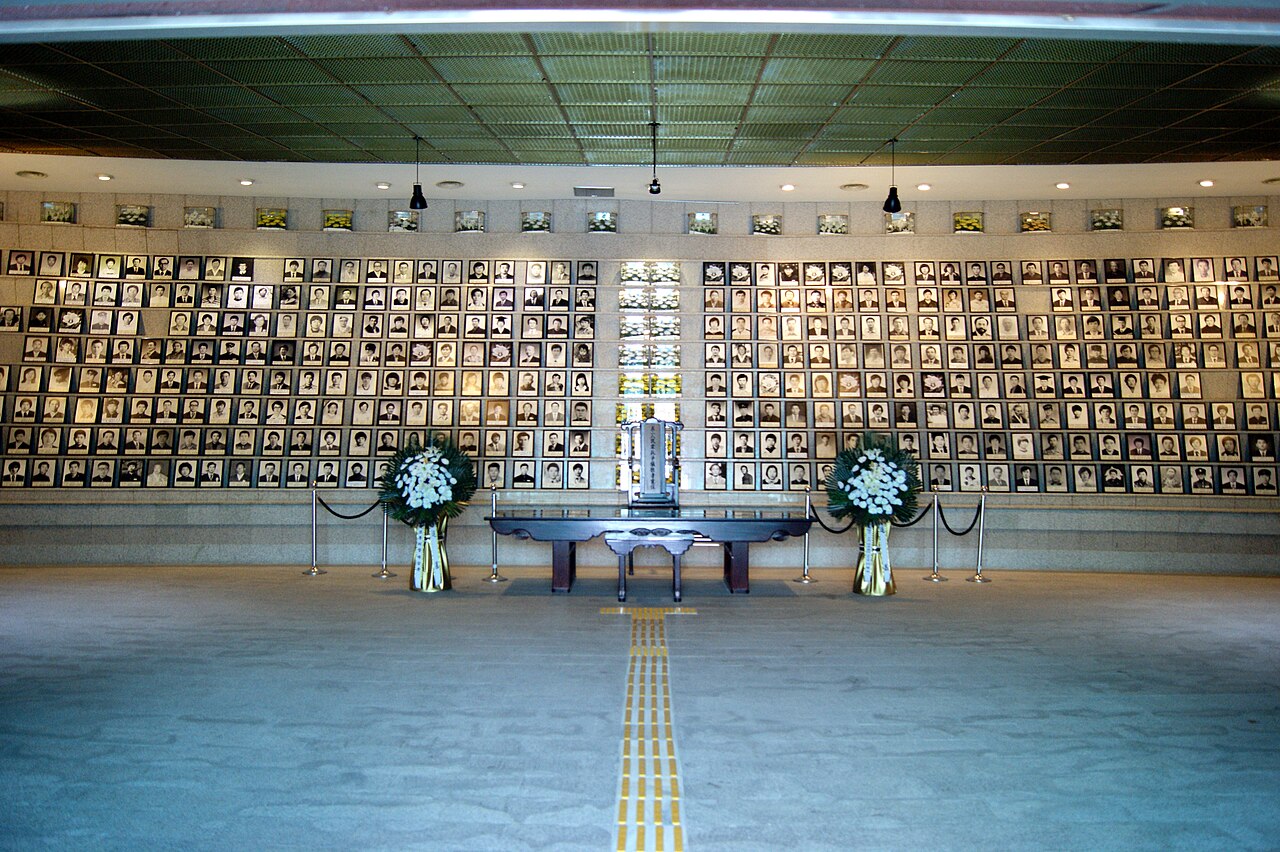
Cover Photo: Students gathered at the College of Engineering in May last year to remember a student whose death sent shockwaves through Chonnam National University. (Kim Dong-gyu)