


Shall We Have a Cup of Tea? : Tea-Brewing Culture in Jeollanam-do
By Jacqueline L. Becerra
With the cooling of the weather showing its presence by brute winds and bare trees, I have found myself seeking refuge on toasty ondol-heated floors and with warm drinks. One might imagine hot cocoa or coffee, but what I carry is a piping hot cup of tea. And it seems like I’m not the only one, with the choice of drink steadily becoming tea. Amongst younger generations, for example, matcha has received the most hype, and whether you are a matcha lover or hater, there is no denying that the popularity of tea has suddenly soared around the world. This has led me to investigate how Korea has placed itself within the tea scene.
The image of Korean tea continues to be shaped through traditional tea houses with antiquated and eclectic old charm in locations like Seoul’s Jong-ro, Insa-dong, or Ikseon-dong. These well- known spots are popular to visiting tourists seeking aspects of traditional Korea – from a multitude of Korean souvenir shops, signage exclusively in Korean (e.g., Insa-dong), and traditional hanok-style buildings. As a result, tea houses reflect this sought-after K-experience not only in aesthetics but drink options, including ssanghwa tea (쌍화차), yuja tea (유자차), and omija tea (오미자차), a staple even with a majority of franchise coffee shops.
Korea, though it gives weight to these classic teas, also has preserved a rich history of variety in teas. While many people may recognize Hadong or Jeju-do for its ever-famous green tea, the main source of tea production actually hails from the province of Jeollanam-do, including areas such as Boseong, Naju, and Jangheung. Spanning
A Boseong tea field in mid-August.
from green tea, yaseng-cha (야생차, wild tea), to cheongtaejeon (청태전), Jeollanam-do has shown itself to be a historic powerhouse in the growing interest in tea culture.
Boseong Tea
Amongst tea sommeliers and those not heavily invested in tea, Boseong is known for its aesthetic luscious array of green tea trees; an iconic photo spot to check out for those in Gwangju and surrounding areas. In addition to holding the title for the oldest tea field in Korea, Boseong has a dedicated tea museum with information translated into English. And upon a simple walk around the fields lie small souvenir shops and cafés offering green tea ice cream, teaware, and local tea goods. I went to Boseong’s Green Tea Festival (보성다향대축제) back in May, where the city not only hosted various tea vendors to share their teas, but held music performances and craft centers to accommodate a wide range of travelers coming to Boseong for the festival. Amongst these, the most memorable was a water fountain that had been filled with massive tea bags, in turn creating a warm fragrant tea bath for passerbys to soak their feet in. However, even on days with no events, it’s easy to see open tea ceremonies by long-time tea masters showcasing and brewing locally grown tea.
Revitalization of Tea: Naju and Jangheung
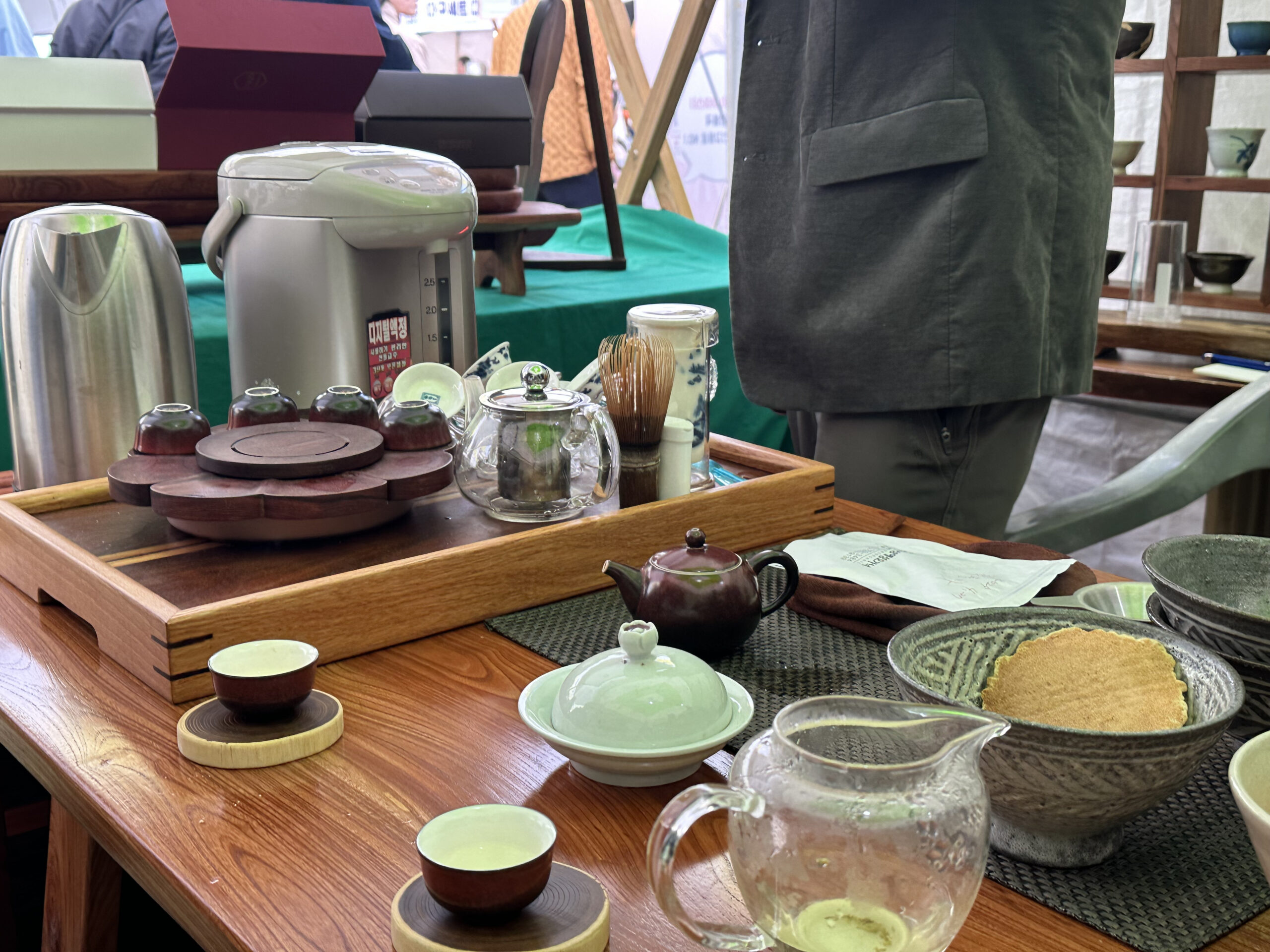
The conversation on tea in Jeollanam-do normally starts and ends with Boseong, being the most representative site. However, about an hour from Gwangju, lies Naju, an up-and-coming city with its production of wild teas. Wild teas can be defined as teas from native or indigenous tea plants not developed with the intent for tea consumption, like those on tea plantations.¹ In recent efforts, Naju has engaged in events such as the Gwangju Tea and Café Show and the Tea World Festival to not only display local cultural goods but to capitalize on its teas, seeking to become the “mecca” of traditional wild tea culture.² When attending the Tea World Festival, I saw the city’s booth: steaming kettles, various tea sets ready for brewing, and a TV screen projecting footage of tea fields and the people behind specialty products. Initially surprised by the scale of the booth, I sat down to talk with one of its staff and sampled Naju-grown teas like Hasimhun’s recently developed lettuce tea (상추차).
Unaware of Naju’s tea, I realized in my conversation and research that the city has a rather extensive history with teas. This deep- rooted tie begins with two Buddhist monks: Marananta and Choui Uisun. The Indian monk Maranata established a Buddhist temple in Naju that allowed for the initial spread of Buddhism and tea culture.³ And in the late 1700s, Choui Uisun, later given the name Cho Ui, cultivated tea plantations in the area of Haenam with seeds from Naju. Cho Ui is known as the father of Korean tea and the great restorer of the Way of Tea in the 19th century, writing a guide on the Way of Tea and several poems still referenced today.¹ These two figures can be viewed as pioneers in the expansion of tea culture in Korea, with Naju as the base starting point.
Thus, we find ourselves in a city south of Naju and closer to Boseong: Jangheung, known for its production of cheongtaejeon. If you translate its Chinese character-based parts, it can be broken down into cheong (blue), tae (moss), and jeon (coin), and due to its fermentation process, leaves a blue moss on its surface. This fermented wild tea is then pressed into small tea cakes that resemble coins, for which it is also called doncha (돈차, money tea). Cheongtaejeon originated in the Three Kingdoms Period and since then has gained international recognition with several wins from the World Green Tea Contest for its rich taste and quality. And when discussing cheongtaejun, Borim Temple cannot be left out – a historic site providing early records of tea consumption.⁴ To this day, travelers to this area can find Borim-sa temple workers producing this tea onsite. As such, Jangheung carries a reputable name for its production of cheongtaejeon.
Broadening Tea Culture
Jeollanam-do, with its warm climate, may be bound to become the main producer of tea for Korea, as tea trees cannot flourish under harsh winter conditions like that north of Jeonju.¹ But it is also doing the work of furthering knowledge by encouraging studies at local universities such as that at Chosun University and Mokpo National University.⁵,⁶ These universities offer departments of international tea and culture for graduate and doctoral programs, with Mokpo
National University being the first in Korea to curate an intensive curriculum on international tea culture. For this reason, it is clear to see that Jeollanam-do is doing its part to promote and expand its position as a major tea producer.
Sources
¹ Brother Anthony of Taizé & Hong Kyeong-Hee. (2007). The Korean way of tea. Seoul Selection.
² Naju City Cultural Foundation. (2025, June 26). 나주시문화재단, ‘국제차문화대전’서 야생차 매력 알렸다 [Wild tea’s charm known at the Tea World Festival]. https://www.njcf.or.kr/www/community/ press?mode=view&idx=35
³ Korea Tourism Organization. (n.d.). Yeonggwang Bulgapsa Temple. https://english.visitkorea.or.kr/svc/contents/ contentsView.do?vcontsId=93885
⁴ Jangheung-gun Agricultural Technology Center. (2024, January 18). 세계가 인정한 명품차, 청태전이란? [What is cheongtaejeon, a world-renowned luxury tea?]. https:// www.jangheung.go.kr/jares/majorplan
⁵ Chosun University. (n.d.). Department of International Tea Culture. https://www3.chosun.ac.kr/eng/1970/subview.do
⁶ Mokpo National University. (n.d.). Department of International Tea and Culture. https://eng.mokpo. ac.kr/eng/1458/subview.do
The Author
Jacqueline Becerra is a past Critical Language Scholarship recipient at Chonnam National University and reminisces back on those memories of humid summer nights. Through her writing at the Gwangju News, she wishes to convey the same fondness the city has given her.
Cover Photo: A tea vendor’s setup for the Boseong Green Tea Festival. (Jacqueline Becerra)