


Sister Cities: Cities as Global Actors – The Medan-Gwangju Partnership
By A. Ayuningsih ||
I was casually scrolling through Instagram when something unexpected caught my attention: a street in Medan bearing the name of a Korean city: Gwangju. Known as “Gwangju Street,” the name felt both familiar and puzzling. According to the inscription, the street was officially named in 2005. That small detail sparked a larger question in my mind: How did a city in Indonesia come to commemorate a city in South Korea through its urban landscape?
Curious, I began to search for its story. What I found was not merely a naming decision but a symbolic gesture rooted in an international collaboration between Medan and Gwangju, one known as a “sister-city partnership.” More than an administrative agreement, the program represents a form of city-to-city diplomacy, where cultural exchange, mutual learning, and shared values are expressed not only through policy but also through everyday spaces such as streets, schools, and public memory. This program was established in 1997, when the mayor of Medan at that time, Bachtiar Djafar, and the mayor of Gwangju, Song Eon-Jong, signed the memorandum of understanding (MOU) for sister-city cooperation. The cooperation focuses on education, culture, technology, and economic development.
Over nearly three decades, this relationship has produced a wide range of concrete programs. In the environmental sector, Gwangju sent policy advisory teams to Medan in 2016 and 2018, conducting workshops, sharing environmental policies, and providing technical advice on waste management systems. Gwangju also invited Medan officials and companies to the 10th International Climate and Environment Fair at the Kim Daejung Convention Center, reinforcing knowledge exchange in sustainable urban development.
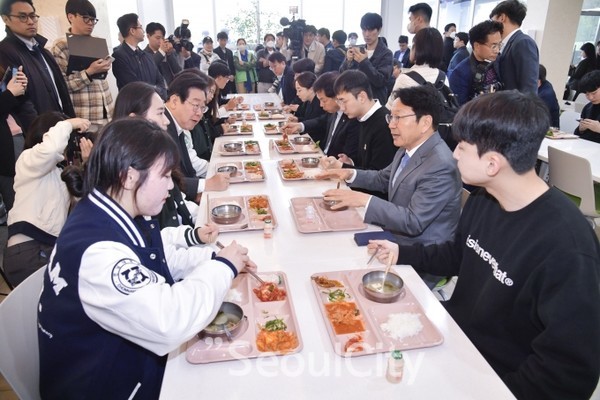
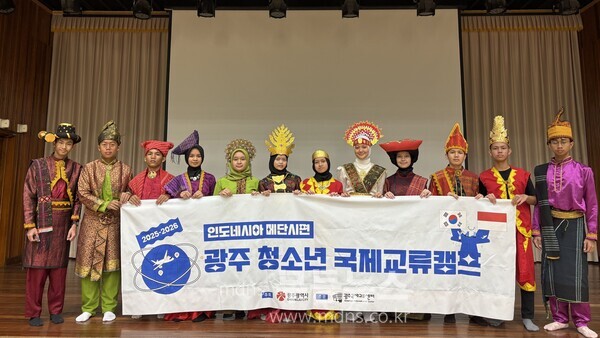
Educational exchange has been another enduring pillar. Since 1999, student exchange programs have been conducted annually on a reciprocal basis, involving high school and university students from both cities. While students from Medan gain exposure to Korean education and culture, students from Gwangju are equally introduced to Southeast Asian perspectives, local traditions, and social realities in Medan. These encounters quietly shape how young people in both cities understand the world beyond their national borders.
The partnership has expanded into economic cooperation. In June 2022, representatives of the Gwangju City Government visited Petisah Market to explore retail and market-sector collaboration. In March 2024, the partnership further expanded into energy and environmental investment, including initiatives related to carbon emissions reduction, waste management, and clean water provision.
Yet, the longevity of a sister-city relationship and the number of programs conducted do not automatically guarantee depth or inclusiveness. The broader public often remains unaware of the partnership’s existence or benefits. Medan’s Gwangju Street highlights this gap. Although it stands as a visible symbol of international cooperation, its historical context and significance are rarely communicated to the public. As a result, even casual observers, myself included, may encounter the name without understanding the sister-city relationship it represents.
Thinking back to how easily I once looked past Gwangju Street in Medan without knowing its meaning, I realize how distant the sister-city program can feel from everyday life. If this partnership is to remain relevant, it cannot live only through official visits or ceremonial agreements. It needs to be felt at ground level, through schools that tell the story behind the name, markets that become spaces of cultural exchange, environmental groups that collaborate across cities, and creative communities that translate diplomacy into shared experiences. With simple efforts like public signage, small exhibitions, or digital storytelling, places like Gwangju Street could invite questions rather than indifference. In this way, the sister-city relationship would no longer exist merely as a symbol I once overlooked but as a living connection woven into the city’s daily rhythm.
Looking ahead, future cooperation would benefit from closer attention to how these initiatives are experienced by residents in both cities. When international collaboration is anchored in everyday urban life, the sister-city relationship becomes more than a record of past agreements; it becomes a living partnership. In this sense, Gwangju Street should not only remind Medan of its international ties but also reflect a relationship in which both cities continue to learn from one another, asking how global friendship can remain meaningful for the people who live within it.
The Author
A. Ayuningsih is a graduate student seeking to express the concerns she observes in her surroundings. She hopes that her words may raise awareness and offer a meaningful contribution to the broader community and society in which she lives.
Cover Photo: Student exchange participants from Medan as part of the 2025 Medan–Gwangju sister-city program. (Gwangju Youth Intl. Exchange Camp)