


Sister Cities: City-to-City Cooperation – Guangzhou and Gwangju
By Li Aoding
Located in the heart of the Pearl River Delta of southeast China, Guangzhou is the capital of Guangdong Province and one of China’s most influential commercial and innovation-oriented cities. Guangzhou and Gwangju (South Korea) share more than just a friendly relationship; they share a striking linguistic resemblance: In Chinese pronunciation, “Guangzhou” (广州) and “Gwangju” (光州) sound remarkably similar, and both contain the Chinese character meaning “region” (州).
This “same-sounding” connection has often been seen as a feature for mutual affinity. It offers a memorable cultural entry-point into a partnership that has been institutionalized for decades. In 1996, the two cities officially signed a sister-city agreement, laying a stable foundation for long-term cooperation. Over time, that framework has evolved from symbolic friendship into more practical, multi-layered collaboration. From December 8 to 11, 2023, Guangzhou’s Huangpu District and Gwangju’s Seo-gu (West District) held a ceremony to sign a friendly exchange agreement, extending the sister-city spirit from the municipal level to district-to-district collaboration – often where policy experimentation, community exchange, and project implementation move fastest.
The political language of this relationship has also carried an uncommon sense of warmth. In 2019, Gwangju Mayor Lee Yong-seob observed that the two cities were not only similar in name but close in relationship, mirroring the broader trend of deepening Korea–China exchanges. He captured the spirit of the sister-city partnership with a vivid line: “In hardship, you reach out a helping hand; and in joy, you cheer for each other.” In 2023, Gwangju Mayor Kang Gi-jung voiced a forward-looking expectation that the two cities would further strengthen exchanges in culture and tourism – a reminder that sister-city ties ultimately gain legitimacy not only through agreements, but through citizens’ lived experiences.
Academic Exchange
Academic exchange is one of the most promising areas for deepening this connection. On August 11, 2025, a study group from Chonnam National University visited Guangzhou University for academic exchange, demonstrating how universities can act as “engines” of sister-city cooperation. Through seminars, campus visits, faculty–student dialogue, and cross-cultural discussion, such programs cultivate long-term networks of trust. They also support a shared future: Students who meet through exchange may later become researchers, entrepreneurs, and public leaders who continue the relationship in new forms.
Beyond bilateral programs, the cooperation horizon is also widening into tri- and multi-party coordination: In 2025, Guangzhou’s Hunan University worked closely with Gwangsan-gu of Gwangju and the Panyu District of Guangzhou to advance multi-field exchanges and, through attracting international students, jointly promote regional economic vitality.
Sports Friendlies
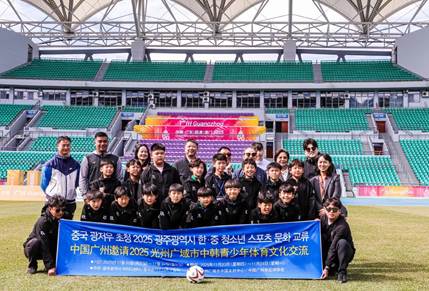
Sports, too, has emerged as a powerful civic connector that can translate goodwill into immediate, memorable encounters. As special international guests of the 2025 Sui–Hong Kong–Macao Football Carnival, the Gwangju youth football team visited Guangzhou from November 20 to 24, engaging Guangzhou’s youth in friendly matches, joint training, and cultural study activities. The program not only embodied the event’s “Greater Bay Area + international” character, but also offered an accessible, high-participation format for strengthening city-to-city friendship – one handshake after a match at a time.
Historical Gateway
For centuries, Guangzhou has served as a gateway between China and the outside world, shaped by trade, migration, and cultural exchange. Today, that openness is reinforced by a comprehensive transportation network and strong economic capacity. Guangzhou is widely recognized for advanced manufacturing, automobiles, biomedicine, artificial intelligence, modern services, and a robust exhibition and trade economy. In the broader imagination of global manufacturing, Guangzhou also stands as an important part of the “world factory” landscape, with dense supply chains and strong production-to-export capabilities that connect it to international markets.
Guangzhou’s identity is inseparable from its long history and distinct Lingnan culture. With a city history of over two thousand years, Guangzhou has deep roots in the Maritime Silk Road tradition, where commerce and multicultural contact helped form a practical, inclusive urban character. The city’s constructed environment reflects this continuity: Traditional arcaded streets and Xiguan residences preserve everyday textures of old Guangzhou, while the modern skyline along the Pearl River signals a confident, global-facing metropolis. The city is at its best when these layers are seen together – where heritage is not frozen in time but continues to coexist with modernization.
Cultural Experiences
Food culture is one of Guangzhou’s most recognizable “languages.” It is often the quickest way for visitors to feel the city’s warmth. Cantonese cuisine is famous for highlighting freshness, natural flavor, and precise technique. The rhythm of daily life is closely tied to eating, especially through the tradition of “morning tea” (dim sum). Classic dishes such as shrimp dumplings, barbecued pork buns, rice noodle rolls, wonton noodles, and roast goose are more than popular foods – they are a living cultural system carried by tea houses, markets, and neighborhood restaurants. For Korean visitors, Guangzhou’s culinary world frequently becomes an easy bridge for conversation and shared experience, turning cultural exchange into something immediate and enjoyable.
Beyond dining, Guangzhou offers a broad cultural and urban experience. Museums, historical sites, and traditional neighborhoods provide windows into Lingnan folk customs and the city’s role as a southern trade hub. At the same time, modern public spaces, riverfront development, and landmark architecture demonstrate how Guangzhou continuously remakes itself. This balance of historical depth paired with a forward-looking mindset helps explain why the city has remained influential across so many eras.
Connectivity
Connectivity is another key reason Guangzhou functions well as a partner city. From Gwangju (KWJ) to Guangzhou (CAN), the main and fastest option is to fly. There are direct or connecting routes covering a distance of a little over 1,800 kilometers. Travelers can also fly first to Seoul and then take an international flight onward to Guangzhou. The ability to travel conveniently and to host large-scale international activities makes exchanges more frequent and cooperation easier to sustain. In sister-city relationships, such practical conditions often matter as much as goodwill because they turn symbolic friendship into repeatable interaction.
Relationships Matter
In an era when cities compete for talent, innovation capacity, and cultural influence, sister-city partnerships matter most when they produce repeatable cooperation mechanisms and shared opportunities. Guangzhou’s industrial and innovative ecosystem can complement Gwangju’s strengths in culture, arts, and humanistic values. Meanwhile, district-level agreements, university exchanges, youth programs, and sports events provide practical platforms where collaboration can be tested, scaled, and sustained. From a name that sounds alike to a relationship that continues to grow closer, Guangzhou and Gwangju are demonstrating how city diplomacy, when anchored in institutions yet animated by citizens, can remain resilient, relevant, and future-oriented.
The Author
Li Aoding, originally from China, is a PhD student at CNU. She loves to live a vivid life and cares about lives. She has lived in South Korea for more than seven years, and she lives a happy life with four cats.
Cover Photo: The Gwangju delegation at the 2025 Guangzhou Invitational Youth Football Tournament. (FUN_L)