


The May Mothers of Gwangju – May 2025
By Park Yeonju
May has returned once again. Fresh green grass begins to sprout, and a gentle breeze flows through the air.
But in Gwangju, many still carry the pain of “that day.” From young students to ordinary citizens, countless people poured into the streets to protect Gwangju on May 18, 1980. Of course, among them were women. There were women who prepared warm rice balls for fellow citizens.
Women who broadcast on the streets to inform others of Gwangju’s situation, Nurses who treated the wounded in hospitals. And those who cared for the injured in the streets.
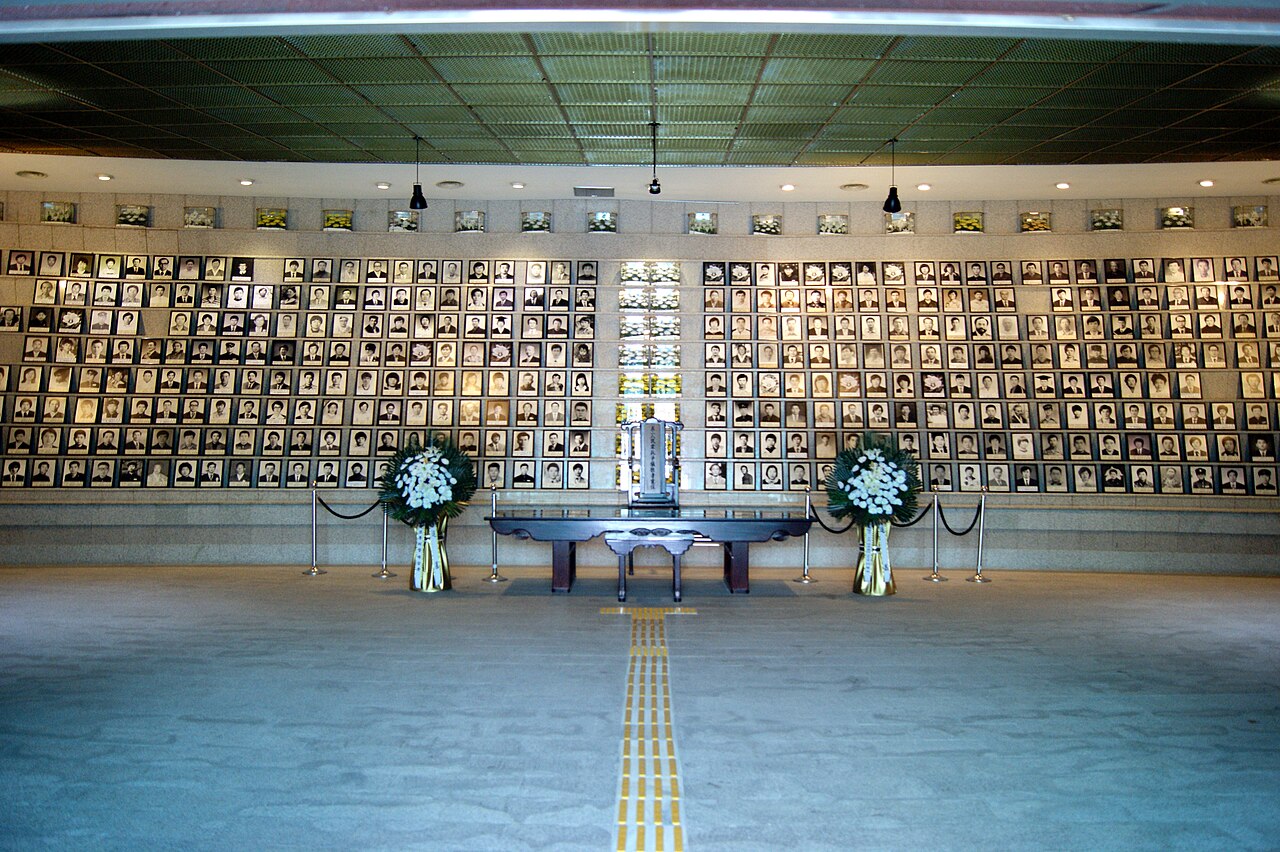
On May 18, 1980, in the face of martial law troops, women of Gwangju raised their voices and stood their ground in various roles. Though the specific contributions of women during that time have not been highlighted, it remains an undeniable truth that they quietly stood as pillars of support for Gwangju. These very women later became part of the May Mothers, a group that continues to work so that Gwangju may one day be in full bloom again.
The May Mothers’ Association is a group of women whose family members were killed, imprisoned, or injured during the May 18 Gwangju Democratic Uprising. During the uprising, although the martial law troops brutally assaulted Gwangju citizens, it was the very citizens and students who tried to protect the city who were falsely labeled as “rioters.” They were arrested, causing their families to live in anxiety and fear.
The current head of the May Mothers’ Association, Lee Myung-ja, also had her husband imprisoned at the time. Not knowing where he had been taken, she searched desperately for him and went from place to place. Along the way, she naturally came into contact with other families of the imprisoned. In October 1980, when trials for the detainees began, these efforts led to the formation of a gathering of detainees’ families.
Right after the Gwangju Uprising, the city remained wounded and isolated. The military regime was still in power, and there was no one willing to truly listen to or uncover the truth behind what the citizens of Gwangju had endured. Even close acquaintances avoided the families of the detainees, fearing that any association might bring trouble. In those lonely and fearful times, it was the families of the detainees who stood by each other. They became each other’s strength and united to confront the truth.
Most of the detainees were brought before military courts, with some even sentenced to death or life imprisonment. The government branded them as rioters and strictly controlled the narrative, pushing it as if it were the only truth. Just as they had isolated Gwangju on May 18 and cut off all means of connection to the outside world. But the May Mothers stood strong. The spark of truth never died. To keep it alive, they carried on acts of resistance, including hunger strikes.
In 1981 the difficult trials continued. Even at the second trial, the court upheld the death sentence. This became a turning point that brought the families of the detainees even closer together. They stayed up all night handwriting leaflets titled “We Are Not Rioters” and took to the streets. To avoid police surveillance, they left at dawn and headed to Myeong-dong Cathedral in Seoul.
After mass, they stood on the podium to distribute their leaflets and spoke out about the Gwangju Uprising and the plight of the detainees. The detainee families’ efforts for the release of their loved ones was intense and desperate. Then on April 3, the Chun Doo-hwan regime commuted the sentences of those sentenced through a special amnesty.
Since no one was willing to stand with them, they often clashed with police chiefs. When trials went against them, they even disrupted courtrooms. They had no choice but to act this way. Without such actions, the world was too cold and indifferent. It would have only driven the detainees’ families further into despair. Despite the tremendous suffering and pain they had endured in 1980, the citizens of Gwangju had no time to heal. They were once again forced to defend themselves on their own.
They were beaten and injured at times, but they could not turn away from those who raised their voices. The experience they gained from fighting for the release of detainees became a powerful resource to support others who were also resisting injustice. They visited prisons across the country to advocate for better treatment of inmates. They also helped secure the release of those who had been imprisoned during various social movements. The May Mothers’ Association acted with purpose and solidarity, ensuring that the pain and injustice they had endured would not be repeated by others in our communities and across the nation.
The May Mothers’ Association was present not only during the June Struggle in 1987. They also stood with the people during the 2016 candlelight protests. More recently, they joined the movement calling for the impeachment of Yoon Suk Yeol, which concluded just recently.
On cold winter days, they offered warm rice balls filled with the spirit of May to the citizens of Gwangju who gathered in protest. In the end, the democratic spirit that began in 1980 once again helped protect South Korea’s democracy. The May Mothers’ Association raised their voices 45 years ago. And even now, they do not hesitate to speak out wherever they are needed. If there is something to protect, they step forward. When democracy in Korea wavers, they walk the path to stand firm as its pillar.
The May Mothers’ Association created a space for ongoing community activities with its members. It also serves to honor the women who dedicated themselves to the May 18 Democratic Uprising. This space is called the May Mothers’ House. It is located in Yangnim-dong in Nam-gu. The May Mothers’ House also carries out various programs to engage with citizens. One such initiative is the May Mothers’ Award. It recognizes individuals and organizations that have contributed to the advancement of democracy in South Korea. From 2007 to 2020, the award was given a total of 14 times. There is also a program in which the May Mothers themselves share personal stories about the May 18 Democratic Uprising. More recently, they have continued to participate in ongoing efforts and struggles. Their aim is to ensure that the truth of the uprising is not distorted and that a full investigation is properly carried out.
The May Mothers’ Association is still writing its story today. In 1980, they lost family members or witnessed them being wounded. Even now, many mothers and women still cannot sleep well when the month of May comes around. This is not a problem that time alone can heal. The truth is that a full and proper investigation has yet to be carried out. There are still many who distort the May 18 Democratic Uprising by exploiting regional divisions. Though the May Mothers carry deep wounds in their hearts, they continue to embrace those who are working to change the world with warmth and compassion.
May has returned to Gwangju once again. Shouldn’t a warm and peaceful spring also come to the May Mothers of Gwangju, who continue to live among us? To remember and not forget the May 18 Democratic Uprising is not just a matter for Gwangju. It is a task for all of us in Korea to uncover the full truth and to establish a just and accurate history. Today, the spring breeze in Gwangju may feel gentle, but it still carries with it streams of tears and pain.
Photograph by Park Yeonju.
The Author
Park Yeonju is an undergraduate at Chonnam National University, majoring in political science and diplomacy as well as Chinese language and literature. Her third major is international development cooperation studies. She was born and raised in Gwangju and wants to promote the colorfulness of the city that she has been a part of for so long. Also, she wants to deliver various voices of the world. It is her dream to become a true journalist by inheriting the spirit of May 18.