







“Gotcha, April Fools!”, April Fools’ Day: Filled with Fun Pranks – April 2025
A day when not telling the truth is acceptable. – as well as tricking or spoofing one another! “I’m actually… moving abroad.” “Really? All of a sudden? Why?”
“Well, it’s April 1st, you know…”
Did everyone see this coming? Even after hearing shocking news, once you realize what day it is, a sense of relief washes over you, followed by laughter. That’s right! It’s April Fools’ Day.
This is probably the day of the year when the most fibs are told and deceptions made. When April 1st comes around, we can’t help but wonder what kind of elaborate pranks people will pull. Do you remember a childhood friend suddenly making a completely unexpected statement? Friends who surprised us with the most unbelievable tall tales. And on the flip side, the times when we tricked others and ran away, shouting, “April Fools!” Looking back, we all have fond memories of April Fools’ Day.
Since childhood, we’ve naturally thought, “April 1st is a day when we can play pranks and fool others!” But when it comes to where and how April Fools’ Day actually began, most of us don’t really know. In this article, we dive deep into the origins and history of April Fools’ Day. A day we’ve always seen as just a time for fun tricks. Now, let’s travel back in time and uncover its obscure history!
Origin
A day when anyone can become a fool! That’s why April 1st is called “April Fools’ Day,” but it is also sometimes referred to as “All Fools’ Day.” Although it is not an official national holiday, many countries – including South Korea, neighboring countries like China and Japan, and Western nations – enjoy this day with playful pranks. April Fools’ Day has been passed down through a surprisingly long history to become what it is today. While its exact origins remain a mystery, the media and major brands have embraced April Fools’ Day jokes, ensuring the unofficial holiday’s longevity.
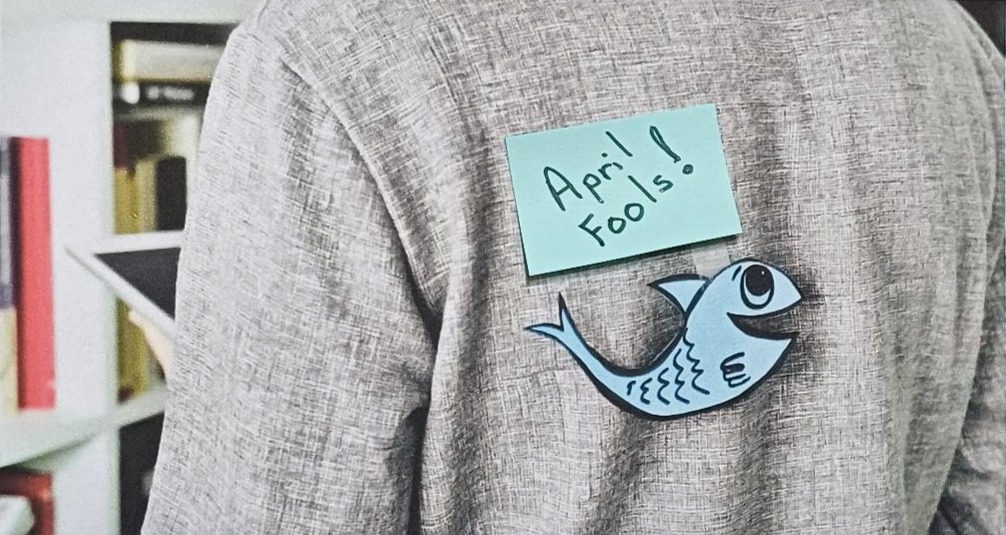
The most widely accepted theory traces the origins of April Fools’ Day back to France. Before adopting the Gregorian calendar (solar calendar), many parts of Europe celebrated the new year around April 1st. However, some people either failed to realize or were late to hear that the start of the new year had officially shifted to January 1st. As a result, they continued their tradition of holding New Year’s celebrations from the last week of March until April 1st. Over time, these people became the butt of jokes and victims of hoaxes, eventually being called “April fools.” One of the classic pranks involved sticking a paper fish on someone’s back and calling them poisson d’avril (“April fish” in French). This April fish symbolizes a young, easily caught fish – a metaphor for a gullible person who is easily fooled.
Historians link April Fools’ Day to festivals such as Hilaria, which was celebrated in late March in ancient Rome. This event involved people dressing up in disguises and mocking fellow citizens and even magistrates. It is said to have been inspired by legends from Egyptian mythology. There is also a popular belief that April Fools’ Day is linked to the vernal equinox, which marks the beginning of spring. This time period is known for its unpredictable weather and is said to have fooled people. This may have also contributed to the rise of April Fools’ Day.
“April Fools’ Day has been bringing joy to people for centuries.”
In England, the origins of early April Fools’ Day are said to come from The Canterbury Tales. This masterpiece, written by Geoffrey Chaucer, is one of the first literary works printed in English. Among its stories, in “The Nun’s Priest’s Tale,” in whichtherearetworidiculouslyfoolishcharacters. The story mentions that a king and a princess’s engagement was set for “since March began / be gone thirty days and two.” Scholars interpret this ambiguity to actually refer to May 2nd. However, many readers misinterpreted this to mean April 1st, leading some to believe that this mistake became the foundation of April Fools’ Day.
When talking about Israel, it’s impossible to leave out biblical stories. Interestingly, the Bible also has a possible April Fools’ Day origin story. One of the most well-known biblical figures, Noah, attempted to check how much the floodwaters had receded. According to some interpretations, the first time he dispatched a dove from the ark to do this was on April 1st. Since the waters had not yet receded, sending the dove was a pointless task. This event is believed by some to be the origin of April Fools’ Day in Israel.
Pranking in Korean History
Did you know that Korea also had a day similar to April Fools’ Day during the Goryeo Dynasty (936–1392)? Isn’t that fascinating? On the first snowfall of the year, people were forgiven for telling small untruths. This tradition continued into the Joseon Dynasty, as people believed that a heavy first snowfall was an omen of a bountiful harvest in the coming year.
One of the greatest pranksters of the Joseon Dynasty was King Taejong. In 1418, the same year that his younger brother Sejong ascended to the throne, Taejong decided to play a trick on Jeongjong (his older brother and former king). He ordered one of his officials to collect the first snowfall in a box and deliver it to Jeongjong, claiming it to be medicine. By the time Jeongjong realized the trick, the official had already left. Why was this prank significant? Because there was the tradition that if someone received snow from the first snowfall in a container, they had to buy the sender a drink. It’s amazing to see that even centuries ago, people in Korea enjoyed playful pranks. Finding a tradition similar to April Fools’ Day in Korean history is truly exciting!
Observing the Day Here & There
April Fools’ Day has been around for quite a long time! While its exact origins remain unclear, the various origin stories from different countries all seem plausible. It seems that no matter the era, playing pranks has always been fun! So, how do different countries celebrate April Fools’ Day? Let’s start with Korea. In Korea, April Fools’ Day is known as Manu-jeol (만우절, “many fools’ day”). It truly lives up to its name, as people can play pranks all day long!
In schools, students often switch classrooms or rearrange their seating as a playful joke on their teachers. Identical twins sometimes swap classes entirely, tricking both teachers and classmates with their indistinguishable appearance! And let’s not forget Lotteria, a popular burger brand in Korea! About a decade ago, Lotteria held a creative April Fools’ Day event. Customers who recited a specific phrase could get a free burger! However, the catch was that they had to say it in a role-playing format with the staff. Only those who overcame their embarrassment could claim their well-earned burger!
Here is an April Fools’ Day prank that I personally experienced. There used to be an online shopping platform called T-mon. When I was a kid, I once visited T-mon and saw that they were selling tickets to space! Of course, the price was unbelievably high, with so many zeros that I couldn’t even count them all. At the time, I was so amazed and excited that I ran to my mom and said, “Mom! T-mon is selling tickets to space!” But she firmly dismissed it, saying, “No way. We can’t just go to space that easily.” Then, I realized it was April 1st. I had completely fallen for an April Fools’ Day prank! It turns out that when a prank is well thought out, you can fall for it completely before you realize that it’s April Fools’ Day!
Shall we head to China next? In China, April Fools’ Day is called (Yúrén Jié). Many people enjoy playing pranks and teasing their close friends on this day. The term zhěnggŭ means to play tricks, fool someone, or prank them. For example, someone might say, “Your shoelaces are untied” or “You’re wearing your pants backward,” But in reality, it’s just a trick to see their friend’s reaction! What about Japan? Japan has a unique tradition for April Fools’ Day. The time for telling falsehoods is actually limited! People are allowed to fib in the morning, but by the afternoon, they must reveal the truth.
Now, let’s fly over to Canada! In Canada, just like in many other countries, people exchange jokes and pranks on April Fools’ Day. After pulling a prank, it’s common to shout, “April Fools!” One popular prank among kids is the whoopee cushion – a rubber cushion that makes the sound of passing gas when someone sits on it. It’s usually placed secretly on a friend’s or family member’s chair to surprise them with this unexpected sound of flatulence. While children especially love this prank, it’s also a lighthearted joke that even teens and adults enjoy.
A day to laugh and let loose! Amid our busy and exhausting routines, April Fools’ Day is a rare occasion when we can laugh freely and play pranks without worries. Though it lasts for just one day, isn’t it great that we get to share extra smiles and laughter with each other? April Fools’ Day has been bringing joy to people for centuries. Even though the name includes “fool,” why not take this chance to embrace the fun and lighthearted spirit of the day?
The Author
Park Yeonju is an undergraduate at Chonnam National University, majoring in political science and diplomacy as well as Chinese language and literature. Her third major is international development cooperation studies. She was born and raised in Gwangju and wants to promote the colorfulness of the city that she has been a part of for so long. Also, she wants to deliver various voices of the world. It is her dream to become a true journalist by inheriting the spirit of May 18.