


Freedom Without Responsibility is Not Democracy: The Shadow of 5.18 Distortion and U.S. Section 230

The United States has long championed freedom of expression as a core value of democracy – a principle that deserves profound respect. However, according to a newspaper report (The Hankyoreh, January 1, 2026), the U.S. government has publicly voiced “significant concerns” regarding South Korea’s moves to strengthen online regulations, stating they could “undermine freedom of expression and disadvantage U.S.-based digital platform companies.”
At first glance, this stance of defending free speech appears principled and legitimate. Yet, if such an attitude relies solely on “market forces and autonomy” while ignoring the reality of systematic historical distortion and hate speech proliferating across digital platforms, it is less a defense of freedom and more a deferral of responsibility.
The gravity of this reality was confirmed through data at a recent National Assembly forum. On November 5, 2025, the Citizens’ Coalition for Democratic Media and the May 18 Memorial Foundation held a session titled “Results of 5.18 Media Monitoring and Discussion.” The findings revealed that expressions distorting or disparaging the May 18 movement are spreading through portal news comments in a repetitive and organized manner. Reported under the headline “Hate Comments Against 5.18 Peaked During Yoon Suk Yeol’s December 3 Insurrection,” the news highlighted that a significant number of distorting comments bypassed automated filters. Consequently, the burden of monitoring and taking action fell excessively on the shoulders of reporting citizens (Ohmynews, November 5, 2025).
Algorithms prioritize anger and provocative content, while platforms maintain their traffic and profits under a guise of neutrality. In this structure, freedom of expression no longer serves as a shield for the vulnerable; instead, it functions as a license to disseminate falsehoods and hatred.
At this juncture, the implications of Section 230 are decisive. A key provision of the U.S. Communications Decency Act of 1996, Section 230 stipulates that online platforms should not be treated as the “publisher” or “speaker” of user-generated content (47 U.S.C. §230). This provision was introduced in the early days of the internet to protect emerging industries from excessive legal liability. Today, however, the internet industry has fully matured. For the now-colossal platform corporations, such legal safeguards grant an excessive concentration of power, leading to numerous adverse effects.
The problem lies in the fact that this immunity under Section 230 remains almost entirely intact today, applied broadly even to giant platforms that actively amplify content through recommendation, ranking, and re-exposure algorithms. Platforms are no longer neutral bulletin boards. By deciding what is visible and what is buried, they have become a pillar of public power that reshapes public opinion and collective memory.
Nevertheless, Section 230 continues to treat them as “neutral intermediaries,” maintaining a high threshold for accountability. As a result, victims and bereaved families of state violence, such as those of the May 18 movement, are left virtually defenseless against repeated distortion, mockery, and secondary victimization in digital spaces.
Crucially, May 18 is not a matter of mere opinion or interpretation. It is an established historical fact, solidified through legislation, investigation, and judicial rulings; it is the very foundation of South Korean democracy. To package its denial as “controversial speech” and leave it unaddressed is not an expansion of freedom, but an erosion of democracy. Data has already proven that relying on self-regulation is a failed experiment.
The debate surrounding Section 230 is often oversimplified as a conflict between censorship and freedom. However, what is required in addressing the distortion of May 18 is not
prior censorship. Rather, it is the minimum “duty of care”: accountability for algorithmic amplification, deterrents against repetitive harm, warnings, exposure limits, and swift remedies for victims. This is not about prohibiting expression; it is about risk management to protect democracy.
Freedom becomes a strength for democracy only when it stands alongside responsibility. Recognizing the public nature of platforms and readjusting the scope of immunity in areas where historical denial and collective human rights violations occur is not censorship – it is a prerequisite for maintaining democracy. The discourse in South Korean society is already pointing in this direction.
What is needed now is neither silence nor unlimited immunity. Freedom accompanied by responsibility – That is the minimum condition for democracy.
References
- The Hankyoreh. (2026, January 1). “US voices ‘significant concerns’ about new Korean regulations on digital platforms.” This article reports on the U.S. government’s official stance regarding South Korea’s digital platform regulations. https://english.hani.co.kr/arti/english_ edition/e_international/1237781.html
- Ohmynews. (2025, November 11). “Results of 5.18 Media Monitoring and Discussion.” National Assembly Forum, co-hosted by the Citizens’ Coalition for Democratic Media and the May 18 Memorial Foundation. The data presented here highlights the organized spread of hate speech and distortion on portal news platforms. https:// news.nate.com/view/20251105n35950
- 47 U.S.C. § 230. Section 230 of the Communications Decency Act of 1996. This U.S. federal law provides immunity to online platforms from liability for content posted by third-party users. https://www.law.cornell. edu/uscode/text/47/230
The Author
Jay Lee, director of ALRC Korea, is a Gwangju Uprising survivor and co-author of the UNESCO-listed Gwangju Diary. For 46 years, he has documented the truth as a researcher and activist to advance democratic values.
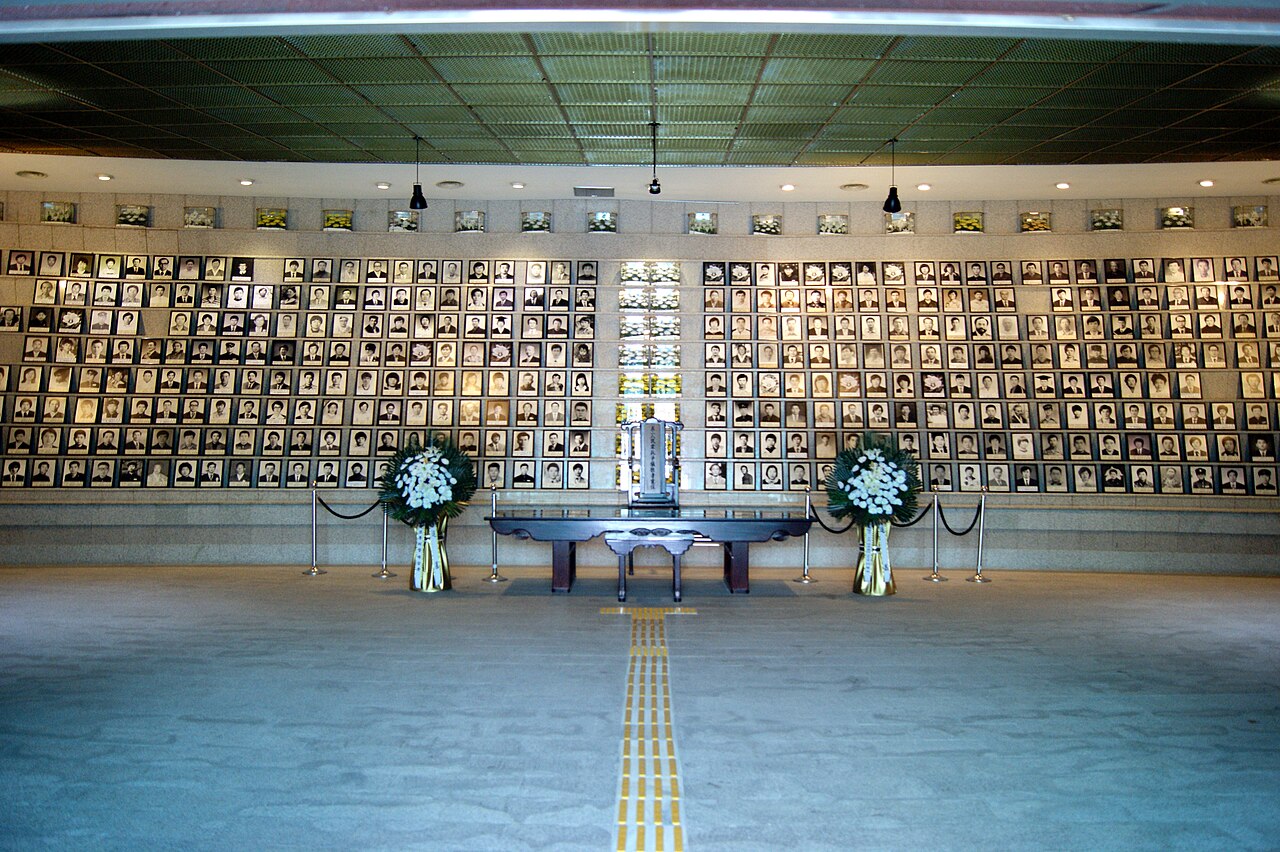
Cover Photo: Memorial Hall in the May 18th National Cemetery where Gwangju Uprising victims’ bodies were buried. (Schlarpi, CC BY-SA 3.0)