

Igniting the Flame of Democracy: The April 19 Revolution in Gwangju – April 2025
By Park Yeonju
In 1960, Gwangju shouted for democracy. High school students and citizens alike gathered to demand their rightful rights as citizens of Korea. The manipulation of the democratic flower, the “election,” was a strategy to pave the way for permanent rule. Blinded by power, the man who led Korea into the swamp of dictatorship was Syngman Rhee. The people of Korea were enraged, and Gwangju was also part of the united voice to defend democracy.
Syngman Rhee (Lee Seungman) was the first president of South Korea, serving from 1948 to 1960. He was also the president of the provisional government in Hawaii during the colonial period and later elected as the speaker of the Constituent Assembly. After the establishment of the Republic of Korea in 1948, he was elected in the first presidential election, which was held through an indirect election by the National Assembly. The second presidential election then transitioned to a direct election system, where the people voted. He continued his political career by defeating independent candidate Cho Bong-am until 1956, demonstrating his influence in politics for 12 years.
Was the 12-year-long rule something all Korean citizens agreed upon? It was the result of Syngman Rhee arbitrarily shaping Korean politics to suit his own interests, without upholding the values of democracy. After the outbreak of the Korean War in 1950, he implemented a strong anti- communist policy to restore order and stabilize public sentiment in the chaotic situation.
However, the “political stability” that the people truly desired was nowhere to be found, and only disorder and confusion persisted. The foundation of democracy was shaken and not allowed to properly took root. A president’s role is to gather public opinion and prevent the nation from falling into division and chaos. They must instill trust in the people and provide them with a sense of stability in their lives. However, despite failing to fulfill this duty, Syngman Rhee was unwilling to relinquish the presidency.
And from that moment, his “subtle maneuvers” for re-election began. In May 1950, a large number of Rhee’s supporters lost in the 2nd National Assembly election. Realizing that the parliamentary electoral system gave him little chance of re-election, he began advocating for a direct presidential election system and a bicameral legislature in preparation for the upcoming presidential election two years later.
But, when things did not go as he had hoped, he declared martial law in Busan, the provisional capital, from May to July 1952. He used this as a means to pressure the National Assembly and opposition forces. As a result, the Busan Political Crisis unfolded. During this period, opposition members of the national assembly were ruthlessly arrested, and attempts were made to dissolve the legislature.
Eventually, on July 4, 1952, the first constitutional amendment since the establishment of the Republic of Korea was enacted. The Extractive Amendment, which included the provision for a direct presidential election system, was passed. Ultimately, he was re-elected for a second term as president. In the process, he gathered his supporters to establish the Liberal Party and laid the foundation for long-term rule by shifting to a presidential system.
However, this constitutional amendment was unconstitutional. The quorum required for approval was 135.33 votes, which should be rounded up to 136. But Liberal Party officials argued that decimal numbers could not be considered as full individuals and, therefore, could not be counted as a person. Based on this reasoning, they applied the “rounding-off” rule, which brought the required number of votes down to 135. Since 135 votes were in favor, it was claimed that the amendment had passed.
The problem was that Rhee did not stop there. His corruption and greed grew worse. By March 1960, election fraud in South Korea had reached its peak. Countless government officials were mobilized to secure Rhee’s victory. The Ministry of Home Affairs and the police effectively became the election headquarters, manipulating the voting process. In 1960, Cho Byeong-ok, the Democratic Party’s presidential candidate, passed away. As he was a strong rival to Syngman Rhee, his death made Rhee’s re-election almost certain.
At this point, the question of who would be elected as vice president became crucial. The competition between Chang Myon and Lee Ki-poong, the candidate backed by Rhee, was the main focus. The police openly supported the Liberal Party candidate, while citizens were forced to cast their votes under strict surveillance in a tense and violent atmosphere. In the end, the election results were completely fabricated, and Lee Ki-poong was declared the vice president with 8.4 million votes.
The opposition Democratic Party naturally declared the election illegal and invalid. Anti- government protests erupted across the country. In early April, a strong movement against election fraud began to take shape. Around that time, the body of Kim Ju-yeol, a student who had apparently been struck in the eye by a tear gas canister, was discovered in the waters off Masan. It was clear that he had been subjected to police violence while participating in protests condemning the fraudulent election. Many people were outraged. The anger of students and citizens grew even stronger. This drove them into the streets in protest.
In Gwangju, the spirit of democracy burned fiercely in opposition to the fraudulent election. However, most people are unaware that Gwangju was the birthplace of the April 19 Revolution. Many tend to summarize the events by stating that Kim Ju-yeol’s body was discovered in Masan, which then led to mass protests. However, Gwangju holds the record of the first violent protest even before the Masan incident. It is crucial to recognize that Gwangju’s spirit for democratization ignited rapidly during the April 19 Revolution.
On March 15, 1960, at a polling station in Gwangju, a citizen discovered fraudulent ballots and protested to the election commission. In response, political thugs unleashed brutal violence on this citizen. This incident sparked a protest, with around 1,000 citizens gathering on Geumnam Street, the city’s main artery, to denounce the rigged election. Mourning the “death of democracy,” protesters wore funeral attire as they marched. Members of the Democratic Party and around 1,200 additional citizens joined in, expanding the demonstration. However, the police suppressed the protest with brutal force, leaving many injured. This event in Gwangju marks the first violent protest of the April 19 Revolution. The March 15 Protest in Gwangju was the first spark igniting the April 19 Revolution.
Later, the body of Kim Ju-yeol was discovered, serving as a catalyst that fueled nationwide protests even further. This shows how the movement continued to spread across the country. The March 15 Protest in Gwangju was not driven by a single goal. It was not only a protest against election fraud and a call to prevent Syngman Rhee’s rule for life, but it also carried the vision of stopping the deepening division between North and South Korea. Ultimately, it aimed to achieve both democracy and national reunification.
On April 18, 1960, the people’s anger erupted. In response, Rhee declared martial law and ordered indiscriminate gunfire and violence against the protesters. Countless casualties followed, leaving the nation with an unhealable wound. Then came April 19. Students from Gwangju High School burst through their school gates and ran into the streets to join the commencing protests. Determined to keep the flame of democracy alive, they stood together to protect it. Inspired by their courage, students from other schools also found their strength and, one by one, began breaking through their own school gates to join the movement.
On April 24, Syngman Rhee resigned from his position as the leader of the Liberal Party, but the people’s anger did not subside easily. On April 25, university professors issued a statement and took to the streets alongside the students. Encouraged by their actions, even more citizens joined the protests, and their numbers grew exponentially. The desire to protect South Korea’s liberal democracy united the people as one. Many were injured or lost their lives in the protests, but the number of protesters on the streets never diminished.
Finally, on April 26, President Rhee announced his resignation. Twelve years of dictatorship had come to an end. The April 19 Revolution became a victory for the Korean people in the name of liberal democracy. Though the April 19 Revolution was a nationwide movement, its starting point was in Gwangju. More than anywhere else, it was from Gwangju High School that the courage and voices of students resounded most powerfully.
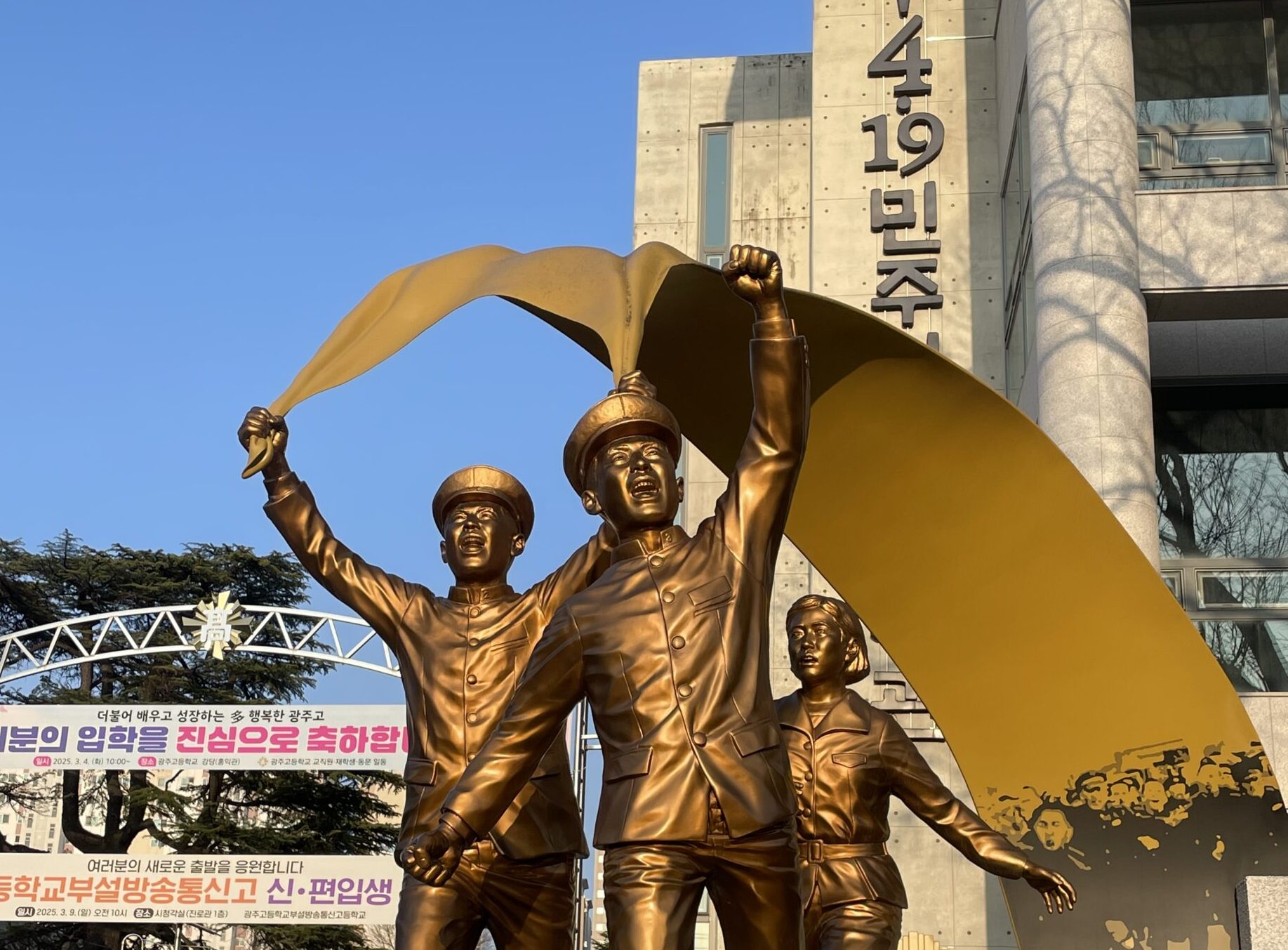
Whenever I pass by Gwangju High School, I always notice the monument inscribed with “The Birthplace of the April 19 Revolution in Gwangju.” However, after learning more about the background, including the Gwangju March 15 Protest, looking at this monument fills me with an even deeper sense of reverence. Moreover, they were students who had not yet fully stepped into society – pure and full of dreams, hoping for a world of opportunity. Despite living in a time of political turmoil and corruption, they made a firm decision to protect democracy. Their determination and willpower remain truly inspiring.
Decades have passed since the students rose up. Yet, as I walked through the school grounds where their successors now study, I could still feel the deep spirit embedded in the atmosphere. In front of the Gwangju High School gate, the story of the April 19 Revolution in Gwangju is illustrated in a way that makes it easy to understand. Gwangju High School is the very cradle of the Gwangju spirit. Many historical records remain there, offering a glimpse into the events of April 1960.
Upon entering the school gate, one is immediately met with a statue of students, seemingly raising their voices in passionate protest. Standing before it, one can almost vividly recall the noble spirit of that day. This monument was erected not only to honor that moment but also to ensure the eternal preservation and development of the April 19 Revolution spirit – both today and for generations to come.
In 2023, the April 19 Revolution was inscribed in the UNESCO Memory of the World Register, and the Gwangju High School April 19 Revolution History Hall was opened on the school campus to all citizens. It vividly conveys the spirit and records of that historic day. As the sun set over the Gwangju High School campus, a strong light appeared beyond the statue. The way it mysteriously met with the statue reminded me of the burning spirit of democracy on April 19, 1960. Thanks to the democracy forged by the students of Gwangju High School in history, the sun of tomorrow will rise once again. The democratic spirit of Gwangju continues to shine brightly.
Photograph by Park Yeonju.
The Author
Park Yeonju is an undergraduate at Chonnam National University, majoring in political science and diplomacy as well as Chinese language and literature. Her third major is international development cooperation studies. She was born and raised in Gwangju and wants to promote the colorfulness of the city that she has been a part of for so long. Also, she wants to deliver various voices of the world. It is her dream to become a true journalist by inheriting the spirit of May 18.