
Memory, Voices, and Visibility: A Conversation with Kim Gyoungrae
By Luis Andrés González
I arrived at Room 212 on the afternoon of May 16, not simply as an audience member at the World Human Rights Cities Forum but as someone deeply invested in the power of memory, community, and inclusive justice. As a foreign student of cultural anthropology at Chonnam National University, I often find myself navigating between languages, institutions, and social layers that intersect in fascinating – and sometimes complicated – ways. My interest in human rights, particularly as someone who identifies as queer and Latin American, brought me to the session titled “The May 18 Gwangju Democratic Uprising and Women 2025.”
The room was full. Older women, student volunteers, international guests, and local activists gathered to share and witness. The energy was solemn but vivid. The stories were honest – sometimes painful – but offered through voices determined to be heard.
I was especially drawn to this event because I believe the legacy of women in democratic movements deserves more than symbolic recognition; it deserves active, intergenerational dialogue. The session reminded me that the history of May 18 is not only about past resistance but also about how we shape the future through inclusion.
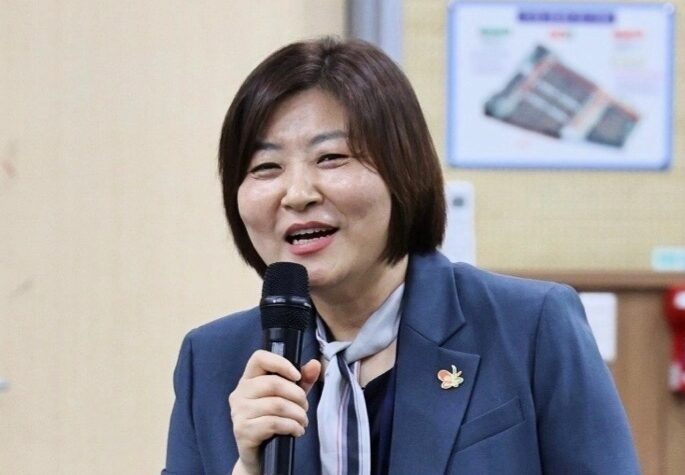
It was in this context that I had the privilege to approach Kim Gyoungrae (김경례), chief executive officer of the Gwangju Foundation for Women and Family (광주여성가족재단), and the moderator of the Forum. In the following interview that I conducted with her, Kim reflects on the relevance of this year’s gathering, the work of the Foundation, and the challenges – and hopes – of making Gwangju a truly inclusive city for all.
Luis: This year’s Forum brought together powerful voices to revisit the role of women in the Gwangju Uprising. Why was it important to host this Forum in 2025?
Kim Gyoungrae: The year 2025 marks the 45th anniversary of the 1980 Gwangju Democratic Uprising. In commemoration, the Gwangju Foundation for Women and Family has been preparing a publication titled “2025: Women and the Gwangju Uprising” since last year. Although 45 years have passed and various materials, such as investigation reports, testimonies, and oral histories, have accumulated, there has been no comprehensive publication focusing on women’s experiences and contributions at that time.
Luis: As the head of the Women’s Foundation, how do you see the importance of documenting women’s contributions to democratic movements, especially when they have been historically overlooked?
Kim Gyoungrae: Historical records are influenced by power structures. In history written from the perspective of the privileged – centering on vested interests, the center, and men – the stories of marginalized groups, including women and regions, have often been excluded. Recording history from the ground up, such as women’s history and local history, is essential for establishing a balanced historical perspective and completing the full picture of the past. Specifically, documenting women’s activities in the democratization movement recognizes them as historical agents and helps future generations inherit a just view of history.
Luis: Gwangju is known as a city of democracy and human rights. In your view, what is the role of the Gwangju Foundation for Women and Family in continuing that legacy today?
Kim Gyoungrae: The Gwangju Foundation for Women and Family is a municipal organization with the mission of achieving gender equality. Gender equality is both a necessary and sufficient condition for the realization of human rights and democracy.
“We must build a social system that promotes coexistence, mutual prosperity, and inclusion, while reducing structural discrimination and social polarization.”
Luis: What are the challenges that you face while promoting the human rights of women and the underprivileged?
Kim Gyoungrae: Around the world, we are witnessing a rise in far-right and conservative movements. In societies dominated by excessive competition, individualism, materialism, and the law of the jungle, there is no room for women or the socially vulnerable. We must build a social system that promotes coexistence, mutual prosperity, and inclusion, while reducing structural discrimination and social polarization.
Luis: As we enter June, a month of reflection and visibility for LGBTQ+ communities worldwide, how does the Foundation engage with gender and sexual diversity in Gwangju?
Kim Gyoungrae: In pursuit of gender equality, the Foundation conducts research on women’s and family policies, gender impact assessments, gender mainstreaming initiatives, gender equality and gender-based violence prevention education, governance network-building, local women’s history research and public awareness campaigns, operation of the Gwangju Ai Kium (광주아이키움) platform for prenatal, childbirth, and parenting support, and various caregiving support programs. Personally, I support the rights of sexual minorities and the protection of sexual diversity. However, the Foundation’s work primarily focuses on achieving gender equality through research and practical programs.
“Gender equality is both a necessary and sufficient condition for the realization of human rights and democracy.”
Luis: What are the Foundation’s upcoming priorities or projects, especially in light of the new administration after the presidential election?
Kim Gyoungrae: President Lee Jae-myung has pledged to restructure the currently marginalized Ministry of Gender Equality and Family into a stronger ministry, reversing the regressions seen under Former President Yoon Suk Yeol. Consequently, we expect strengthened gender equality policies at the local level. Our Foundation, as an intermediary support body for gender equality at the municipal level, must expand both its size and functions. Most urgently, as gender division fueled by political discourse deepens misogyny among youth, we must broaden policies and programs that improve gender sensitivity and foster mutual respect and a culture of community.
Luis: As a young foreigner living in Gwangju and committed to social justice, I’d love to hear your message to people like me. How can youth and foreigners contribute to Gwangju’s democratic spirit?
Kim Gyoungrae: Human rights, equality, and justice are universal values of our time. The effort to realize these values requires no distinction of nationality or race. There are only global democratic citizens. I firmly believe that global democratic citizens can resist injustice and inequality, and form solidarities across national, racial, ethnic, and gender boundaries.
Luis: To conclude, I want to thank you, Director Kim, for your time, your leadership, and your kindness throughout this interview. I believe readers will not only better understand what the Gwangju Foundation for Women and Family does, but also feel the spirit and care with which you lead it. We’ll certainly be following the Foundation’s next steps, and I look forward to seeing your work continue to inspire Gwangju and beyond.
The Author
Luis Andrés González is a Mexican Global Korea Scholarship scholar and master’s student in cultural anthropology at Chonnam National University. He advocates for LGBTQ+ rights and gender equality, and explores global affairs through pop culture. He is the founder of Erreizando, a digital magazine.
Instagram: @luisin97 / @ erreizando
Cover photo courtesy of Kim Gyoungrae and Luis
Andrés González.