

Religion and Resistance: May 18 and the Priests
By Dr. Don Baker
This past September, the May 18 Foundation organized a conference to which Dr. Donald Baker was invited to speak. Dr. Baker is a Korean studies scholar, and the May 18 Gwangju Uprising is one of his research areas of interest. The article that follows borrows in part from the talk that Dr. Baker gave at the May 18 Foundation’s event. — Editor
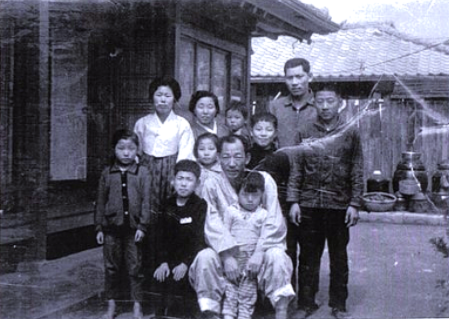
Fifty-four years ago, in 1971, I arrived in Gwangju, the first city I lived in in Korea. The United States Peace Corps had dispatched me to Gwangju to teach English. The city I found myself in back then was very different from the Gwangju we see today. There was no subway. I took a crowded city bus to my classes at Dongshin Middle School. There was not much in the way of Western food. If I got tired of Korean food (though I learned quickly that the food in Gwangju is delicious!), the main options were jajangmyeon, sashimi, and “hamburg steak.” And there were no high-rise apartment buildings. I lived in a small room in a Korean-style boarding house. There was no bathtub or shower in that house. Instead, every morning I walked down the street to a public bath house to bathe and shave.
Not only does Gwangju look very different now than it did half a century ago, it also has a different image. Back then it was a sleepy provincial capital. Peace Corps staff members in Seoul apologized for sending me to the undeveloped countryside, which is how people in Seoul thought of Gwangju back then. Today, Gwangju is a modern city respected for the role it played in accelerating Korea’s progress from dictatorship to democracy.
As I am sure you all know, Gwangju’s image changed because of the May 1980 Gwangju Democratization Movement. Gwangju was the only city in Korea that had demonstrations protesting Chun Doo-hwan’s seizure of political power on May 17, 1980. It paid a heavy price for those demonstrations but, once the rest of the country learned of the atrocities inflicted on Gwangju between May 18 and May 27 (it took a few years for the news to spread because of strict censorship), people began to rise up and demand an end to military rule. In 1987, Chun was forced to step away from the Blue House and allow freely contested elections for the presidency. The courage people in Gwangju displayed in 1980 inspired people in Seoul and other cities in 1987 to demand an end to the dictatorship under which they had lived for far too long.
In May 1980, I was in Seoul, engaged in research for my doctoral dissertation on Joseon Dynasty history. However, when I learned via short-wave radio (we did not have the internet then, and local media was censored) what was happening in Gwangju, I hurried down south, sneaking around the military cordon to get into the city. I wanted to see if my friends here were still alive. They were, but when I saw what had happened to other people in Gwangju, I was shocked. My memories of what I saw then have haunted me for the rest of my life.
“Today, Gwangju is a modern city respected for the role it played in accelerating Korea’s progress from dictatorship to democracy.”
As someone who studies Korean history, I am supposed to adopt an objective, non-emotional tone when I write about events of the past. It has been difficult for me to keep my emotions in check when I talk or write about May 18. I remember the ajumma who grabbed my arm when I was leaving Gwangju late that May and begged me to tell the world what had happened to them. However, until recently, it has been difficult for me to do so while maintaining the professorial objectivity my academic position required me to have.
Finally, after almost half a century, I am now able to keep my emotions under control and look back on that important historical event and try to figure out exactly what happened and why it happened the way it did.
It is the job of historians to find answers to questions about the past. There are still many unanswered questions about May 18. For example, we still don’t know who gave the order for the special forces troops to shoot into unarmed crowds. However, the question that I have been focused on recently concerns what I first (mistakenly) thought was religious bias in who was arrested. When I discovered that the only clerics arrested in Gwangju in the immediate aftermath of May 18 were Catholic priests, I was puzzled.
In 1980, there were only about 22,000 people in Gwangju who were baptized Roman Catholics, less than three percent of the population then. Moreover, there were only 14 parish churches for them to attend, and only nine of the priests at those churches were Korean. There were many more Protestant churches in the city. There were also a few Buddhist temples in the city and many more in the surrounding area. But no Gwangju pastors or Gwangju monks were arrested in late May or early June of 1980. How can we explain why only Catholic priests were arrested?
When I dug into the records, I discovered that there were several activist Protestant pastors in Gwangju in 1980. However, they had been harassed by Park Chung Hee’s dictatorial regime and therefore went into hiding on May 17 so that they wouldn’t be arrested again. As for monks, the major temples were outside the city, so most of the monks were not in Gwangju when Chun’s special forces began attacking the city on May 18. That left Catholic priests as the only religious leaders who could help the people of Gwangju cope with the disaster that was unfolding around them.
Their first attempt to step up came on May 21. Thousands of Gwangju citizens had gathered around the rotary in front of what was then the Provincial Office building and was then serving as the headquarters of Chun’s troops. That crowd began calling peacefully but loudly for the troops to leave the city. Fearing the violence might break out, eight of Gwangju’s priests began discussing putting on clerical garb and going downtown to stand between the soldiers and the people in an effort to prevent further violence. Before they could do that, however, at 1 p.m., soldiers started firing into that crowd. Dozens were killed.
That massacre so angered the young men of Gwangju that they broke into reserve army arsenals, grabbed rifles, formed a citizens’ militia, and started shooting at those soldiers. That was the first time people in Gwangju had returned fire, though at that point they had been beaten, stabbed, and shot at for three days. Soon Chun’s soldiers retreated from the center of the city and Gwangju was free. However, it was clear the soldiers would return before too long, which could lead to even worse bloodshed.
Concerned about what the future might hold, leading citizens formed what they called a settlement committee to mediate between the angry citizens of Gwangju and Chun’s armed forces. They asked Archbishop Youn Kong-hi to serve on that committee. Bishop Youn said he was too busy and suggested instead that Fr. Jo Pio (Cheolhyeon) act as the Catholic representative on that committee.
When the first settlement committee angered Gwangju citizens by calling for the people to surrender unconditionally, a group of more progressive prominent Gwangju citizens met at Namdong Catholic Church to see if they could come up with a better solution. A prominent member of this group, popularly known as the Namdong Church group, was Fr. Kim Seongyong, the pastor of Namdong Catholic Church.
Fr. Kim was worried not only about the upcoming return of Chun’s forces to the streets of Gwangju but also about the danger posed by thousands of weapons in the hands of young men inside Gwangju. That led him to lead a drive to collect weapons from the citizens’ militia. His plan was to have the local police watch over those weapons while he used them as a negotiating tool with the military. He and the other members of that second settlement committee hoped to get the military to promise to release the innocent people they had arrested, to apologize for the innocent people they had killed, and to guarantee that there would be no reprisals when they re-entered the city, in return for those weapons being turned over. Between May 22 and May 26, they were able to retrieve 4,500 of the 5,000 guns that had been in the hands of angry Gwangju citizens and keep them under guard in the now-liberated Provincial Office building.
“When I discovered that the only clerics arrested in Gwangju in the immediate aftermath of May 18 were Catholic priests, I was puzzled.”
On May 26, fearing that the standoff between the Gwangju people and Chun Doo-hwan’s troops was going to end soon with a full-scale attack, Fr. Kim and some other members of the more progressive settlement committee led what they called a death-defying march. Unarmed, they marched to the outskirts of the city, confronted the tanks and the soldiers they met there, and tried to convince them to refrain from trying to violently regain control over Gwangju. The army responded that they had until midnight to turn over all the weapons in the city or the army would attack.
Knowing his mission had failed, Fr. Kim escaped to Seoul, where he composed a report on what was happening in Gwangju. That report, called “More Out of Sorrow Than Anger,” was soon smuggled out of Korea to be translated and reprinted by Catholic organizations in Japan and beyond. It became one of the first eyewitness accounts of the tragedy to reach people beyond the Korean peninsula.
While Fr. Kim was still in Seoul, the army launched its attack on Gwangju early in the morning of May 27 and soon the entire city had fallen under Chun’s control. Soon after that eight of Gwangju’s nine Koreans priests were arrested. Most of them were released after only a month in jail. However, Fr. Jo was given a sentence of three years, though he was released after only five and a half months. Fr. Kim was given a sentence of 15 years, of which he served only 14 months. It didn’t stop there. On June 25, government agents attacked Fr. Bak Changsin in Jeonbuk Province and left him with serious wounds requiring hospitalization because he had spoken in a sermon about what happened in Gwangju. Then, in July, five priests and a nun were arrested in Seoul for sending information about Gwangju out of the country. That nun, Jeong Marianna, underwent such intense interrogation that she was left paralyzed for the rest of her life.
The Chun regime clearly feared the ability of Catholic priests and nuns to utilize the Catholic international network to let people outside Gwangju, and even outside Korea, know of the atrocities he had committed here. That is why those Catholic priests in Gwangju were arrested. Of course, Catholics were not the only ones fighting against injustice and for truth. We can’t ignore the contributions of Protestants, Buddhists, and the non-religious to the democratization of the southern part of the Korean peninsula. However, we should not forget the important role played by the Catholic community in letting outsiders know what happened in this city 45 years ago, thereby accelerating Korea’s progress toward democratization.
The Author
Don Baker, taught English in Gwangju as a U.S. Peace Corps volunteer from 1971 to 1974. He later earned a PhD in Korean history from the University of Washington and has been teaching Korean history and culture at the University of British Columbia since 1987.
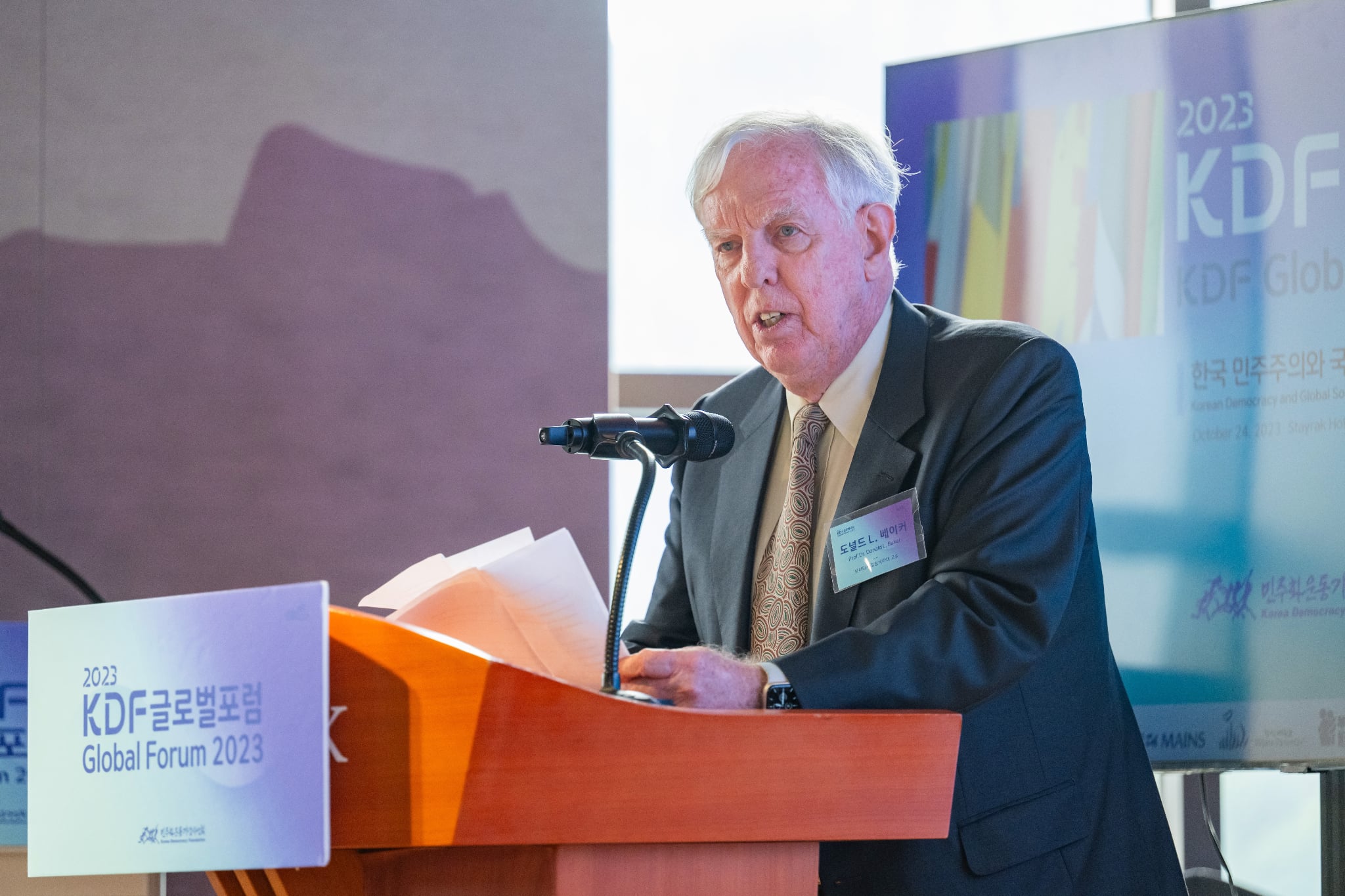
Cover Photo: Dr. Baker speaking at the Korea Democracy Foundation Global Forum in Seoul in 2023.