

Damyang Coffee Farm: Rural Revitalization Efforts and Businesses
By Yousra Feriel Drioua
In a greenhouse tucked among the groves of Damyang County, the scent of freshly roasted coffee mingles with the sound of joyful laughter. Visitors lean over trays of glossy coffee cherries, learning how to sort, roast, and brew under the guidance of Lim Young-ju, a former photojournalist turned coffee farmer.
Lim’s interest in coffee began during a 2014 assignment in Kenya and Ethiopia. In an interview with Hankyoreh21, he recalled, “The fresh coffee aroma I encountered at the source went beyond being moving, it was addictive.” In 2017, Lim returned to his hometown of Damyang County, Jeollanam-do, and established the Damyang Coffee Farm. The farm spans about 400 pyeong (approximately 1,320 m²) and houses between 1,200 and 2,000 Arabica coffee plants cultivated in greenhouses to counter Korea’s cold winters. The coffee that the farm produces is known as Gold Castle (골드캐슬), named after the literal translation of Geumseong-myeon, his township.
He has earned certifications as a fragrance specialist and Italian barista, applying his expertise to an immersive visitor experience. Guests can observe coffee flowers and cherries, sample coffee flower tea, pick cherries, roast beans, brew hand- drip coffee, and compare Gold Castle coffee with imported varieties. Lim emphasizes freshness as a key differentiator, noting that Korean-grown coffee reaches consumers far more quickly than imported beans. In 2020, he was named a New Knowledge Farmer in the agriculture sector for his role in integrating agriculture, tourism, and education through coffee farming and experiential programs.
One of the rural revitalization initiatives connected to such projects is the Ttobagi Farm Family (또바기팜족) program, run by the Ministry of Agriculture, Food, and Rural Affairs (MAFRA) and the Korea Rural Community Corporation. The name combines ttobagi (“always” in a local dialect) with “farm” and “family,” meaning “a family always with the countryside.” Now in its ninth year, the 2025 program includes participants from various countries. MAFRA describes it as a promotional activity to introduce the traditions, culture, food, and lifestyle of Korean rural areas to a global audience. Participants visit rural villages throughout the year and create content for social media platforms.
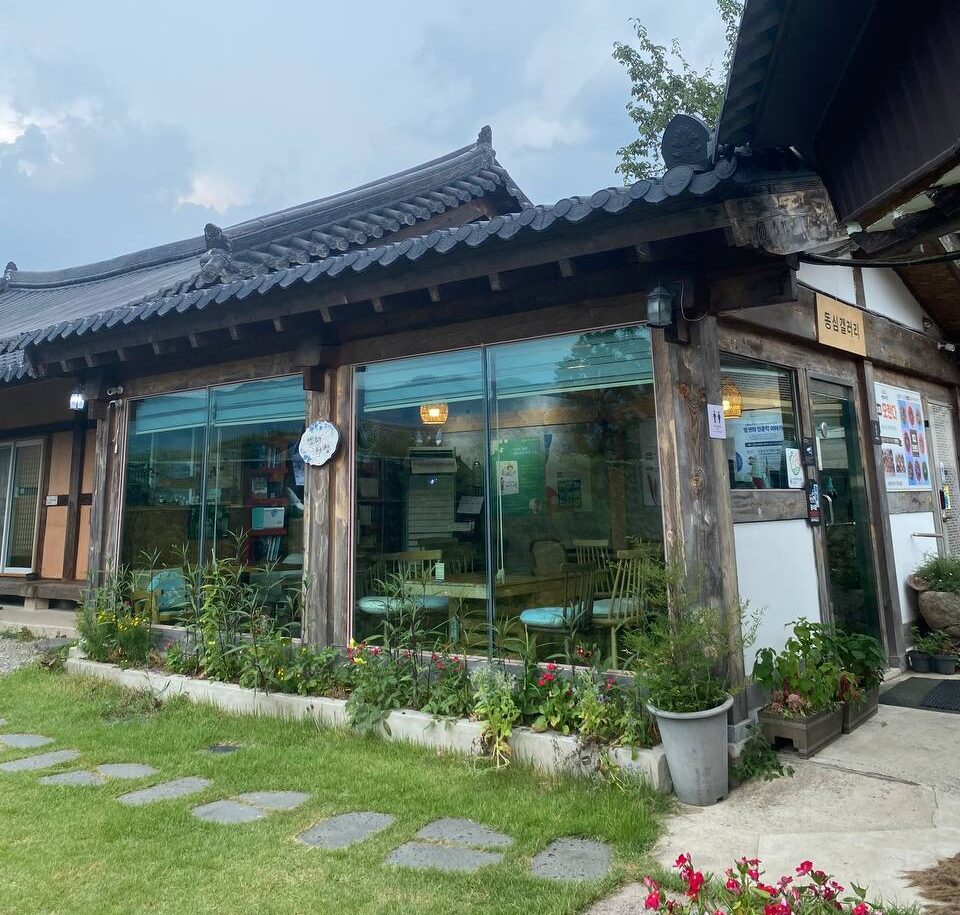
During one visit to Moonlight Muwol Village in Damyang County, most houses appeared either vacant or converted into guest accommodations. No public transport was visible, and the only residents encountered were those running experience programs. The itinerary included a stop at Lim’s farm and a visit to Maehwa Namu Jip (카페매화나무집, the plum-tree house), a restored hanok café in Changpyeong-myeon. There, the owner produces hangwa (한과; traditional Korean confections) in a donut form with varied flavors, all made onsite. Situated along the stone- wall alleys of Samcheon-ri, the building doubles as a café and guesthouse, retaining its traditional layout and courtyard garden to offer visitors an extended stay option.
The menu draws on local flavors, such as dried persimmon tea, ssanghwa-cha (a traditional medicinal tea), misut-garu (a roasted grain drink), and small-batch snacks like oranda, alongside coffee. Most ingredients are sourced from within Jeollanam-do, reflecting the owner’s goal of preserving regional tastes for the next generation.
For residents, cafés like Maehwa Namu Jip serve as informal gathering places in towns where shops and social venues have steadily disappeared. For visitors, they provide an authentic encounter with rural heritage, not as a staged display but as part of everyday life. Its dual role as a business and residence reflects a broader adaptation strategy in depopulating areas: diversifying income sources while maintaining the character of traditional architecture.
Such adaptations have become increasingly relevant as South Korea’s rural population continues to shrink. Government statistics show the share of people living in rural areas fell from over 70 percent in the 1960s to less than 20 percent today. In October 2021, the Ministry of the Interior and Safety (MOIS) designated 89 cities, counties, and districts as “depopulation areas” based on eight indicators, including population change, youth net migration, and aging rates. An additional 18 districts were labeled “areas of concern.” However, independent analyses, including those by the Korea Institute for Health and Social Affairs, note that there is no established evidence linking short-term tourism programs to long-term demographic stabilization. Government evaluations tend to measure implementation and budget execution rates rather than sustained changes in resident population or local economic output.
In Damyang, the coexistence of empty homes, small-scale craft businesses, and specialized farms like Damyang Coffee Farm reflects both the challenges and the variety of local responses in areas facing population decline. The future of such initiatives and their ability to deliver measurable impact remains an open question.
Damyang Coffee Farm (담양커피농장)
Address: 87 Seokhyeon-gil, Geumseong- myeon, Damyang-gun, Jeollanam-do
Phone: 010-5214-2408
Café Maehwa Namu Jip (카페매화나무집)
Address: 86 Doldam-gil, Changpyeong- myeon, Damyang-gun, Jeollanam-do
The Author
Yousra Feriel Drioua is a freelance journalist and media enthusiast from Algeria, currently based in South Korea. A former Global Korea Scholarship scholar, she holds an MA in media and communication and writes on issues at the intersection of gender, media framing, sociopolitics, and civic society. In her free time, she enjoys being a barista. Instagram: myyilgi
Cover Photograph by Yousra Feriel Drioua.