





Kimchi: Food, Art Form, Spirit of a Nation
By Murdock O’ Mooney ||
Few words evoke images of Korea more strongly than the word kimchi. For those unfamiliar, kimchi is a fermented vegetable (usually radishes, cabbage, or cucumbers) that is similar to sauerkraut, but spicier and infinitely more varied and interesting on the palate. Kimchi is the national dish of Korea and has been instrumental in helping establish K-food as a serious player on the global food scene. Nutritionally, kimchi is a superfood and a probiotic powerhouse, containing roughly 10 billion colony-forming units (CFU) of lactic acid bacteria per gram, which is higher than most yogurts.
Kimchi itself is simple: It’s a vegetable, soaked in salt water, spiced, and aged to perfection. Of course, there is almost infinite variation within that simple formula. Some kimchi is young, while others are old; some contain oysters, shrimp, or mackerel, while others are vegetarian. Baek kimchi (“white kimchi”) and mul kimchi (“water kimchi”) are mild and refreshing and made without red chili powder. Conversely, Gyeongsan kimchi is some of the oldest and spiciest available, with a few contemporary chefs incorporating ghost peppers into the formula (aka “bhut jolokia”) for an extra dose of spice. It’s safe to say that whatever your gastronomical fancy, there’s a kimchi for you.
While kimchi might be simple, the cultural phenomena surrounding the dish is anything but. Park Shin-ja, a competitor at the 2019 Gwangju World Kimchi Championships, told Aririang News that “kimchi contains the spirit of our nation,” and “It’s not only our culture, but a form of art.” Park was competing for the coveted title of “kimchi master,” a very significant accolade that includes the President’s Award and three million won in prize money.
The kimchi masters are the official keepers of the sacred dish, often sign lucrative food manufacturing deals and operate successful restaurants. Kimchi is so loved by Koreans that in 2008, Korea’s first astronaut, Yi So-yeon, took a special “space-friendly” kimchi to the International Space Station. That’s dedication!
There are also over 200 types of kimchi common on dinner tables around the world, with Korea’s kimchi economy being valued between USD 5–7 billion per year. And while these statistics are impressive, possibly the most endearing aspect of kimchi is how universal it is in Korea, and in a country often embroiled in disputes over social inequity and classism, kimchi remains the great equalizer, as everyone from paupers to kings is a fan of the dish. In fact, according to a 2023 Chosun Daily article, 90 percent of South Koreans own a kimchi refrigerator and although declining, 22–43 percent still make their kimchi at home, the old-school way.
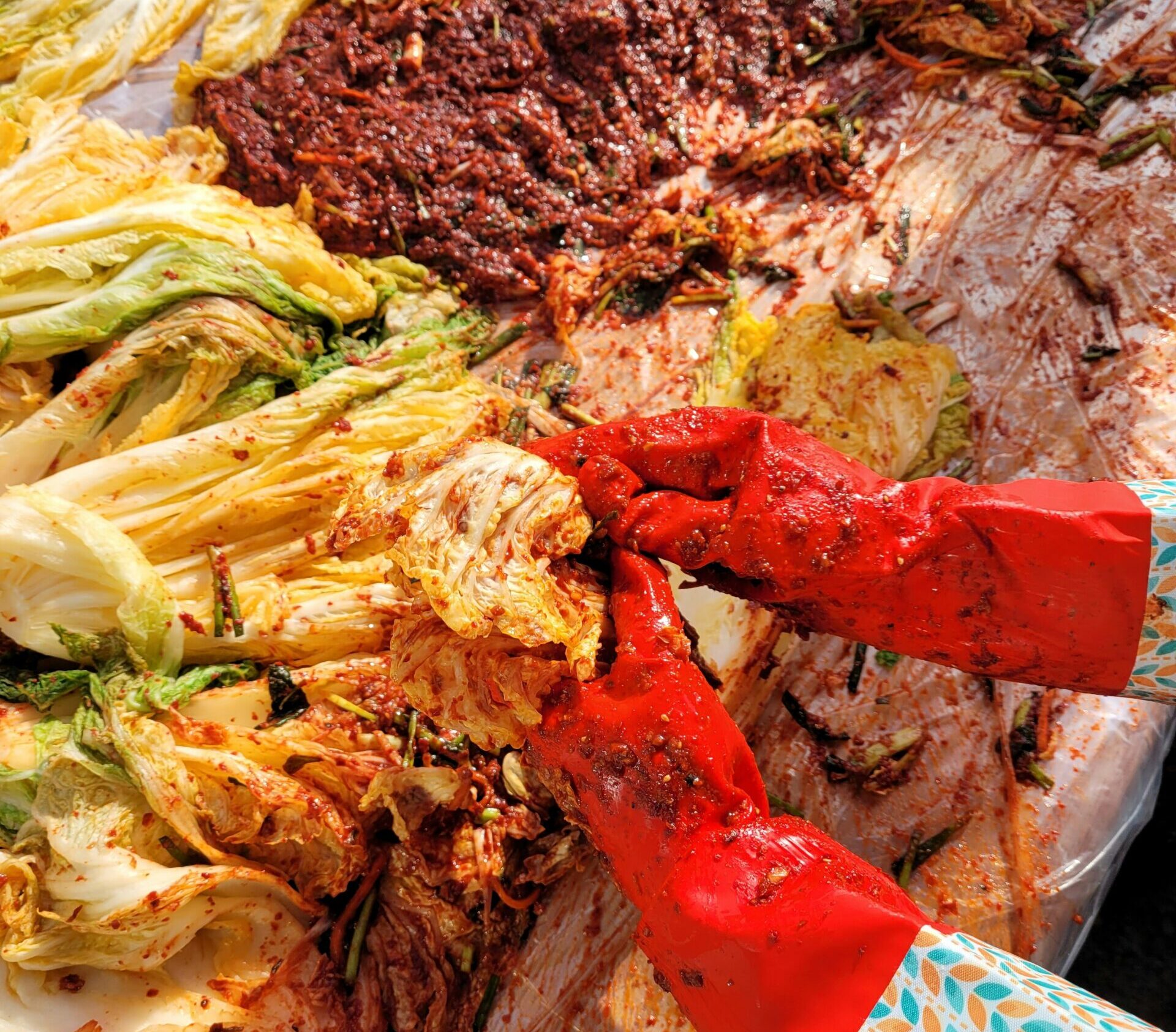
My wife’s family still makes their kimchi at home, usually sometime after Chuseok and before the Lunar New Year. In the old days, cabbage was soaked in the bathtub, but now it’s done in large plastic containers. The multi-day process usually involves the women of a family sitting together on tarps, wearing dish gloves, and adding red chili paste to cabbage leaves. The precious vegetables will then be stored in a kimchi refrigerator, or underground in an earthen pot, until ready. The women might complain about the task, but from an outsider’s perspective it seems like a precious time to rekindle bonds and catch up with family.
The earliest mention of kimchi in Korea was during the Three Kingdoms Period, circa 57 BCE. At that time, the dish was described as vegetables soaked in salt brine to survive the winter. This was known as chimchae (“sunken vegetables”). The kimchi we are familiar with today incorporates chili powder, or gochugaru, which originated from Portuguese traders and was introduced to Korea via the Japanese during the 1592 Imjin War.
As beloved as it is, even kimchi isn’t without controversy. In a 2005 academic article, researchers at Seoul National University claimed that kimchi could possibly cure bird flu, and a more recent 2014 article suggested it might help protect against Ebola. While the health benefits of kimchi are undeniable, there is no evidence it can prevent or cure serious diseases.
More recently a 2020 article in The Guardian highlighted the social media feud between South Korea and China over the origins of kimchi, with China claiming pao cai (a pickled vegetable dish common in Sichuan cuisine) as the original kimchi. A Korean netizen accused China of “trying to take over the world” and called the Chinese claim “absurd,” while a Chinese netizen said, “Even the pronunciation of ‘kimchi’ originated from Chinese, what else is there to say?” It’s worth noting that the majority of the international community recognizes kimchi as being of Korean origin. Some other lesser-known but entertaining facts about kimchi is the use of it in place of “cheese!” when taking photos in Korea. Gwangju is also home to the World Kimchi Institute, and you can also visit Gwangju Kimchi Town in Nam-gu if you are so inclined.
There’s a lot to say about kimchi. Overall, it’s healthy, fresh, and versatile, which I love. I also like the fact that it keeps well (sometimes for years!); is highly varied and customizable; and can be grilled, fried, dried, boiled, baked, or eaten raw. One of my favorite kimchi dishes is kimchi tuna fried rice, or kimchi chamchi bokkeumbap. When the kimchi is crunchy and a little burnt, it takes on a savory taste and helps cut through the saltiness of the tuna. Add gochu-jang (and maybe some Tabasco for a Western twist) and you’ve got one delicious kimchi dish. However, as the popular Korean saying goes, “If you have only kimchi and rice, you have a meal.”
Sources
- Arirang News. (2018, October 25). “Kimchi connects us all.”.. 2018 Gwangju World Kimchi Festival presents the traditional dish. YouTube. https://www.youtube. com/watch?v=rGwu9rgfoEk
- Cain, G. (2016, July 30). Can kimchi cure Ebola?
- Agence France-Presse. https://www.theworld.org/ stories/2016/07/30/can-kimchi-cure-ebola
- Hwang, J. (2023, March 31). Koreans no longer make kimchi at home. The Chosun Daily. https://
- www.chosun.com/english/national-en/2023/03/31/ LT65IM6CK4FHIVDYIKT47MAZM4/
- McCurry, J. (2020, November 30). “Stealing our culture”: South Koreans upset after China claims kimchi as its own. The Guardian. https://www.theguardian.com/ world/2020/dec/01/stealing-our-culture-south-koreans-upset-after-china-claims-kimchi-as-its-own
- Surya, R., & Nugroho, D. (2023). “Kimchi throughout millennia: A narrative review on the early and modern history of kimchi.” Journal of Ethnic Foods, 10(1), 1–17. https://doi.org/10.1186/s42779-023-00171-w
The Author
Murdock O’Mooney is an educator and writer based in Albuquerque, New Mexico, USA. He lived in Gwangju, and worked at Chosun University, from 2015 to 2022. He’s interested in geopolitics, education, and trying to help build a more just world.
Cover Photo: Putting chili paste onto cabbage leaves. (Huiyeon Kim on Unsplash)