

Gwangju City News – March 2026
Integrated Jeonnam-Gwangju Special City Launches in July
Administrative Roadmap Finalized
Gwangju Metropolitan City and Jeollanam-do (Jeonnam Province) have officially confirmed the launch of the Jeonnam-Gwangju Integrated Special City on July 1, 2026. This administrative merger is a strategic response to the rapid demographic shift, as Gwangju’s population fell below the 1.4 million mark in late 2025 and more than half of Jeonnam’s districts are now classified as high-risk zones for local extinction. By combining their administrative borders, the new entity will boast a population of approximately 3.16 million and a regional GDP of 150 trillion won (approx. 103.3 billion USD). This move positions the region as the third-largest economic bloc in non-metropolitan South Korea, aimed at securing greater autonomy and national funding to balance the overwhelming growth of the Seoul metropolitan area.
Economic Synergy with a 25 Trillion Won Budget
The economic impact of the merger is most evident in its consolidated fiscal power. When the 7.7-trillion-won budget of Gwangju is combined with Jeonnam’s 12.7-trillion-won budget, and bolstered by the central government’s recently pledged 5-trillion-won annual integration incentive, the special city’s total annual budget is expected to reach 25 trillion won. This capital will be concentrated on fostering a mega industrial cluster that links Gwangju’s expertise in artificial intelligence and future mobility with Jeonnam’s infrastructure in energy, aerospace, and maritime tourism. Key projects, such as the expansion of Energy Valley centered in Naju and the Gwangju–Naju wide-area railway, are expected to see accelerated execution under the unified administrative framework.
Integrated Special City Roadmap in Full Motion
Following the passage of the Special Act in February, the first half of the year is to be dedicated to rapid operational execution. In March, the Joint Integration Preparation Group officially launches to establish the foundational administrative framework, including organizational structures, personnel systems, and the final location of the integrated headquarters. While the ensuing presidential decrees and ordinances are being finalized, the path is clear for the June 3rd inaugural election. Voters will elect the first special mayor and the unified local assembly, leading to the historic official launch of the new administrative system on July 1, 2026.
Regional Strategy Divergence Within Honam: Jeonnam and Jeonbuk
While Gwangju and Jeollanam-do (Jeonnam) move toward full administrative integration, Jeollabuk-do (Jeonbuk) continues its independent path as a special autonomous province. This dual-track dynamic within the Honam region creates two distinct models: a 3.2 million-strong integrated special city here in the south and a specialized autonomous province of 1.7 million people to the north. Jeonbuk has strategically focused on securing practical benefits by communicating directly with the central government to obtain regulatory exceptions tailored to its specific industrial needs.
A primary example of Jeonbuk’s proactive strategy is the early adoption of the Regional Specialized Visa (F-2-R) initiative. By focusing on workforce supply for major industrial hubs like the Saemangeum secondary battery cluster and agri-bio sectors, Jeonbuk has already begun to see tangible benefits.
In contrast to Jeonbuk’s established operations, the Jeonnam-Gwangju Integrated Special City is currently laying the legal groundwork to secure specialized visa services. The recently proposed special act seeks to establish a framework for a Global Open Campus vision, designed to support high-tech and essential regional sectors, including AI, future mobility, and smart rural development. If the proposed act passes the legislative process, the integrated special city is highly likely to secure unique administrative exceptions for visa management.
Expansion of Gwangju’s Regional Visa Program
The Gwangju Metropolitan Government is taking a decisive step toward addressing labor shortages in its core automotive industry by quadrupling the recruitment quota for its regional visa pilot program. This significant expansion, recently highlighted as a landmark achievement during the G-RISE (Sustainable Regional University Innovation System) Festa performance sharing meeting, follows an official approval from the Ministry of Justice to increase the international student capacity from 60 to 240. The move signals a transition toward a regionally led innovation model where the city of Gwangju and local universities collaborate to cultivate a global workforce tailored for Gwangju’s high-tech ecosystem.
The expansion is grounded in the high performance of the initial pilot program, which was a central theme at the G-RISE Festa. Last year’s pilot at Seoyoung University achieved a remarkable 95% fulfillment rate, successfully attracting 57 students from nations such as Uzbekistan, Vietnam, Bangladesh, China, and Sri Lanka. Based on this proven track record, the Ministry of Justice approved the participation of two additional institutions – Donggang University and Chosun College of Science and Technology – joining Seoyoung University to offer specialized tracks in AI-integrated future automotive technology, mobility, and mechanical convergence.
One of the most impactful policy changes presented at the performance sharing session is the drastic reduction of the financial guarantee (bank balance certificate) requirement for the D-2 student visa. To lower the entry barrier for talented global youth, the required amount has been halved from 16 million won to 8 million won. This strategic financial easing is complemented by mandatory scholarships covering at least 30 percent of tuition and the provision of stable on-campus housing, ensuring that international students can focus on their technical training without excessive financial strain.
From Warm Breakfast to Safety Net: Gwangju Expands “Simply Given” Initiative
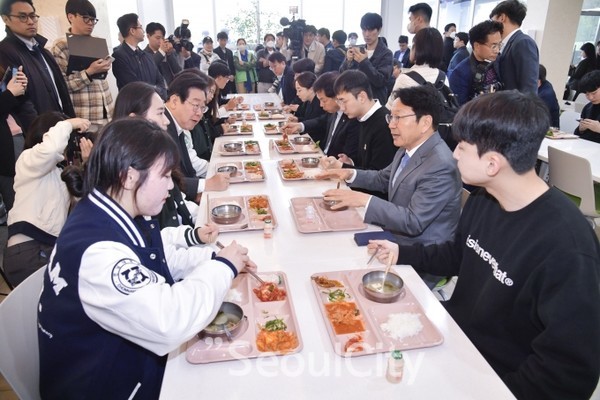
Gwangju Metropolitan City is broadening its social welfare horizons by integrating local success with visionary national policies. The journey toward ensuring basic food rights for all began with Mayor Kang Gi-jung’s 1,000 Won Breakfast program, which has provided a dignified and affordable start to the day for university students. Building on this local foundation, Gwangju is now actively implementing and expanding the “Simply Given” (Geunyang Deurim) food support policy, an initiative originally conceptualized and championed by President Lee Jae-myung. This policy reflects a shared commitment to a welfare state where no one suffers from hunger due to bureaucratic barriers.
As the city continues to strengthen its Gwangju-Style Integrated Care system, the expansion of the Simply Given program serves as a vital safety net against economic instability. The city plans to increase the number of these accessible centers across all districts by the first half of 2026. This expansion ensures that help will always be within reach.
The Simply Given program operates on a no-questions-asked basis to provide immediate relief to any resident facing a sudden crisis. At designated community centers and food markets, individuals can receive up to 20,000 won worth of essential items per visit. The selection includes daily necessities and staples such as ramen, instant rice, and canned goods, allowing those in need to maintain their health and dignity without the immediate burden of proving their financial status. This “support first, administration later” approach ensures that help reaches the most vulnerable people as quickly as possible.
Beyond providing immediate sustenance, the program is designed to be a bridge to long-term stability and self-sufficiency. While the first visit is focused on emergency food assistance, the second visit introduces a comprehensive counseling system.
Currently, the government is conducting a five-month pilot program that runs from December 2025 through April 2026 to refine the delivery system and assess local needs. Following this initial phase, the Simply Given initiative will officially transition into a full-scale, regular project starting in May 2026. As part of this rollout, Gwangju City has committed to establishing 25 dedicated corners across its five districts by the first half of 2026. As of March 2026, the Simply Given service is provided at selected central hubs in each district, with plans to expand to 25 neighborhood locations throughout Gwangju by the first half of this year.
Compiled by Amy Park.
Amy Park is a program officer for Asian Legal Resource Center (ALRC Korea) based in Gwangju. She helps build the organization’s foundation and supports new efforts in human rights advocacy and resource sharing.
Cover Photo: Breakfast with Mayor Kang, 2023. (Gwangju City)