

Refuge at Yeoseo Island: A Wartime Recollection
By Young B. Choi ||
Many years have passed. Yet the stories my parents have told me about their wartime flight during the Korean War remain vivid in my mind, like scenes from an old film that refuse to fade. Time has softened some details, but the fear, desperation, and miraculous moments of survival are etched indelibly into memory. Drawing upon these fragments, I attempt here to record the days when my parents’ lives – and the fate of our family – hung in the balance.
As news spread that the North Korean People’s Army was advancing southward, fear crept into every village. Those who believed the world was about to change turned cruel overnight, committing unspeakable acts against innocent neighbors. Ordinary people, guilty of nothing, clutched their children’s hands and searched desperately for somewhere – anywhere – safe. Nights passed without sleep as villagers strained their ears for the sound of approaching boots.
At that time, my father, Choi Hyung-Oh, was serving as a police officer in Wando, the large island county just off the southern coast of Jeollanam-do. One day, word came through the emergency line that Gwangju had fallen. The enemy was advancing toward the southern shoreline with terrifying speed. There was no time left to hesitate. My father immediately set out to secure a vessel for civilian evacuation, persuading a captain through the night. Then, quietly but urgently, he spread word throughout the village: “Take only what you must. Put the children on board first.”
His voice was firm, but beneath it lay an overwhelming urgency – an urgency to save not only his own family but the entire community. The village descended into chaos. Children cried, elders hesitated over belongings they could not bear to abandon, families clung to one another in fear of being separated. My mother later recalled that one woman, in her panic, ran barefoot toward the boat with a bundle on her back – only to discover later that she had wrapped a pillow instead of her baby. War strips human reason with merciless efficiency.
Packed tightly aboard the refugee boat, my mother suddenly felt the onset of labor pains. The sea was rough; fear froze the faces around her. Then the captain’s desperate announcement echoed across the deck: “Is there a doctor on board? If there is a doctor on board, please come forward!”
After a moment of silence, a miracle occurred: A man raised his hand. As it turned out, he was a physician and an acquaintance of my mother’s maternal uncle. In that unfamiliar boat, among refugees fleeing death, a new life was born. Amid gunfire and screams, the cry of a newborn rang out – a testament to life’s stubborn insistence on continuing. That baby was my second older sister.
For years, our elders would fondly call her “the child born on a refugee boat.”
But the danger was far from over. Suddenly, friendly aircraft appeared overhead and, mistaking the refugee ship for an enemy vessel, opened fire. Bullets tore across the water. In terror, people leaped into the sea. At that moment, my father stood at the bow, waving a flag with all his might to signal that the ship carried civilians. His arms ached as he waved again and again. After several more shots, the attack finally ceased. My mother, clutching her newborn, had not moved from the deck.
“How could you be so fearless?” the captain later asked her.
“How could I jump into the sea while holding my baby?” she replied.
Her words revealed a quiet, unyielding resolve.
After ensuring that the villagers and his family were safely aboard, my father immediately turned back toward Wando Harbor in a small police patrol boat. His superior had already fled to Busan. With only one trusted colleague, my father engaged enemy forces who had entered Wando. Known by the nickname “The Tiger of Mudeung Mountain,” he was a man of imposing stature and fearless resolve. During the firefight, his companion was shot in the lower abdomen and began bleeding profusely. My father pressed his foot firmly against the wound to stop the bleeding while steering their boat to safety. That night, the sea was dark and unforgiving, and the boundary between life and death razor-thin.
After hours at sea, the refugee boat finally reached Yeoseo Island – a tiny, remote island some 40 kilometers southeast of Wando, midway between Wando and Jeju-do, difficult to access, and barely marked on maps. Its isolation became a blessing, saving hundreds of lives. When the refugees arrived, island residents emerged in disbelief.
“What kind of disaster has struck the mainland?” The islanders, who had lived in peace for over 250 years, welcomed the refugees with open hearts. As a woman who had just given birth, my mother received special care. Each day, she was served seaweed soup made with freshly harvested wild seaweed and just-caught cutlassfish. Though the unfamiliar preparation was difficult to eat at first, the warmth and sincerity of the islanders sustained her.
Without proper postpartum care, my mother suffered greatly from complications. Still, when the war situation later improved, the family returned to Wando, where she and my father were reunited in a moment nothing short of miraculous. At that time, we were a family of five. In the years that followed, more children were born until we became a family of ten, with four sons and four daughters. Every one of those lives rests upon the choices made and the miracles granted during that desperate flight.
I have heard that in Wando there stands a monument erected by grateful residents to honor my father’s actions. To my shame as a son, I have yet to visit it. After the war, my father was promoted as Wando’s chief of police, serving once again the very people he had saved. They welcomed him with tears, remembering the daring “Great Escape” he had led.
Such tragedy must never be repeated. Fratricidal war leaves wounds that do not heal with time. As I finally set these memories down in writing, recalling the painful stories my parents once told me, I find myself reflecting deeply on the future and destiny of our nation. Survival may have been a matter of chance, but remembering and recording these stories is the responsibility of those who remain.
The Author
Young B. Choi is a professor of information systems technology at Regent University, USA. Dr. Choi has published 33 books, autobiographical essays, critiques of Gani Choi Rip’s classical poetry, a biography of Dosan Ahn Chang-Ho, John Steinbeck book reviews, and writings in the fields of cybersecurity and AI.
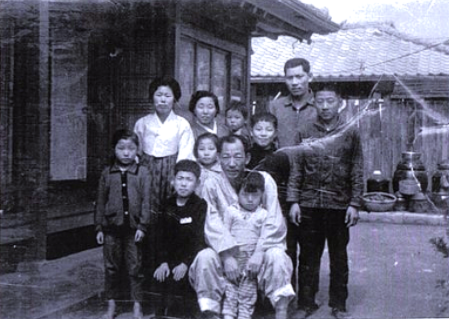
Cover Photo: The Choi family. The author is in his father’s arms, 1965. (Kim Jae-Yeol)