





Lucerium: The Gwangju National Science Museum
By Chung Hyunhwa
I had the good fortune of meeting Ms. Park Eun-mi, a researcher who is working at the Gwangju National Science Museum – the Lucerium. We met at a fair where she was participating as an exhibitor to promote the museum. The magic harp she brought did not have any strings, but it made sound when your fingers moved where the strings should have been. This stringless harp’s purpose was to show children how light sensors work. Her job is to curate such displays in a way that children can have fun and understand science concepts at the same time. She was highly social and invited me to the museum. The stringless harp was certainly intriguing enough for me to want to make a visit, so I did.
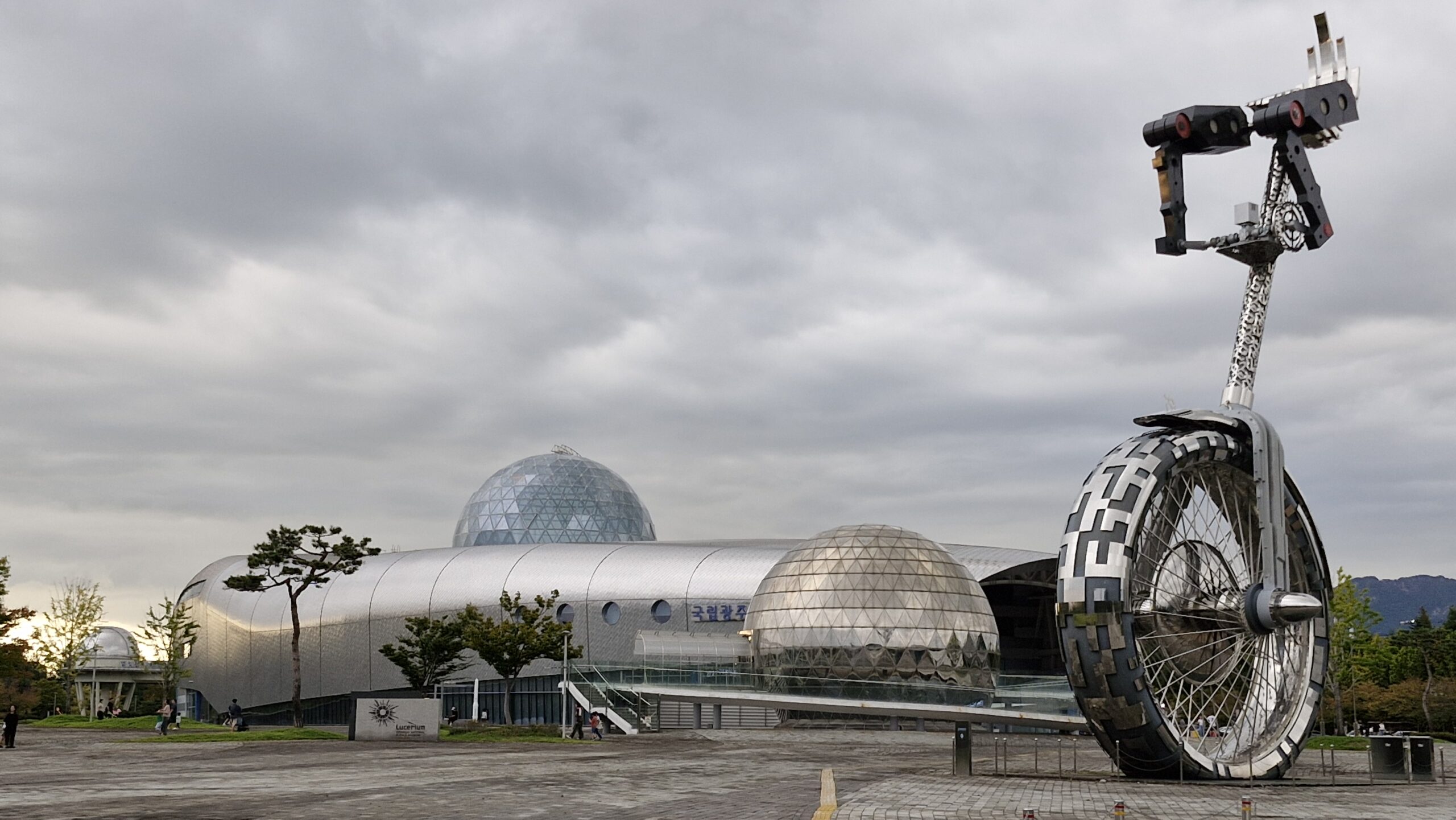
On the day I visited, there were lots of families, since it was the last day of the long Chuseok holiday. First of all, I felt embarrassed that I had not known there was such a nice science museum in Gwangju. You could get tickets at the entrance to the main building, which looks like a shiny space station. There are four buildings in all, and you could get a ticket for 2,000 or 3,000 won to visit a single exhibition building, or 5,000 won for three buildings. The best is to get a one-year membership for 30,000 won, if you have children. This allows free access to the museum with free parking any time, and the special theaters in the museum are all free with this membership as well. Not only that, it gives you access to the 370 museums under the ASTC passport program, if you travel abroad. It is a great opportunity for families with children for only 30,000 won a year.
Inside the building, there is a pond with robot fish swimming around, and the little kids were absorbed in watching them when I was there. The movements of the robotic fish were quite realistic. No fish feed needed. The main building has two floors for displays to explain science concepts: Light, Radio Waves, Sports, Science in Daily Life, Space and the Oceans, and Science Art. I found the stringless harp here. One thing you should not miss is the Tornado simulation. It consists of a tall, transparent tube, and you can watch a tornado swirling inside. I thought it was really cool. Most of the displays here are touch- based experiences. There is also a 4D Theater in this building, which I want to visit next time.
On the north side of the main building is the Astronomical Observatory, which runs educational programs that require reservations. On November 5, supermoon watching is scheduled, so if you are interested, make your reservation through the museum’s website.
Since the Observatory is open only when programs are running, I moved to the next building, the Artificial Intelligence Exhibition Hall. AI is developing so rapidly that I cannot say it has the most updated displays, but they were quite appropriate for children, and even I found some displays that were interesting for me – such things as virtual clothes fitting and dancing with an AI instructor. This hall provides the newest trends in AI, and also tosses out questions about it.
The last hall I visited was Children’s Hall, which is designed for preschool children. I could see parents with young children playing or resting there, which was really nice to see. There I saw Space 360, a metal globe three-dimensional, virtual-reality theater hall between the main building and the children’s science museum, which I did not have time for that day. It is 3,000 won for 17-minute short movies. I thought they must be worth watching and that I should check them out next time.
The official name of the museum, Lucerium, is a suitable one for Gwangju, the City of Light (the name is Latin based; luc means “light”). I thought the museum’s location, Cheomdan, was also quite appropriate for such a nice science museum, since Cheomdan is home to a lot of tech companies and the Gwangju Institute of Science and Technology. As a person who likes to go to museums, I am very proud of our Gwangju National Science Museum and wish that this will be the foundational experience to instill in our children hope for a positive future. For more information or reservations, visit the Lucerium website.
The Author
Chung Hyunhwa, a native of Gwangju, recently worked for a local horticultural company. She led the international eco-hike group Gwangju Hikers at the GIC in 2020 and 2021. Previously, she taught English at Yantai American School and Yantai Korean School in China and worked in school administration at Branksome Hall Asia in Jeju. She holds a master’s degree in TESOL from TCNJ in the U.S. and has a license to teach Korean. She loves plants, birds, and repurposing items creatively.
Cover photograph by Chung Hyunhwa.