




The Silent Poison in Our Seas: Why Fish Have More Mercury
By Siddhant Kumar
Mercury (Hg) is not something most people think about when they look out at pristine blue coastlines. Yet this invisible metal is quietly making its way into the Korean natural waters, settling into the mud, and crawling up the food chain. Oceanographers warn that it is becoming one of the most persistent threats to marine life and the seafood communities that depend on it.
Air pollution has been identified as the largest source of mercury entering the Korean oceans. Easterlies, winds blowing eastward, carry industrial emissions from other parts of Asia, and eventually the Korean peninsula receives much of this airborne mercury during dusty spring storms (hwangsa) and seasonal rains. Once it reaches Korean waters, rivers such as the Han, Nakdong, and Geum deliver even more mercury runoff from cities, farms, and older mining districts.
These combined inputs concentrate most strongly along the western and southern coasts. Harbors near major industrial zones, including Ulsan, Busan, Gwangyang, and Incheon, often show the highest levels in seafloor sediments.
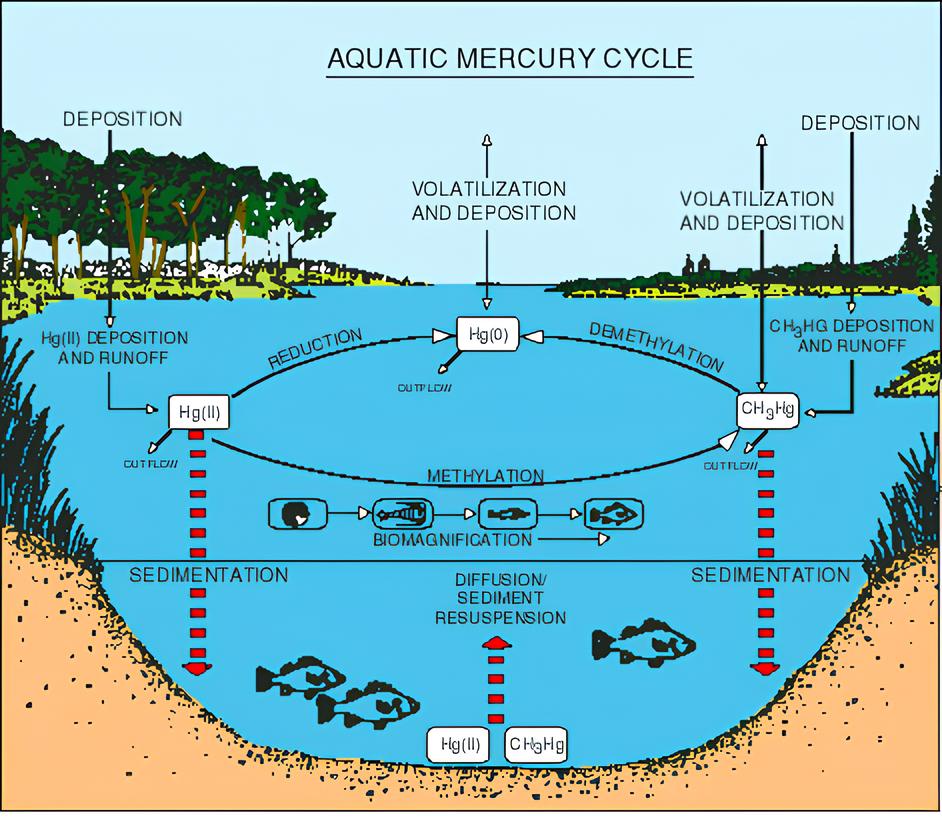
When mercury settles into the mud, the problem does not end there. In low-oxygen conditions, sulfur-reducing and iron-reducing naturally occurring bacteria can turn mercury into methylmercury, a far more toxic form that accumulates in marine animals. This is why larger fish can contain higher levels than the smaller species they eat, that is, bioaccumulation.
We at the Trace Metal Biogeochemistry Laboratory at the Gwangju Institute of Science and Technology focus on quantifying how mercury is transported, transformed, and bioaccumulated across connected systems – from the atmosphere to lakes, rivers, estuaries, and coastal seas. In practice, this means we run a long- term, nationwide mercury monitoring program on Korean lakes and rivers, measuring total mercury and methylmercury in water, suspended particles, sediments, and biota, and using these data to design a national observation network for Minamata Convention implementation.
We also operate one of Korea’s wet-deposition stations within the Asia-Pacific Mercury Monitoring Network, where we collect rainfall and snow, determine mercury fluxes, and analyze how seasonal climate patterns and pollution events control atmospheric inputs. In parallel, we develop and calibrate passive samplers and other field devices to estimate the bioavailable fraction of dissolved metals, and we carry out laboratory and field experiments to determine methylation and demethylation rate constants, redox- driven speciation changes, and the efficiency of engineered remediation materials such as zero- valent iron for contaminated groundwater and waste streams.
Within Korean coastal and estuarine environments, our current projects target the sediment biogeochemistry of mercury in offshore aquaculture sites and in contaminated river estuaries such as the Hyeongsan River. There, we couple vertical pore-water profiles, solid- phase speciation, and benthic flux measurements with microbial and redox indicators (iron, sulfur, methane) to resolve how organic- rich, low-oxygen muds promote mercury methylation beneath fish and shellfish farms. We then construct site-specific mass budgets for methylmercury, using measured concentration gradients and rate constants to separate in situ production in sediments from upstream riverine inputs, and identify the dominant sources feeding
local food webs. These estuarine and coastal data sets, combined with our inland and atmospheric monitoring work, provide the process-level basis for explaining why some reaches of the Yellow Sea coast show elevated methylmercury exposure risk while less enriched South Sea sites remain comparatively closer to background conditions.
The movement of mercury in lakes, rivers, and oceans is quite complicated. Different types of mercury can change from one form to another, and the most dangerous change is when it turns into methylmercury (CH₃Hg⁺), a highly toxic substance. Over time, mercury can settle into sediments, build up in fish and other wildlife, or escape back into the air.
Although mercury pollution is not always visible, its impacts are real. Fish and shellfish play a central role in Korean cuisine, and protecting marine health is important not only for ecosystems but also for public well-being. Oceanographers have started claiming that climate-driven warming and declining oxygen levels in some coastal waters may increase the amount of mercury that becomes biologically active and can be consumed by the organisms that end up on our dinner plates.
Understanding how this metal moves from air to sea and from sediment to seafood is increasingly important. Ongoing research from several institutes, including our TMBL at GIST, is providing clearer evidence of how mercury travels through the marine environment and where efforts should focus to keep coastal waters safe in the years ahead.
The Author
Siddhant Kumar is a geochemical oceanographer and researcher at TMBL at the Gwangju Institute of Science and Technology (GIST). His work focuses on marine minerals, sediment chemistry, and paleoenvironmental change. He is passionate about communicating ocean science to broader communities in Korea.
Cover Photo: Mercury cycling pathways in aquatic environments. (USGS, Science for a Changing World)