





What’s It Like to Learn Chinese in China?: A Vivid Month-Long Experience
By Park Yeonju ||
In July of 2025, I left for Weihai in Shandong Province of China to study Chinese. On a day when the hot sunlight beat down, I set off for nearby China with a heart full of excitement. It was about a one-hour flight. Over the wide ocean, land began to appear little by little, signaling the opening of a new page in my summer.
Writing Chinese characters was fun, and Chinese felt appealing to me. The interest I had studying since childhood naturally led to a double major in university. I still could not speak fluently, but in the China I had vaguely pictured since I was young, I wanted to spend some time – at least once. Even if for only a short time having the experience and being able to say even one more sentence would make a huge difference. With curiosity about China and a desire to improve my Chinese, I took my first steps in Weihai.
The first sight of China did not feel very unfamiliar. Since Korea is also part of the Chinese-character cultural sphere, it was simply fascinating that everything was written in Chinese characters. It did not feel foreign. However, China uses simplified Chinese characters rather than the traditional Chinese characters used in Korea. Because of this, the form of the character was often different from the form I was used to. If it was a character I had studied, no problem. If not, I had to infer the meaning from a simplified shape that looked similar to the traditional characters I already knew. They matched fairly often. Still, because simplified characters often have clear differences in form, I sometimes struggled.
However, if I had not known the traditional Chinese characters used in Korea, there were times when I wouldn’t have been able to even make a guess. So whenever I studied Chinese, I kept reminding myself that I should neglect neither simplified nor traditional characters. Once you know traditional characters to a certain degree, simplified characters become easier to understand as well. On top of this, Taiwan uses traditional characters, the same system used in Korea. China and Tiawan are two places that share the same language but use different scripts.
Another feature of Chinese is that even if you don’t know what a character means, you can still pronounce it. Chinese has three components you need to learn: the characters themselves; Hanyu Pinyin, which displays the pronunciation in the Roman alphabet; and the four tones that distinguish meaning by pitch. Because you have to memorize all three, Chinese can feel like it has a higher barrier to entry than other languages. Even when you learn a single Chinese word, it takes time to be able to use all three parts smoothly.
Think about Korean. Even if you do not know a word’s meaning, as long as you know vowels and consonants you can still pronounce it. So, does that mean you cannot pronounce a Chinese word you have never learned? Not necessarily. Because Chinese characters are pictographs, there are many characters that look similar. They are clearly different characters, yet they often share a visual component that is the same. In these cases, the meaning may differ but the pronunciation is often the same, or very close. If you use this strategy, even when you meet an unfamiliar character, you can make an educated guess at the pronunciation, thinking, “Maybe it is pronounced like this,” and little by little you train yourself to pronounce Chinese characters.
When I first stepped out onto the street after arriving in China, I felt nervous and excited. I was thrilled that I could finally use Chinese in real life, after learning it only from books and school classes in Korea. It was not anything grand. Still, when I used simple Chinese to place an order, the whole process felt amazing. They understood my words and served me the food. Every step of it was fascinating. I started communicating with a simple mindset: I may be lacking, but I will use as much Chinese as I need to get my meaning across. As I kept trying, I gradually became more interested in Chinese.
Even though I might not have known a word in Chinese, I didn’t feel too discouraged. I looked it up in a dictionary or boldly used a digital translator. Even if I did not know much, I reminded myself that I was learning new words and sentences in that moment. That made my fear of communicating disappear. After that, even when I could not fully understand what people were saying, I could roughly understand it through key words and be able to handle the situation. That was when the saying “Even if the language is difficult, experience it on site first” truly felt real.
Because the Chinese I learned at school in Korea was taught mainly through textbooks, the focus in China was on learning how to speak for specific situations. There were several class levels. In the beginner class, we learned Chinese through English. From the intermediate level, the teacher taught Chinese using only Chinese. As an intermediate student, I worried at first about whether I could keep up. But as I listened to Chinese for several hours every day, it felt like my ears were opening up. Frequently used words and expressions were absorbed naturally, and I became able to use them.
At first, of course, I couldn’t follow everything quickly. Still, the teacher’s repeated practice and the way students had to say example sentences and present them gradually built my confidence. It was okay to make mistakes. The teacher corrected my errors.
In Korea, I had learned Chinese in a class of Korean students. Once I came to the Chinese school, there were many Russian students as well. It was my first time to meet Russians. During our breaks, we sometimes spent time talking about “K-culture” and about each other’s countries. Hearing about Korean culture and K-pop from people in other countries made me feel proud. It also made me realize how strong Korea’s soft power is.
That month-long experience was incredibly precious, and it is still quite vivid in my thoughts. It was a time that changed how I will think and study from now on. Of course, you can study Chinese well enough in Korea. There are plenty of learning materials and a wide range of online lessons. Still, I recommend studying in the country where Chinese lives at least once. It helps you reconnect with why you are learning Chinese in the first place. It also helps you approach the language with more enjoyment. As you travel and slowly get to know the place, you start to want more.
You want to raise your Chinese level and open the door to more diverse experiences. I also promised myself that when I returned to Korea, I would use the time as nourishment and take one more step closer to Chinese. When I used to study only through books, I often put off studying when it felt difficult. But now it is different. I’ve brought so many good memories back. Sometimes I take out the photos from my experience in China and steady myself for a wider view of the world.
My month in Weihai is still shining. Now I can think more independently. What part of China should I travel to next? What phrases do locals use most often? Where will my next destination be?
The Author
Park Yeonju is an undergraduate at Chonnam National University, majoring in political science and diplomacy as well as Chinese language and literature. Her third specialization is international development cooperation studies. She was born and raised in Gwangju and wants to promote the colorfulness of the city. It is her dream to become a true journalist by inheriting the spirit of May 18.
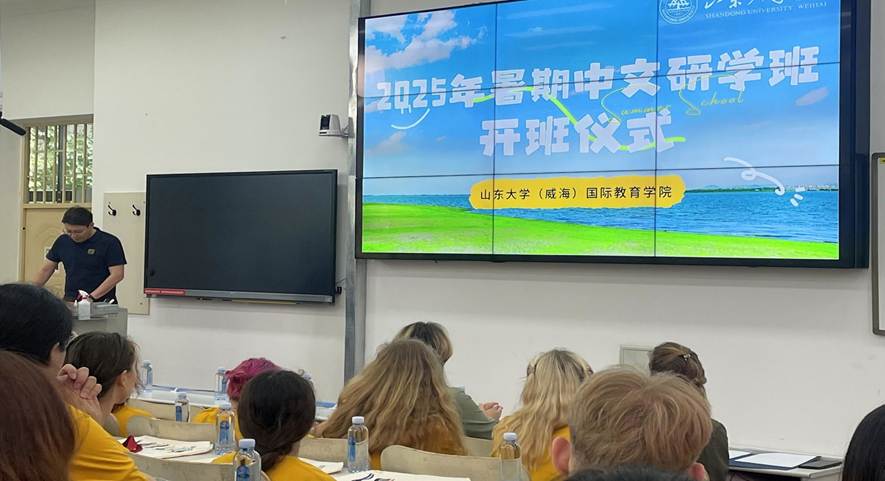
Cover Photo: Orientation session for all program participants. (Park Yeonju)