

From Gwangju to Jeolla’s Gateway of Light: A Motorbike Ride
By Vibhanshu Maurya
It was one of those lazy Sunday mornings when the weather itself seemed to suggest a road trip. No plans, no checklist, just an open sky and an urge to ride. That’s how most of my trips begin. I prefer choosing destinations randomly; sometimes by how long I want to sit on a bus, or if I’m on my bike, by the direction that feels right – city, seaside, or countryside.
That day, after a week of rain, the bright sun felt like an invitation. I wanted to feel the sea breeze, the hum of the road, and the warmth of light on my face. While scrolling through the map, a name caught my attention: “Birthplace of Baekje Buddhism” (백제불교최초도래지) in Beopseong- po in Yeonggwang County. I had never heard of it before, but the name alone felt calming, historic, spiritual, and right by the ocean. Perfect!
So, I packed lightly, put on my helmet, and convinced a friend to hop on the back seat, without telling him where we were going. We started a little after 11 a.m., and by 12:30, we had reached our destination.
First Impressions – sea, silence, and sunlight. The place was serene; sunlit air mixed with salt and silence. The Birthplace of Baekje Buddhism, officially located at 203 Baekje-munhwa- ro, Beopseong-myeon, Yeonggwang-gun, Jeollanam-do, sits between a mountain slope and the coastline. To reach the top, we took a long glass elevator that rose slowly up the cliffside. From the top, the view opened wide, the sea stretched endlessly, a suspension bridge linked one mountain to another, and seagulls perched lazily on the steel wires, sunbathing as if posing for the horizon.
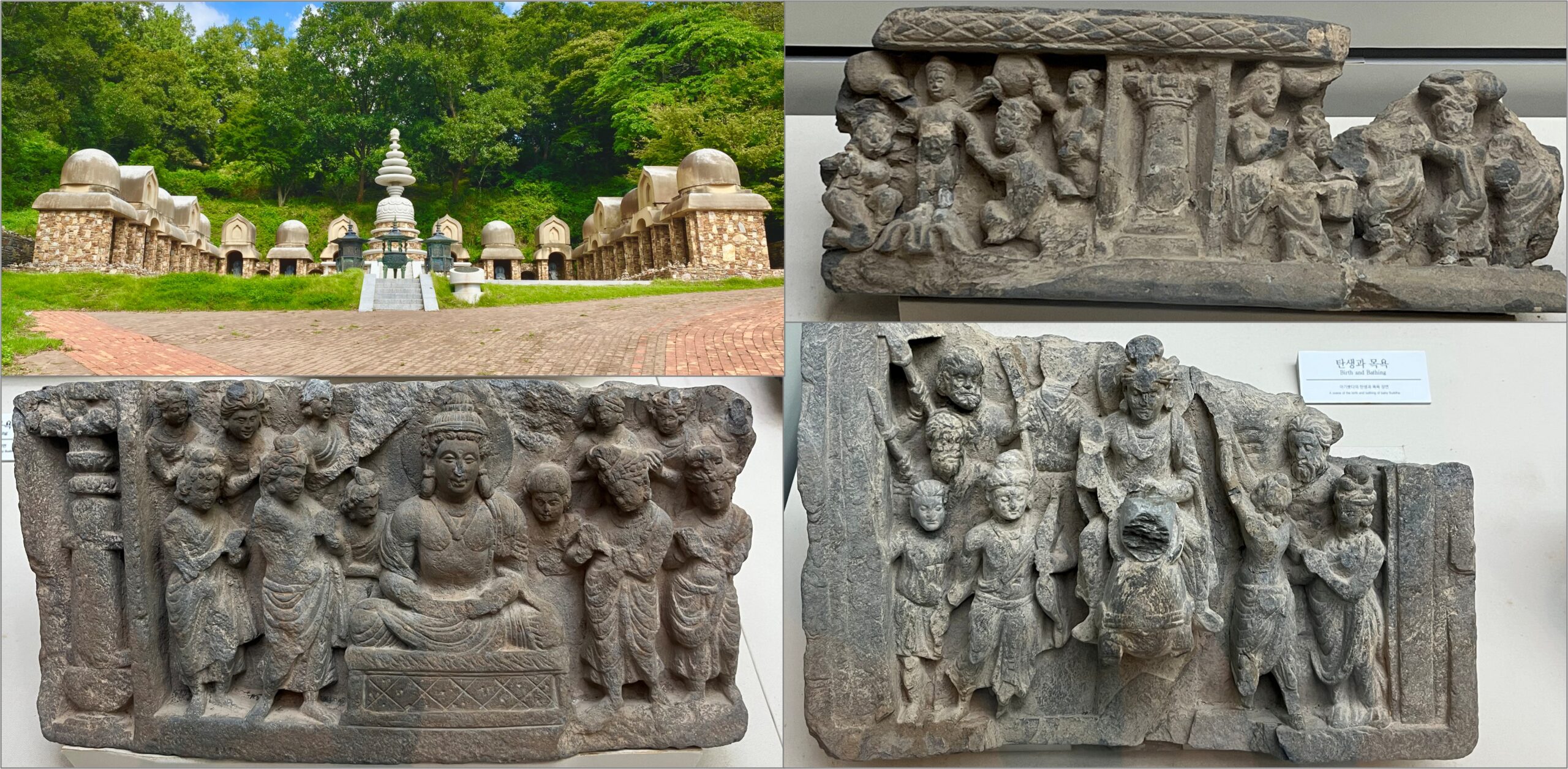
The first landmark that greeted us was a stunning statue: four Buddhas facing four directions. Their faces radiated calmness, their gestures gentleness. The sculptural style felt unmistakably Indian, especially one figure of Shakyamuni Buddha, reminiscent of Gandharan art. Seeing this blend of Indian and Korean expression was deeply moving.
The site sprawls across 45,000 square meters, with winding walkways and viewing decks overlooking the sea. One trail curved upward through a forested hill, the other descended toward the main temple area. We took the uphill route first, walking under the green canopy freshly washed by rain.
Along the way, we spotted mushrooms in all shapes and colors: tiny white domes on mossy trunks, coral-red caps hiding under ferns, and tall speckled ones standing like forest sentinels. The higher we climbed, the more the sea revealed itself, sparkling below the mist.
From the ridge, another bridge extended to a neighboring mountain. On the way down, a stone statue of a mouse caught our eye. The plaque beneath said, “The mouse is intelligent, it senses water.” A curious, symbolic guardian of this coastal sanctuary.
Down below, a group of motorcyclists from another island were passing by, their laughter mixing with the ocean’s rhythm. It was a joyful reminder that even sacred places can carry a playful heartbeat.
At the base stood a towering pillar modeled after Emperor Ashoka’s column from Nalanda, India, symbolizing the spiritual link between the two ancient civilizations. Though less ornate than the original, it stood proud, a marker of Buddhism’s maritime journey. Standing there, I felt an odd sense of homecoming; an Indian monk had once landed here, carrying the same teachings born in my homeland.
Inside the exhibition hall, the displays traced that journey: artifacts, sculptures, and multilingual panels recounting how Bud dhism reached Baekje in 384 CE. The story goes that Mārananda (마라난타), an Indian monk from Gandhāra, traveled via the Eastern Jin Dynasty of China and arrived on these shores. King Chimnyu of Baekje welcomed him into the royal court, officially recognizing Buddhism, a decision that reshaped Baekje’s cultural identity.
From this moment, Baekje’s art, architecture, and diplomacy flourished. The kingdom became a beacon of Buddhist learning, later transmitting those teachings to Japan around the mid-6th century. The elegance of Baekje’s sculpture, seen today in finds from the Gunsu-ri temple site in Buyeo, reflects a harmony of Indian, Central Asian, and East Asian influences.
Many scholars note that Beopseong-po’s Jwaodu Village is now accepted as the monk’s first landing site, following a 1998 historical verification study by Dongguk University. The very name “Beopseong” (법성) translates beautifully: beop meaning “Dharma” and seong meaning “saint.” Standing at the lookout point, I imagined Mārananda’s ship approaching this same coastline sixteen centuries ago: sails creaking, monks watching the unfamiliar land rise on the horizon. The ocean here still feels like a messenger between civilizations.
What touched me most was not just the history but its continuity. The architecture of the park, the Indian motifs, and the peaceful rhythm of the sea; all seemed to echo a dialogue that began long ago between India and Korea.
The visit wasn’t planned, yet it felt meant to be. In that unplanned hour of sun and salt, the ride turned into a pilgrimage.
If You Go
Location: Birthplace of Baekje Buddhism (백제불교최초도래지) 203 Baekje-munhwa- ro, Beopseong-myeon, Yeonggwang-gun, Jeollanam-do
How to Get There: From Gwangju, take a bus to Yeonggwang Terminal (about 1 hr. 30 min.). From there, local buses or taxis reach Beopseong-po in 15–20 minutes. Parking for private vehicles and bikes is available at the foot of the hill.
Best Time to Visit: Late spring to early autumn (April–October) offers pleasant coastal weather, and in September, vibrant fields of red spider lilies (상사화) are near the site.
What to See
- Four-sided sculpture of Buddha statues
- Ashoka-inspired stone pillar
- Coastal skywalk bridge
- Exhibition hall on Baekje–India Buddhism exchange
- Sunset from the upper ridge
Walking Route Tip
Take the elevator up, follow the ridge trail through the forest for panoramic views, then descend via the lower path toward the exhibition hall and sea promenade. Plan 60–90 minutes for a leisurely visit.
The Author
Vibhanshu Maurya, originally from India, is pursuing his PhD at CNU. He leads a vibrant lifestyle, driving his motorbike across the Korean Peninsula. He directed the Gwangju Hikers group and used to create podcasts that explored the challenges of residing in Korea and strategies for overcoming them.
Cover Photo: Gandhara-style pagoda (top left). A sculpture of the birth and bathing of baby Buddha (top right). Buddha leaves the palace riding a horse to find enlightenment (bottom right). A number of Bodhisattvas attend to Shakyamuni, sitting in the center (bottom left). (Vibhanshu Maurya)