



Life in Overdrive: Understanding the Korean Phrase “Ppalli-Ppalli!”
By Murdock O’ Mooney ||
If you’ve visited South Korea, you’ve probably observed the ppalli-ppalli (Hurry, hurry) culture in action. Buses take off suddenly, tossing passengers down the aisle; taxi drivers honk and race to their destinations; and even a doctor’s visit might only last a few minutes – there are just too many patients to see! From a romanticized perspective, the concept of ppalli-ppalli (빨리빨리) translates as energy, efficiency, and extreme diligence. In reality, the concept can create dangerous situations, avoidable mistakes, and generate copious amounts of unnecessary stress. Regardless of your position on the phrase, it inarguably holds a lot of meaning and relevance in Korean culture and society.
According to the 2018 BBC article “South Korea’s Unstoppable Taste for Haste,” Gary Rector, a naturalized Korean citizen, said that when he first came to South Korea as a U.S. Peace Corps volunteer in 1967, he expected to find the stereotypical Eastern zenned-out populous but was instead surprised to find “people my age – and I was 24 years old – were very busy rushing around trying to improve their lifestyle.” Rector also made the point that the older generations seemed to be slower and more deliberate in their movement and approach to life.
While the philosophy of ppalli-ppalli has its roots in post-Korean War industrialization known as “the Miracle of the Han,” earlier references of Koreans rushing about are plentiful. Korea’s beloved King Sejeong of the Joseon Dynasty once said about his own people, “Our people tend to be in a rush on every occasion, so they lack precision.” Even the founder of North Korea, Kim Il Sung, encouraged haste, telling citizens to work at “Chollima speed,” which references a mythical horse that could fly 1,000 ri (천리, 400 km) in a day. The current supreme leader, Kim Jong Eun, increased this to “Mallima speed” (만리마), or 10 times faster.
It’s also no secret that South Korea’s rapid economic growth is nothing short of miraculous. Some insightful statistics include going from an average annual income of $57 in 1957 to $33,475 in 2023, and being the first aid-recipient country to become a donor for the OECD’s Development Assistance Committee (DAC). Beyond this, South Korea is also the fourth largest economy in Asia and thirteenth largest in the world, despite having a population of only 50 million. It also took just twelve years to complete the 300 kph KTX bullet train, first beginning operation in 2004 from Seoul to Busan, which required drilling tunnels through 38 mountains! Should Korea attribute this rapid development to ppalli-ppalli, or are there other contributing factors?
The Korean War certainly helped establish ppalli-ppalli as a default modus operandi. Beyond ripping the country apart, civilians were rapidly displaced, often seeking refuge from fighting, taking nothing more than what they could carry with them. After WWII, Korea was divided with the Soviet Union controlling the north, and the United States and UN controlling the south. After fighting broke out, control of Seoul changed hands four times: first North Korea took control, then the UN recapture, then a Chinese capture, and finally a UN recapture when fighting ceased in 1953. Once the South Koreans had their country back, it was time to get to work. This is where ppalli-ppalli found its footing.
When asked about ppalli-ppalli, my Korean mother-in-law, Jeong-sun, said, “The word originated from the image of a diligent people who woke up at dawn and worked in the fields.” She continued with “It is a word that is absolutely used with a positive meaning, but it is also used when one is faced with dangerous or urgent situations.”
I know what Jeong-sun means. Once, while coming from Incheon Airport to Seoul, I thought I was going to die because our taxi driver was speeding along at 160 kph on the expressway. When I asked him to slow down, he replied with, “Korean ppalli-ppalli, very fast and good service.” While the service was no doubt fast, and the driver no doubt dedicated, I was terrified and stressed, which made the ride unpleasant.
In an article for Newsweek, tech CEO Jae-il Shin of Agility Systems claims that the spirit of ppalli-ppalli is shaping global business and thinks of the phrase as a mantra. The way Shin sees it, ppalli-ppalli can be understood to mean “move fast, innovate faster, and never waste time,” in reference to South Korea’s prominence in logistics, AI, drone technology, construction, and battery manufacturing. Conveniently, Shin left out the part about making mistakes.
In his best-selling 2015 book, Burnout Society, South Korean philosopher Byung-Chul Han takes a different stance claiming that Korea’s achievement-based approach that places emphasis on speed, performance, and self-exploitation, creates burnout and a lack of genuine contemplation of life. Han goes on to explain that excessive speed in daily life focuses on “doing rather than being.” To combat the ppalli-ppalli mindset, Han encourages slowness, rest, and contemplation to help find meaning, as well as promote a healthier lifestyle.
There’s no easy way to understand ppalli-ppalli from a philosophical, cultural, or social perspective – it’s a complex phrase, for sure. And whether it’s seen as a positive or negative might depend on the individual. For me, I see ppalli-ppalli as a defining trait of the Korean people. And like many things in life, when applied in the correct amount (whatever this might be), ppalli-ppalli is a blessing. When abused, it might be a curse. But that’s just one person’s opinion.
Sources
- Crawford, M. C. (2018, July 9). South Korea’s unstoppable taste for haste. BBC. https://www.bbc.com/travel/ article/20180708-south-koreas-unstoppable-taste-for-haste
- de Bomford, D., & Lange, Q. (n.d.). Agility as strategy: How Korea’s “ppalli-ppalli” spirit is shaping global business. Worldfolio. https://d.newsweek.com/en/ file/478459/what-makes-koreas-business-agility-powerful-lever-global-success.pdf
- Greenspan, J. (2025). 8 things you should know about the Korean War. History, A&E Television Networks. https:// www.history.com/news/8-things-you-should-know-about-the-korean-war
- Maden, J. (2023). Byung-Chul Han’s burnout society: Our only imperative is to achieve. Philosophy Break. https:// philosophybreak.com/articles/byung-chul-han-burnout-society-our-only-imperative-is-to-achieve/
- Republic of Korea: Overview. (2025, December 3). The World Bank. https://www.worldbank.org/en/country/ korea/overview
The Author
Murdock O’Mooney is an educator and writer based in Albuquerque, New Mexico, USA. He lived in Gwangju, and worked at Chosun University, from 2015 to 2022. He’s interested in geopolitics, education, and trying to help build a more just world.
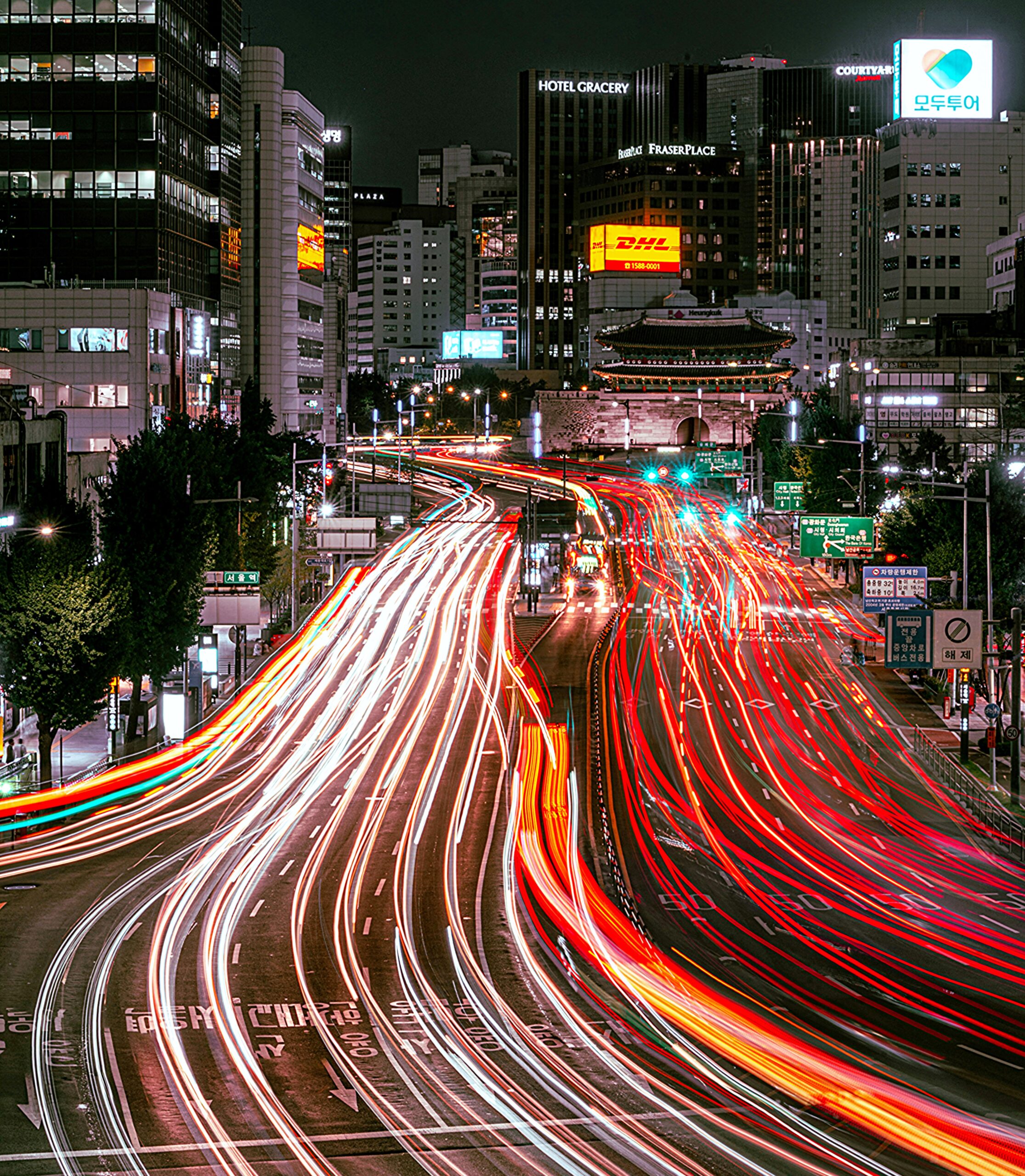
Cover Photo: The hustle bustle of nightlife in downtown Seoul. (Dmitry Voronov on Unsplash)