





The Price of Bread: Attack on Ukraine’s Fields Impact the World
By Andriievska Anastasiia ||
Ukraine continues to rank among the world’s top ten suppliers of agricultural products, holding fourth place in corn exports and sixth place in wheat exports. In December 2025, 86% of Ukrainian wheat was exported to North Africa and the Middle East, amounting to approximately 335.5 thousand tons. In addition, Ukraine exports grain to European and Asian countries. Due to Russia’s full-scale invasion, Ukraine was unable to supply grain to other countries for a certain period, which led to serious shortages in many regions, especially in the Middle East and Africa. As a result, bread production and the production of other bakery products significantly declined, while bread prices rose sharply.
On December 19, 2025, Russia shelled a grain port in the Odesa region, where grain intended for export was being stored. Truck drivers who were waiting for the grain to be loaded were killed. A day earlier, Russia carried out several days of massive attacks on a bridge in the Odesa region used by trucks transporting grain to Europe. This bridge is a key route to Bessarabia and is located near the border crossing with Moldova. As a result of strikes by Russian UAVs (unmanned aerial vehicles, drones) and ballistic missiles, a woman was killed and her three children were injured.
In addition, Ukraine is the world’s leading exporter of sunflower oil, exporting millions of tons annually, with export revenues exceeding $5 billion in 2024 and accounting for approximately 37–40% of the global market. Although exports declined to 4.73 million tons in the 2024–2025 season due to seasonal factors, Ukraine remains a key global supplier, exporting sunflower oil to India, Spain, Italy, and other countries despite ongoing challenges. In 2025, Russia captured approximately 0.72% of the entire territory of Ukraine. In total, from January 1, 2023, to January 1, 2026, the increase in Russian-occupied territory was 7,463 square kilometers or 1.28% of the entire territory of Ukraine. Overall, as of early 2026, 19.25% of Ukraine’s territory, or 116,165 square kilometers, remains under occupation. A significant portion of this land consists of agricultural fields in which Ukrainian farmers cultivated various crops before the full-scale invasion. Farmers risk their lives every day to feed not only Ukraine but the entire world.
Ukraine is now one of the most mine-contaminated countries in the world, according to the Parliamentary Committee on Agrarian and Land Policy. The Office of the United Nations High Commissioner for Refugees (UNHCR) reported that land contamination with explosive remnants of war in Ukraine threatens the lives and health of approximately 6.37 million people. Since February 2022, farmers have been particularly affected by landmines, with 128 farmers killed. According to the Ukrainian Association of Deminers, the most severe mine contamination remains in Kherson, Kharkiv, Mykolaiv, and Donetsk regions.
“Russia also deliberately targets agricultural flelds just before harvest to intentionally destroy crops.”
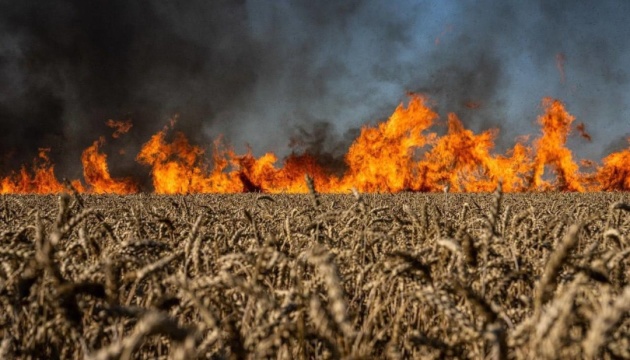
The Food and Agriculture Organization of the United Nations (FAO) reported that Ukrainian agricultural enterprises in crop and livestock production managing up to 250 hectares suffered losses of $3.85 billion as a result of Russia’s full-scale invasion. Due to constant shelling and fragments of missiles and drones hitting farmland, toxic substances are released into the soil, making crop cultivation impossible. Russia also deliberately targets agricultural fields just before harvest to intentionally destroy crops. Not only fields burn, so do nearby forest areas and buildings, as farmland is often located close to residential areas. At the same time, air raid alerts in rural areas do not always activate, especially in frontline zones where warnings often fail to sound in time.
Ukraine’s losses are not limited to contaminated or occupied farmland – they also include the loss of farmers’ lives. In the Kherson region, a 58-year-old farmer named Oleksandr was killed by a Russian drone attack. On the morning of September 5, 2025, an enemy UAV struck the vehicle in which he was working in the field. Oleksandr had been engaged in agriculture for over thirty years. He owned a farming enterprise and headed the regional association of farmers and private landowners. He spoke publicly about how, despite shelling and drone attacks, he defended his fields with a shotgun. According to him, farmers independently carried out demining efforts and removed around 5,000 anti-tank mines from their fields.
These are not isolated cases. Numerous video recordings show Russian drones deliberately targeting farmers, aiming not only to destroy crops and farmland but also to kill farmers themselves. On January 6, 2026, an enemy strike UAV attacked the territory of an agricultural enterprise in the Sumy region and, fortunately, did not explode upon impact. A similar incident occurred on October 7, 2024, in the Odesa region, where a farmer discovered a drone in his field that, fortunately, did not explode and did not destroy the entire harvest. Movement both within and between settlements is extremely dangerous, as a drone can strike at any moment, with a damage radius ranging from 100 to 500 meters or more.
Losses are also not limited to unharvested crops. Russia continuously launches massive attacks on enterprises that produce sunflower oil and process grain. On the night of December 24–25, 2025, Russia carried out a large-scale attack on the Odesa region, damaging an oil and fat processing plant where sunflower seeds are processed and sunflower oil is produced. As a result of a UAV strike, an oil storage tank was damaged, causing a large-scale fire and oil leakage. The fire spread across the production facilities, posing a serious threat to infrastructure and personnel. UAV debris also damaged part of the production block. Notably, December 25 is Christmas, celebrated by Ukrainians and much of the world. Nothing stops Russia – not even Christmas – from destroying everything Ukrainian.
Earlier, on October 30, a grain processing plant was struck, partially destroying the facility. As a result, fuel oil (a petroleum product) leaked into a local reservoir used by residents as a source of drinking water. In addition to the damage to critical infrastructure, civilian homes were also affected. Tragically, a seven-year-old girl was killed; doctors attempted to save her after the attack, but her injuries were too extensive.
Furthermore, constant attacks on Ukraine’s energy infrastructure cause severe damage to enterprises, particularly in the production and storage of food products. The destruction of power plants, substations, and energy networks leads
to frequent and unpredictable power outages, making stable economic activity impossible. For food-related enterprises, uninterrupted electricity supply is critically important. Without power, refrigeration equipment and storage systems cannot function properly, causing food to spoil rapidly. This results in significant financial losses and reduced production volumes.
“Nothing stops Russia – not even Christmas – from destroying everything Ukrainian.”
To mitigate risks, enterprises are forced to reduce inventories, alter logistics, and operate under constant uncertainty. Additional expenses for alternative power sources, including generators and fuel, significantly increase production costs. Small and medium-sized enterprises are especially vulnerable, as they lack sufficient financial reserves. An unstable energy supply affects not only internal business processes but also the market as a whole. Supply chains are disrupted, product availability decreases, and prices rise for consumers. In some cases, enterprises are forced to temporarily suspend operations, negatively affecting regional economic stability.
Ukraine is one of the world’s largest grain exporters, but Russia’s full-scale invasion has threatened global food security. Nevertheless, despite blockades, shelling of port infrastructure, and the mining of agricultural land, agricultural exports continue, and Ukraine continues to “feed the world.”
The Author
Andriievska Anastasiia was a Global Korea Scholarship student from Vinnytsia, Ukraine, in 2024 and 2025. She is now an active Ukrainian and international volunteer.
Cover Photo: In the Donetsk region, a wheat field burns as a result of Russian shelling. (Ministry of Foreign Affairs, Ukraine / evgeniy maloletka)