

Changing to an F-2 Visa
By Dhivyaa S. P. ||
Why does the F-2 visa matter?
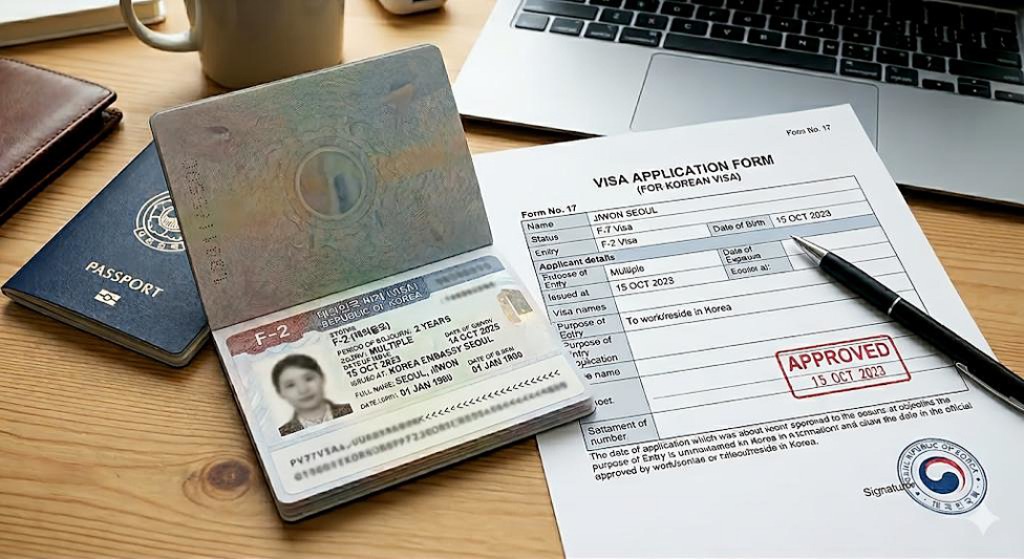
For many foreign residents in Korea, the F-2 visa is an important step toward a more stable life. It is called a resident visa. It is usually for people who have built a real base in Korea, such as skilled workers, professionals, investors, long-term residents, or people who meet special point-system rules.
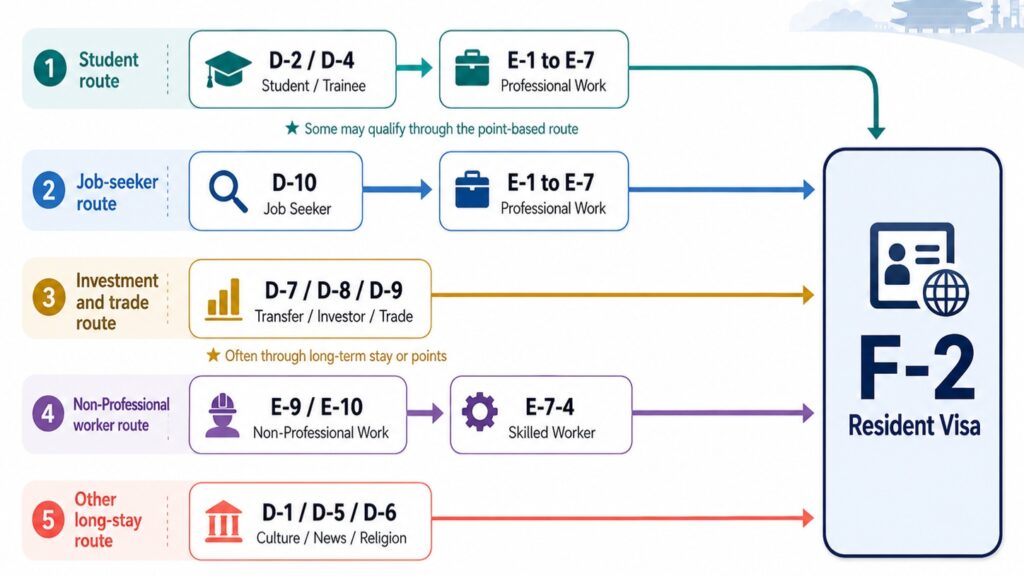
There isn’t just a single path to obtaining an F-2 visa. Different people can reach it from different visa types. The best route depends on your current visa, your work, your income, your Korean language ability, your period of stay, and your record in Korea.
From Student Visas: Many students start with a D-2 student visa or D-4 trainee visa. After graduation, they usually move to a professional work visa, such as E-1 to E-7, and later apply for an F-2 after meeting the requirements. Some students may qualify more directly through the point system if they have strong Korean ability, education, income, and other needed points.
From Job Seeker Visa: The D-10 visa is for job seekers, start-up preparers, and high-tech interns. Most D-10 holders first need to get a qualified job and change to a work visa. Start-up applicants may move from D-10 to D-8 before applying for an F-2 or permanent residence.
From Professional Work Visas: E-1 to E-7 visa holders have one of the clearest routes to an F-2. They may apply through the point system or as long-term residents after several years of legal stay. Stable income, tax records, Korean language ability, and a clean immigration record are important.
From Investment and Trade Visas: D-7, D-8, and D-9 visa holders may also apply for an F-2 through points or long-term residence. These visas include company transferees, investors, entrepreneurs, and trade workers. Investors may have separate routes depending on investment amount and employment conditions.
From Non-Professional Work Visas: For E-9 and E-10 workers, the path is usually longer. They often need to change first to E-7-4 skilled worker status. After that, they may apply for F-2 status if they meet the stay, income, and point requirements.
From Other Long-Stay Visas: D-1, D-5, and D-6 visa holders may qualify as long-term residents. In most cases, Korea looks at legal stay, good conduct, financial ability, and basic knowledge of Korean society.
(GN with OpenAI ChatGPT)
My Experience as a GKS-G Student
My F-2 journey started as a GKS-G student. After completing my master’s degree in Korea, I was recommended by NIIED as an outstanding talent. That recommendation made my case stronger and gave my application a clear direction. Being from a Korean War participating country also helped with points, but the most important part was not nationality alone. It was the combination of study in Korea, recommendation, documents, and total score.
The document preparation was the most stressful part. I had to get a TB test from one of the approved hospitals and submit a criminal background certificate from my home country with an apostille. Among all the documents, the criminal background certificate took the longest time to prepare, so I would strongly advise future applicants to start that first.
For points, I received credit for my age, Korean degree, NIIED recommendation, Korean War participating country category, and volunteer work. Volunteering was especially important because I had done it for three years. For each year, I needed to show at least 50 hours of volunteer work to count it for points. Students who are planning ahead can use the 1365 volunteer website and keep proper records from the beginning.
Getting an F-2 visa while I was still a student felt exciting, but it also came with some surprises. One of the first changes I noticed was health insurance. As a student, I was used to a certain level of payment and support. After changing to an F-2, my insurance situation became different, and the monthly cost could increase depending on income, status, and household situation. It reminded me that a better visa can also bring more adult responsibilities.
The biggest change was mental. On a student visa, I felt like I was still temporary. After receiving my F-2, I felt that Korea was becoming a more serious long-term home. This was a good feeling, but also a little heavy. I had more freedom to work and plan my future, but I also had to understand that every benefit comes with responsibility.
The Author
Dhivyaa believes that every action, no matter how small, contributes to a bigger change. Up Next: Fitness Life.
Cover Photo by GN via Google Gemini.