

Gwangju City News – July 2026
A New Dawn: Jeonnam-Gwangju Special City Sets Sail
The Jeonnam (Jeollanam-do) and Gwangju regions have launched a historic administrative merger on July 1, marking the creation of the country’s first-ever unified special city. The milestone reunites two entities that were separated forty years ago when Gwangju was elevated to a directly-governed metropolitan city in 1986 – a division that shaped the region’s political and administrative landscape for four decades.
Encompassing 3.2 million people and twelve percent of the nation’s territory, this super-regional entity significantly elevates the region’s political standing and confers upon the new mayoralty a cabinet-level status equivalent to that of the mayor of Seoul. With key development rights, administrative licensing powers, and exemptions from preliminary feasibility studies transferred from the central government, the unified city can now swiftly pursue customized public policies and secure national budget funds.
At the helm of this monumental shift, Mayor Min Hyung-bae – elected with over 80 percent of the vote – begins his official tenure guided by two governing pillars: growth and citizen sovereignty. Rejecting top-down bureaucratic approaches, the administration is establishing a citizen-sovereign government where residents participate in designing public policies from conception to implementation. This consensus-driven leadership will serve as the primary mechanism to resolve internal frictions, including the location of the integrated government complex and equitable budget distribution between metropolitan centers and rural communities, with a three-zone, balanced arrangement and rotating regional deputy mayors already proposed.
Economically, the newly created unified special city aims to build a massive ultra-regional ecosystem by blending Gwangju’s advanced artificial intelligence and cultural assets with Jeonnam’s robust renewable energy and semiconductor infrastructure. This industrial foundation is designed to create quality employment and stem the outflow of young talent from the region, supported by a comprehensive mega-transportation network connecting all major regional hubs within a single hour.
On the social and environmental fronts, the city is implementing progressive structural frameworks. To address critical gaps in regional healthcare access, the administration will establish an integrated, distributed medical school model jointly operating across regional universities. Financially, the city will deploy twenty trillion won in special-purpose grants over four years, with 80 percent earmarked for investment attraction and the remainder split between talent development and social safety nets, alongside expanded local tax transfers to fund a pioneering basic income framework. Embracing a sustainable future, the city will also construct a green, circular RE100 ecosystem to build a carbon-neutral metropolis, positioning the unified city as a national model for balanced development beyond the capital region.
Three Regional Specialized High Schools Secure Funding to Foster Tech Talent
The special metropolitan city government announced that three regional specialized high schools – Gwangju Technical High School, Dongil Future Science High School, and a selected high school from the Jeonnam region – have been officially chosen for the Ministry of Education’s 2026 Covenant-Based Specialized High School Project. Following the recent historic merger establishing the unified metropolitan framework, this project expands its regional footprint to build a comprehensive vocational pipeline. This national initiative forms powerful alliances among local governments, education offices, industry leaders, and universities to ensure high school graduates successfully transition from local employment to permanent regional settlement.
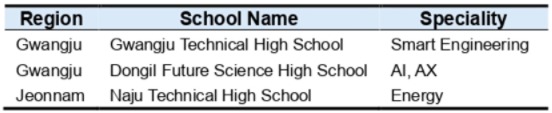
Three high schools in the integrated region selected by the Ministry of Education as covenant-based specialized schools out of 16 nationwide (3rd cohort) in June 2026.
Each selected school will receive up to 4.5 billion won in national funding over the next five years to aggressively redesign curricula, restructure academic departments, upgrade advanced laboratory environments, and expand collaborative industry–academia programs. Gwangju Technical High School will lead training in the smart manufacturing sector by focusing on automated facilities and AI-based manufacturing technologies. Dongil Future Science High School will foster specialists in digital transformation, future mobility, and semiconductors, while the newly added Jeonnam institution will cultivate technical talent tailored directly to the broader region’s strategic industries.
Local authorities attribute this major administrative milestone to a cohesive governance body established earlier to support regional high school graduates, a strategy that aligned perfectly with national policy goals. Leadership from across the newly integrated administrative and educational branches personally participated in the rigorous evaluation process to demonstrate an unyielding institutional commitment. Moving forward, the regional education office will implement a phased rollout encompassing advanced practice lab construction and curriculum design, supported by separate, supplementary funding linked through the local Meister High School framework.
Government and education officials highly praised the breakthrough, calling the selection of the three schools a vital turning point for regional vocational education to grow hand-in-hand with key strategic sectors. They pledged aggressive, unified administrative support to ensure all three institutions successfully solidify their positions as central hubs for developing the highly skilled technical talent needed to drive the newly expanded local economy.
Jeonnam Secures Headquarters of National AI Computing Center in Haenam
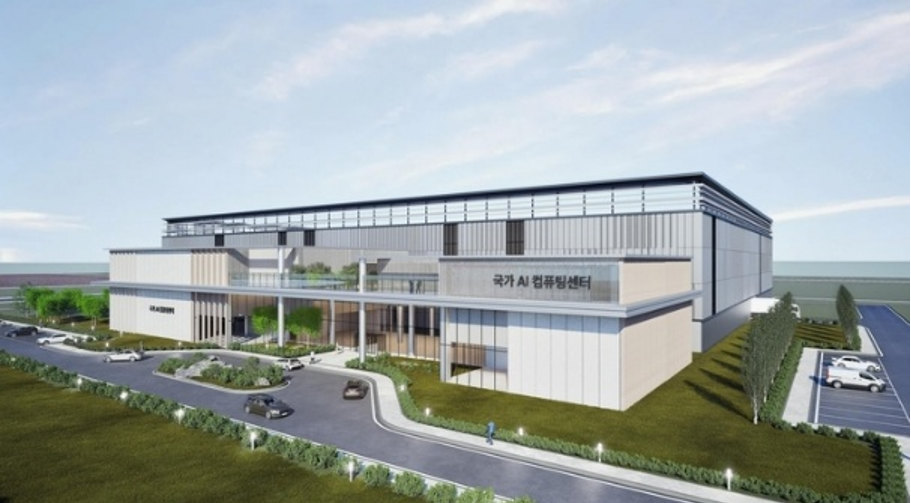
Blueprint of National AI Computing Center planned for Haenam. (Jeonnam)
Jeonnam has achieved a major milestone in its bid to become a global high-tech hub, as the newly formed special purpose company for the National Artificial Intelligence Computing Center has officially chosen Haenam as its permanent headquarters. Despite strong initial pushback to place the corporate headquarters in the Seoul metropolitan area for client accessibility, the province successfully anchored the entity to the actual data center site in Haenam. The corporate body will set up its temporary operations in the SolaSeaDo Promotion Hall in Sanim-myeon, Haenam, before moving into the state-of-the-art facility upon its completion. This decision ensures that Jeonnam will not just host the physical infrastructure but will serve as the administrative and strategic brain of South Korea’s next-generation AI foundation.
The multi-billion won project represents a monumental partnership between the public sector and top-tier tech giants, bringing immense economic weight to the region. Samsung SDS leads the venture as the largest shareholder with a 30 percent stake, while the central government holds 29 percent, and Naver Cloud holds another 26.1 percent. Other major conglomerates – Samsung C&T, Kakao, Samsung Electronics, and KT – are also participating as equity investors. By drawing these industry leaders directly to Haenam, Jeonnam positions itself at the very forefront of the nation’s digital economy, bridging the regional digital divide and creating a brand-new technological ecosystem in the southwestern region.
The regional development of the SolaSeaDo district is set to accelerate rapidly as construction is scheduled to break ground this July or August. Final administrative licensing and power grid impact assessments have already been successfully cleared, allowing the province to avoid the power supply challenges frequently faced by metropolitan data centers. Local development is further boosted as Boseong Construction, an active participant in the broader regional SolaSeaDo development project, is strongly positioned alongside Samsung C&T to handle the construction phase. With a clear target completion date set for 2028, the project will immediately drive regional construction jobs and boost the local economy during the third quarter of this year.
Once fully operational, the Haenam center will house fifteen thousand of Nvidia’s most advanced graphics processing units, which were secured by the government following the Asia-Pacific Economic Cooperation summit. The facility is slated to feature Nvidia’s highly anticipated next-generation Vera Rubin chips, making Jeonnam the home of one of the most powerful computing infrastructures in Asia. Provincial officials view this center as a definitive game-changer that will transform Jeonnam from a traditionally agricultural and maritime region into a core pillar of the national defense, space, and artificial intelligence industries.
Yeosu World Island Exhibition Moves Closer to Completion
The organizing committee for the 2026 Yeosu World Island Exhibition has entered its most critical phase, with only a couple of months remaining until the September grand opening. Executive Director Kim Jong-gi confirmed that construction at the main Jinmo District venue in Dolsan has advanced significantly past the 73 percent completion mark reported last month, entering its final weeks of structural handover and solidifying absolute confidence in the event’s success.
The physical landscape of the main venue has transformed dramatically over the weeks. The signature open cultural space is now fully complete, offering panoramic coastline views for upcoming major performances. Structural steel frameworks for the landmark Theme Island pavilion are entirely erected, and the structural installation of the eight thematic exhibition halls is complete. Curators and tech teams have officially moved indoors to install advanced media systems, keeping the infrastructure strictly on track for full completion ahead of August pilot operations.
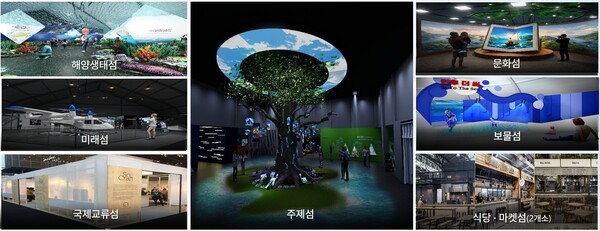
These halls are currently being outfitted to merge cutting-edge technology with maritime nature under the theme Connecting Islands, Sea, and the Future. The Theme Island pavilion is finalizing an immersive media tunnel and a massive symbolic tree sculpture, complemented by an outdoor LED media facade. Specialized spaces like the Marine Eco-Island and Future Island pavilions will feature digital aquariums for protected species, real-world Urban Air Mobility models, and hydrogen-powered vessels. Cultural exhibits from thirty nations are also being assembled alongside interactive marine augmented-reality experiences for families.
The finalized programming schedule for the 61-day exhibition features 133 performances, kicking off on opening day with a creative musical inspired by the local Sinjikki mermaid legend of Geomun Island. The lineup features K-pop festivals, public concerts, and traditional maritime folklore from fifteen countries during the dedicated Island Friends Day. Simultaneously, the Yeosu Expo Site will host global academic events like the International Island Forum and the World Island Cities General Assembly, alongside 27 peripheral events including the 3rd Jeonnam World Gimbap and Salt Festival.
A defining feature of this exhibition is its expansion onto real, inhabited islands. On the island of Gaedo, local communities have finalized 16 immersion programs including coastal camping, arts festivals, and outdoor wellness activities. Geumodo will offer 21 specialized itineraries, showcasing its famous Bireong-gil coastal cliff pathways through stamp tours and native culinary storytelling. Tailored accommodation and dining packages are fully organized, allowing visitors to stay overnight in local villages and experience authentic meals made entirely from indigenous island ingredients.
To maximize attendance, Jeonnam Province and Yeosu City have activated extensive logistical and financial incentives. Passenger ferry fares across six major island routes have been slashed by 50 percent. Under regional travel initiatives, tourists will receive substantial local currency rebates on island lodging and dining, while non-local visitors can get up to half of their expenses reimbursed. Furthermore, 29 public buses across 16 island routes are now operating entirely free of charge, supported by up to 60 weekend shuttle buses and ongoing negotiations to increase KTX train frequencies from Seoul.
Marking this critical countdown milestone, the committee has launched an aggressive promotional campaign across all media channels. Following the online inauguration of 2,026 promotional ambassadors, a nationwide social media push is in full swing. On the streets of Yeosu, public buses wrapped with the official mascot, Daseomi, and flag-bearing taxis are building local momentum, backed by short-form video contests and mobile promotional booths traveling to major metropolitan hubs. Organizers emphasize that with structural heavy lifting finished, the focus has shifted entirely to perfecting an unforgettable visitor experience.
Gwangju and Jeonnam Align Strategies Against Starbucks Controversy
As the newly elected mayor of Jeonnam-Gwangju Special City officially assumes office this July 1, the mega-regional integration transitions into a governing reality. This historic launch coincides with the region’s intense backlash against Starbucks Korea’s controversial May 18 marketing campaign, which local critics argued mocked the historic democratization movement. In response, the newly integrated administrative regions have mobilized a synchronized strategy, demonstrating that the unified metropolitan vision operates seamlessly to defend its historical dignity.
Gwangju continues to anchor the economic response by enforcing strict corporate accountability measures, a stance heavily driven by the political transition. Prior to taking office, newly elected Mayor Min Hyung-bae condemned the corporate event as an arrogant disaster rather than a mistake. This political friction has cast a significant shadow over Shinsegae Group’s 4.2-trillion-won regional investment portfolio, which now falls under the permitting purview of the new leadership. Public outrage has fueled widespread petitions demanding a freeze on Shinsegae flagship projects, including the 2.9-trillion-won “The Great Gwangju” expansion and the 1.3-trillion-won “Grand Starfield Gwangju,” putting the group’s scheduled late-2026 groundbreakings under unprecedented scrutiny.
Simultaneously, Jeonnam has sustained the cultural front through a robust educational and preventative framework designed to fortify regional identity. The Jeonnam Provincial Office of Education countered the corporate narrative by expanding democratic and human rights education initiatives for the summer term. By ramping up youth-centered historical tours of regional resistance sites and broadening the curriculum surrounding state-sponsored violence, Jeonnam transforms a public relations disaster into systemic educational reform, ensuring that the collective memory of the unified territory remains resilient.
Viewed from the desk of the newly inaugurated leadership, these actions reveal a sophisticated division of labor within the unified special city. While Gwangju utilizes administrative leverage to scrutinize major corporate investments and enforce economic boycotts, Jeonnam secures the generational high ground through long-term educational supports. This coordinated approach signals to the rest of South Korea that the Jeonnam-Gwangju Unified Special City begins its official tenure with an unyielding commitment to defending its historical legacy.
Compiler
Amy Park is a content producer and the program officer for the ALRC Korea, based in Gwangju. She helps build the organization’s foundation and supports new efforts in human rights advocacy and resource sharing.
Cover Photo: 2026 Island Expo Images. (Island Expo Steering Committee)