

Global Expedition to Mongolia: Sharing Inclusive City Values
By Park Yeonju
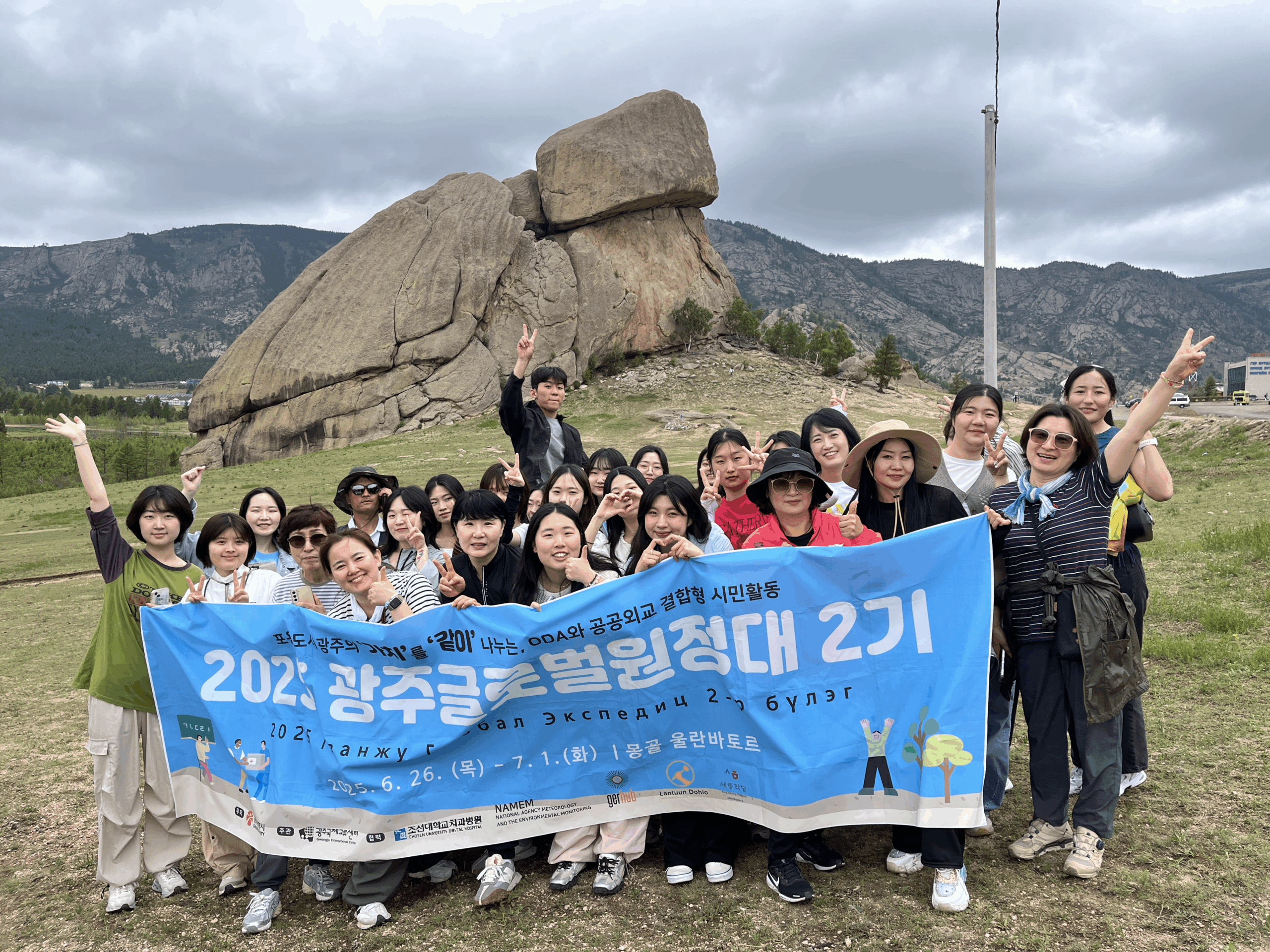
This summer, from June 26 to July 1, the Gwangju International Center carried out a public diplomacy project in Ulaanbaatar, Mongolia. A group of 28 Gwangju citizens participated in three teams: the Education Team, the Korean Culture Team, and the Onsite Support Team. After about a month of preparation, they embarked on their journey to Mongolia, joined by three Mongolian students residing in Gwangju, as well as a dental team from Chosun University Dental Hospital. The Gwangju Global Expedition began its first program in Cambodia in early 2024 and has now conducted its second round this year. Any Gwangju citizen who wishes to contribute to the value of public diplomacy is welcome to participate. The program brings together people of all ages – from high school and university students to retirees.
“Inclusive City Gwangju”
To promote the meaning of “Inclusive City Gwangju” to the world, the 2025 Gwangju Global Expedition is a citizen-led initiative that combines ODA (Official Development Assistance) with public diplomacy. “Public diplomacy” refers to a wide range of diplomatic activities carried out not just by governments but also by ordinary citizens and various civil society organizations. This year’s Gwangju Global Expedition organized a wide range of public diplomacy activities. Each participant contributed by drawing on their academic background and personal experience. Activities included hygiene education, K-pop dance classes, introductions to the city of Gwangju, and caricature drawing. Their efforts extended from self-planned public diplomacy projects to village volunteer work and climate and environmental activities.
It was a meaningful time not only to share the value of giving with the citizens of Gwangju, but also to reflect on Mongolia’s climate crisis. Before their departure, participants had the opportunity to deepen their understanding of public diplomacy and international development cooperation. They attended a lecture on public diplomacy by a professor from the Department of Political Science and International Relations at Chonnam National University. They also received an ODA lecture from the director of the Gwangju Center for International Development Cooperation. This deeper understanding laid a solid foundation for future public diplomacy efforts.
Sister Cities
Ulaanbaatar, the capital of Mongolia, signed a sister-city friendship agreement with Gwangju Metropolitan City in 2016. Marking the tenth anniversary of the agreement this year, the two cities have maintained a close and lasting relationship. With the excitement of carrying out public diplomacy in a city with such strong ties to Gwangju, the Gwangju delegation arrived in Mongolia after a three-hour flight from Korea.
Focus on the Climate
On the first day the team visited NAMEM – Mongolia’s National Agency for Meteorology and Environmental Monitoring. They learned about the country’s climate changes, the climate crisis it faces, and its impact on agriculture. Mongolia, with its vast territory, is experiencing rapid desertification across large areas. To combat this, NAMEM is working to monitor environmental conditions and prevent desertification through tree-planting efforts.
They also mentioned that Korea is the only country that visits regularly for tree-planting volunteer work. This made the Gwangju Global Expedition’s scheduled tree-planting activity even more meaningful during the visit to NAMEM. After learning about the current state of Mongolia’s climate and environment, participants engaged in an open Q&A session. They asked questions ranging from how well the trees are being maintained to how interested Mongolian youth are in the climate crisis. It was a valuable opportunity to gain a deeper understanding of Mongolia’s overall climate and environmental conditions.
The team also visited the Forecasting Department, where they observed real-time weather changes on screen and took a closer look at how climate data is analyzed. By watching firsthand how weather forecasts are produced in Mongolia, participants gained a deeper understanding of Mongolia’s climate system. Next, the team visited the Supercomputer Room – a facility every national weather agency possesses. They received an in-depth explanation of how the supercomputer operates 24 hours a day and how the system is managed. Inside the room was the Automated Weather Observation System, installed by Korea. Seeing the logo of the Korea Meteorological Administration and the Korean flag brought a sense of familiarity, and it was a reminder of the strong technological ties between Korea and Mongolia.
Educational Activities
At the Ger Innovation Hub, Education Team 1 conducted hygiene education, while the Medical Team provided one-on-one tooth brushing guidance and oral health education. The Korean Culture Team ran a bracelet-making booth, where Mongolian children changed their names into Korean to experience the beauty of the Korean language.
Education Team 2 led activities ranging from traditional fan-making, showcasing Korean aesthetics, to dynamic taekwondo classes held outdoors with the children. The Onsite Support Team collaborated with the Korean Culture Team’s Hanbok-Wearing booth by taking hanbok-themed photographs. They also offeredexperiences such as hair styling and caricature drawing, providing a variety of fun activities for the children. The children’s faces lit up with bright smiles when they saw the adorable caricatures capturing their unique features.
At first, the children were shy and hesitant, despite their curiosity. However, as they engaged in the activities, they gradually opened up and became more comfortable. By the end, they were fully immersed in the ODA program, enjoying every moment without even noticing the passage of time. In the afternoon, the Korean Culture Team and Onsite Support Team carried out public diplomacy activities centered on Korean Culture at the King Sejong Institute, located at the National University of Mongolia. One participant of the Korean Culture Team gave a presentation introducing Gwangju and shared information about TOPIK, the Korean language proficiency test, deepening students’ understanding of Korean language education.
Korean Cultural Experiences
The Korean Culture Team then launched into a variety of cultural experiences, including trying on hanbok attire and Korean-style makeup, as well as Korean calligraphy, taekwondo, and a K-pop dance class. During the K-pop class, students learned the choreography for Jennie’s “Like Jennie,” a hit song that has recently gained popularity both in Korea and abroad. Although many found it difficult at first, as they relaxed, they began to follow the rhythm and fully enjoy the dance. The following day marked the official launch of the ODA activities with a tree-planting initiative. The team visited the desertified area of Moltsukh Els, a dune formation located in the South Gobi region of Mongolia, and also toured the Forest of Coexistence in Bayanhongor.
To Conclude
Though we spoke different languages, we became one under the shared theme of Korean culture. The curious eyes of the Mongolian children at the beginning and how they gradually grew close to the members of the Global Expedition, eventually walking hand in hand, remain unforgettable moments. It was deeply meaningful to carry out citizen-led public diplomacy in Ulaanbaatar, a sister city of Gwangju. Public diplomacy is something that can be practiced in everyday life, anywhere. The Gwangju International Center continues to develop new public diplomacy initiatives to strengthen exchanges with sister and friendship cities. The 2025 Gwangju 2nd Global Expedition created unforgettable memories of cultural exchange with Ulaanbaatar, Mongolia.
Forest of Coexistence
The Forest of Coexistence is a project jointly promoted by the international environmental organization Green Asia and the Korea Forestry Promotion Institute under the Korea Forest Service. It began in 2022 and aims to prevent desertification through tree planting. The project not only focuses on sustainable forest management but also seeks to empower local communities toward self-reliance. As part of this effort, members of the Gwangju Global Expedition each planted a tree to help sustain Mongolia’s forests. They gave names to their trees and attached message plaques filled with hope, wishing for climate stability not only in Mongolia but around the world.
Magic Land
At the “Magic Land” Mongolian Child Center, further ODA and public diplomacy activities were carried out. One of the highlights was the Korean Traditional Game Festival, where children had the chance to experience traditional Korean games. The festival featured a competition that included games such as ttakji-chigi (slap-match), tuho (arrow throwing), jegi-chagi (Korean hackysack), gonggi (jacks), archery, and tug-of-war. The children enthusiastically participated in each game, and the atmosphere was filled with cheering and laughter, creating an exciting and joyful experience for all.
The Author
Park Yeonju is an undergraduate at Chonnam National University, majoring in political science and diplomacy as well as Chinese language and literature. Her third major is international development cooperation studies. She was born and raised in Gwangju and wants to promote the colorfulness of the city that she has been a part of for so long.
Cover Photo courtesy of the Gwangju International Center (GIC).