


Justice in the City: Refugee Children, Mothers, and Urban Life
By Reeti Roy ||
Urban life offers both sanctuary and marginalization. For refugee children and their mothers, cities can be places of safety, but they can also be spaces where exclusion, precarity, and uncertainty shape the everyday. This article draws on my work with refugee children in London, my training in social anthropology, and my wider engagement with policy and human-centered programs to examine how justice is lived and contested in the city, and what urban actors can do to strengthen protection, dignity, and inclusion.
Seeing the City Through Children’s Eyes
When I first began volunteering as a play worker with the British Refugee Council, my journals quickly filled with observations that illustrated the complexity of urban life for displaced families. Anthropologist Liisa Malkki (1995) observed that displacement unsettles everyday categories of belonging. In London’s shelters and day centers,
I saw this unfold in real time: children navigating a city not built with them in mind, yet inventing moments of joy within it.
Many of the children I met wanted what any child wants: a school to attend, friends to play with, a safe place to imagine their future. Yet they were often moved from one shelter to another, their routines repeatedly disrupted by the demands of displacement and urban precarity.
Mothers Carry the City on Their Shoulders
The mothers who brought their children to the Day Centre carried immense burdens. Many had fled persecution tied to political dissent, sexuality, or religion. They faced legal uncertainty, restrictions on work, and the exhaustion of navigating social services. Research consistently highlights the gendered labor of survival during displacement (UNHCR, 2020), and I witnessed that labor daily.
Despite barriers to welfare, healthcare, and education, mothers created routines, formed informal support networks, and advocated fiercely for their children’s well-being. Justice in the city requires making this invisible labor visible and reducing the structural pressures that demand it.
Evidence, Policy, and the Realities of Urban Displacement
In the UK today, approximately 515,700 refugees live in the country, around one per cent of the population (UNHCR UK Data Portal, 2024). In the year ending March 2025, 109,343 people claimed asylum (UK Home Office, 2025). These numbers shape local service provision, school availability, and the pressure on temporary accommodation.
Common barriers faced by asylum-seeking children include delays in school enrollment, isolation due to accommodation location, language barriers in healthcare, limited parental ability to work, and financial stress affecting nutrition and stability. Cities must recognize that these barriers are structural, produced by policy design rather than personal failure.
Urban Spaces: Between Opportunity and Exclusion
Cities are celebrated for opportunity, yet for many displaced families, infrastructure amplifies vulnerability. Research on right to the city frameworks (Harvey, 2003) reminds us that access is not merely about physical proximity but about practical usability.
For refugee families, a school may exist but be unreachable without transport subsidies. A park may be nearby but feel unsafe due to policing or discrimination. A clinic may be open yet inaccessible without interpretation.
Abdou Maliq Simone’s (2004) notion of people as infrastructure is particularly useful here. Refugee mothers act as infrastructural agents, navigating, negotiating, and stitching together fragile networks of safety across the city.
From Observation to Action: The Role of Anthropology
My training in social anthropology has shaped how I observe, listen, and translate lived realities into policy insights. Participant observation allows attention to the small details: how children reclaim space through play, how mothers share information in waiting rooms, how families negotiate uncertainty over months or years.
Anthropological methods help identify gaps often overlooked by quantitative assessments, offering what Veena Das (2007) described as the anthropology of the everyday, where suffering and repair coexist. This approach is essential for designing interventions that reflect real needs.
Linking Past and Present: Policy, Law, and Lived Realities
My work with Dr. Shashi Tharoor, member of Parliament and former UN under-secretary-general, demonstrated how laws and policies shape the lives of displaced communities. I worked on the National Commission for Minorities and aided him in research pertaining to the UNHCR in my capacity as legislative assistant (legislative aide) to a member of Parliament. Legal frameworks can protect but can also generate exclusion if they fail to account for lived realities.
Today, as CEO of Aglet Ink, I design human-centered programs informed by research, field observation, and community engagement. Across contexts, one truth remains clear: Justice requires systems that listen before they legislate.
Storytelling as Advocacy
Stories reveal the emotional and social dimensions of displacement. In the Day Centre, I met a young man who longed for university but was denied stable education due to years of temporary accommodation. Such stories show how urban systems determine futures.
As NGOs increasingly use narratives for advocacy (UNICEF, 2021), storytelling becomes a tool for visibility, ensuring that policymaking reflects lived experience rather than abstract categories.
Justice in the City: Principles for Urban Action
- Accessibility must replace theoretical availability. Interpretation services, transport support, and decentralized information points are essential. Without these, access remains symbolic.
- Reduce legal and welfare precarity. Shorter asylum timeframes, expanded work rights, and strengthened welfare support directly improve children’s well-being.
- Create inclusive, trauma-sensitive public spaces.
Urban planning must include child-friendly design and safe community spaces, particularly for women and children affected by displacement.
These principles align with existing urban inclusion frameworks (UN-Habitat, 2022) and require collaboration between local authorities, civil society, urban planners, and displaced communities themselves.
Conclusion: Cities as Sites of Possibility
Cities reflect the decisions of those who build, govern, and navigate them. For refugee children and mothers, justice in the city is found not only in policy but in daily life: the route to school, the safety of a shelter, the ability to play, and the reliability of welfare support.
The lesson I carry from my work is simple: Observe, listen, understand, and act. When cities prioritize their most vulnerable residents, they become more humane, more just, and more livable for everyone.
References
- Das, V. (2007). Life and words: Violence and the descent into the ordinary. University of California Press.
- Harvey, D. (2003). The right to the city. International Journal of Urban and Regional Research, 27(4), 939–941.
- Malkki, L. (1995). Purity and exile: Violence, memory, and national cosmology among Hutu refugees in Tanzania. University of Chicago Press.
- Simone, A. (2004). People as infrastructure: Intersecting fragments in Johannesburg. Public Culture, 16(3), 407–429.
- UN-Habitat. (2022). Inclusive cities: Policies for social cohesion.
- UNHCR. (2020). Women on the move: Refugee women and gendered survival strategies.
- UNHCR UK Data Portal. (2024). UK refugee statistics. UNHCR.
- UK Home Office. (2025). Asylum statistics, year ending March 2025.
- UNICEF. (2021). Storytelling for social change.
The Author
Reeti Roy is a writer and researcher with a master’s degree in social anthropology from the London School of Economics, where her thesis examined refugees, internally displaced persons, and narratives of trauma. This article is based on a September 2025 guest lecture delivered at Ewha Womans University.
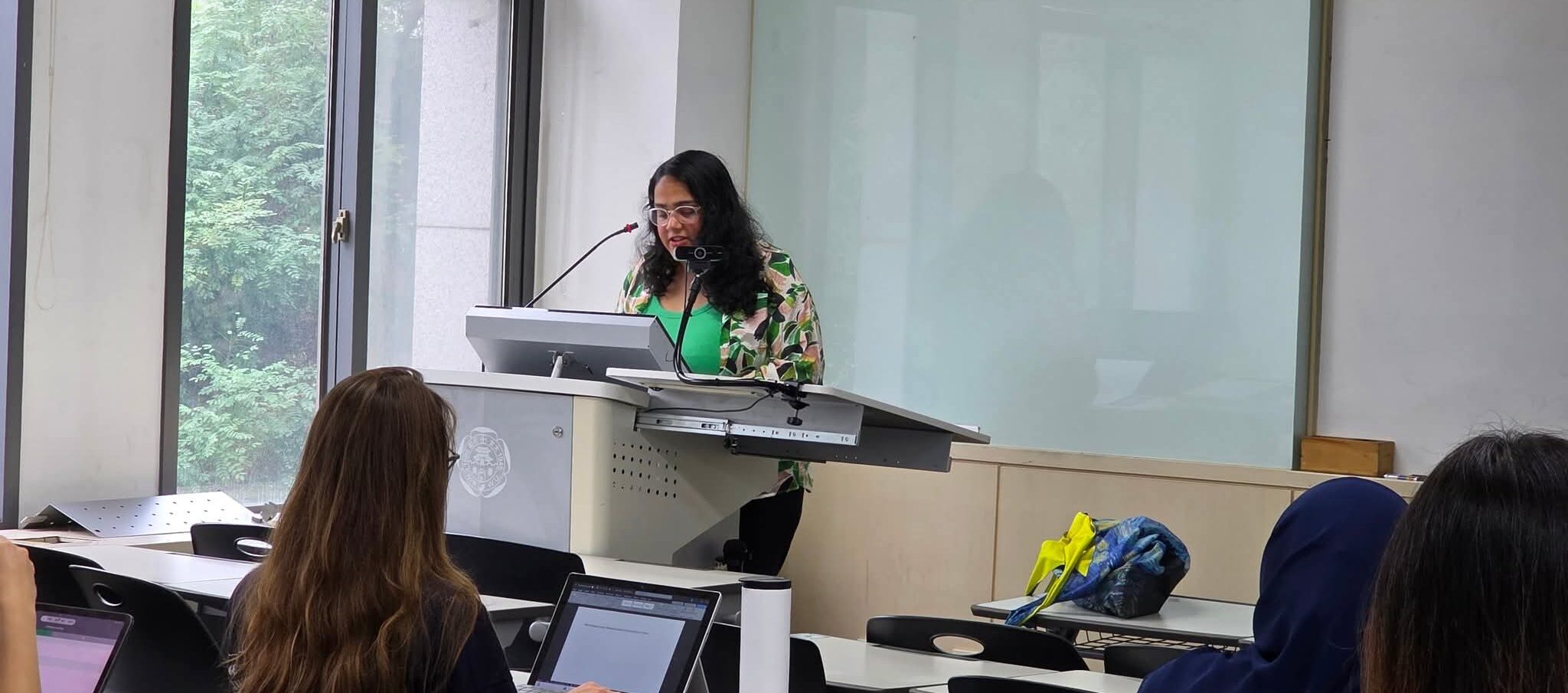
Cover Photo: The author addresses students and professionals on personal insights at the British Refugee Council, courtesy of Reeti Roy.