






Valentine’s Day: Love, Money, and the Planet
By Neha Bisht ||
Every year on February 14, hearts, roses, chocolates, and candlelit dinners take center stage across continents. Valentine’s Day, often seen simply as a celebration of romance, has quietly grown into a powerful global economic event – one that moves billions of dollars, sustains industries across regions, and leaves a visible environmental footprint. Behind the sweetness lies a complex story of global trade, consumer behavior, and environmental responsibility.
Valentine’s Day as a Global Economic Engine
What appears to be a single-day celebration now functions as a multi-billion-dollar global economic engine, with distinct roles played by different regions across the world.
In the United States, Valentine’s Day represents the largest single-market spending surge globally.
According to a 2025 National Retail Federation survey, Americans were estimated to spend around USD 27.5 billion on the holiday, with average per-person expenditure approaching USD 180–190. Spending is concentrated on jewelry, dining, flowers, chocolates, and experiential gifts, making Valentine’s Day a strong indicator of discretionary consumer confidence.
Across Europe, spending is more fragmented but remains substantial. Countries such as the United Kingdom, France, and Germany collectively contribute billions of euros each year. According to Forbes, the UK alone was expected to generate over £1.3 billion in Valentine’s-related sales, while average per-person spending across Western Europe ranges from €80 to €110. European consumers increasingly prioritize experiences – romantic dinners, short trips, and cultural events – over purely material gifts, reflecting broader lifestyle and sustainability trends.
Asia: An Emerging and Diversifying Valentine’s Market
In Asia, Valentine’s Day spending is lower in absolute terms than in Western economies, but it is growing at a significantly faster pace. Countries such as Japan, South Korea, China, and India have adapted the holiday to local customs, often extending it into multi-day or multi-stage celebrations. While per-capita spending remains modest, the region shows double-digit annual growth rates of approximately 12–15%, driven by urban youth culture, rapid e-commerce expansion, and Western cultural influence. In many Asian economies, Valentine’s Day remains an emerging commercial opportunity rather than a mature consumer market.
In South Korea, Valentine’s Day has become a noticeable commercial event, particularly among younger urban consumers. Spending is largely focused on chocolates, flowers, dining, and shared experiences, rather than luxury gifts. South Korea’s floriculture sector depends on a mix of domestic production and imports, with imported flowers accounting for around 30 percent of total flower consumption. During Valentine’s Day, demand for imported roses and cut flowers rises, linking Korean consumers to global supply chains – particularly to South America.
Compared with Japan and China, where Valentine’s Day has expanded into multi-stage, high-volume gift economies, South Korea’s market remains smaller and more restrained, characterized by lower per-capita spending but a similarly strong reliance on imported flowers and chocolates.
Producers Behind the Celebration: Africa and South America
While North America, Europe, and parts of Asia dominate Valentine’s Day consumption, Africa and South America form the production backbone of the global celebration.
In Africa, particularly Kenya and Ethiopia, floriculture plays a critical economic role.
During the 2025 Valentine’s Day season, Kenya exported approximately 4,200 metric tons of roses, generating hundreds of millions of dollars in export revenue. Valentine’s Day represents a crucial income period for the African flower industry, supporting tens of thousands of workers, many of them women. In addition to floriculture, West African countries such as Côte d’Ivoire and Ghana play an indirect but essential role by supplying cocoa used in Valentine’s Day chocolate production worldwide.
South America plays a similarly vital role as a producer. Colombia and Ecuador rank among the world’s largest exporters of cut flowers, supplying the majority of roses to the United States and Europe during the Valentine’s Day season. According to FloralDaily, Colombia exported approximately 59,000 metric tons of cut flowers during the 2024 Valentine’s Day period, with the United States accounting for nearly 76 percent of total shipments. Colombian flowers also reached other key markets, including the United Kingdom (5%), Canada (3%), the Netherlands (3%), and Japan (3%), as well as more than 100 additional countries worldwide.
Furthermore, according to Floriexpo, FedEx Corporation, one of the world’s largest logistics companies, announced that it expected to transport around 800,000 kilograms of flowers from Colombia and more than 290,000 kilograms from Ecuador during February 2025, highlighting the scale of South America’s contribution to Valentine’s Day supply chains.
Although Valentine’s Day is celebrated locally in both regions, consumer spending remains modest compared to Western markets, with greater emphasis placed on dining, social gatherings, and shared experiences rather than high-value gifts.
Together, these regions illustrate how Valentine’s Day links producers in the Global South with consumers in wealthier economies through highly globalized and time-sensitive supply chains.
The Environmental Cost of Romance
Behind the economic boost lies a less romantic reality. Valentine’s Day carries a significant environmental footprint:
- Carbon emissions increase due to air freight transporting flowers from Africa and South America to Europe, North America, and Asia.
- Flower cultivation requires intensive water use, fertilizers, and pesticides, placing stress on local ecosystems, particularly in water-scarce regions.
- Packaging waste, including plastic wraps, decorative boxes, ribbons, and greeting cards, often becomes single-use landfill waste.
- Chocolate production, driven by seasonal demand, has been linked to deforestation and biodiversity loss when cocoa supply chains lack sustainability safeguards.
In this way, a celebration intended to express love can unintentionally contribute to environmental degradation – a lack of love for our planet.
Shifting Trends: Redefining Romantic Consumption
Encouragingly, consumer behavior is beginning to evolve. Across the U.S., Europe, Asia, and emerging urban markets, people are increasingly choosing more conscious expressions of love, such as locally grown or seasonal flowers, fair-trade chocolates supporting cocoa farmers, recyclable or minimal packaging, and experience-based gifts over material excess.
Producers and retailers are also responding by adopting ethical labor certifications, water-efficient farming methods, and lower-carbon logistics.
Love Beyond Consumption
Valentine’s Day now reflects the realities of a deeply interconnected world economy. A bouquet exchanged in New York may be grown in Colombia, while chocolates shared in Paris may trace their origins to cocoa farms in West Africa. These connections reveal both the economic opportunities and environmental responsibilities embedded in modern romance.
As Valentine’s Day continues to evolve, its future may depend less on how much is spent and more on how thoughtfully love is expressed – toward partners, communities, and the planet itself. After all, care that endures is the most meaningful form of love.
The Author
A native of India, Neha Bisht is pursuing her PhD research at Chonnam National University’s School of Materials Science and Engineering. She loves to meet new people and make new friends. Neha endeavors to contribute to the well-being of society in whatever way she can.
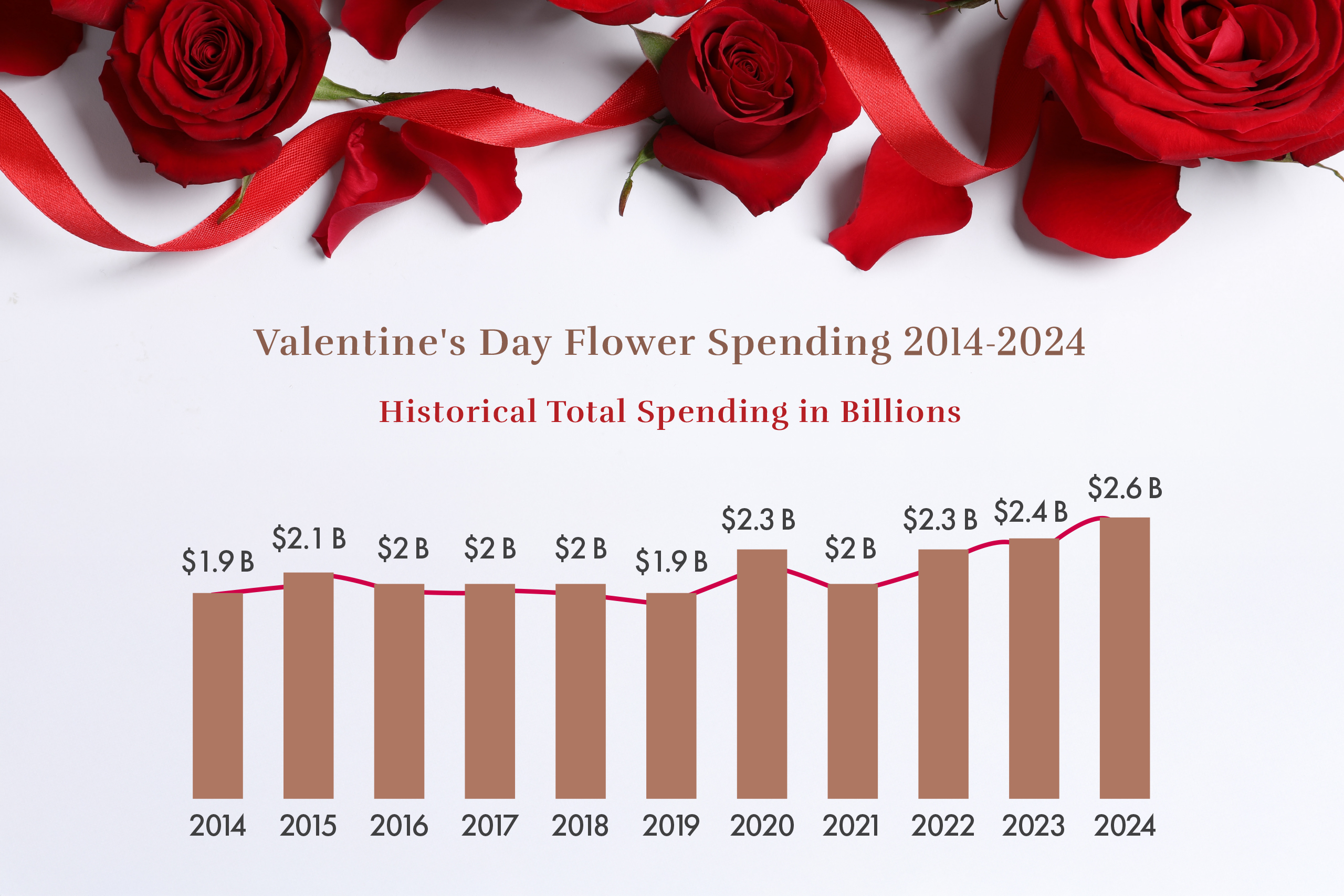
Cover Photo: (https://www.rioroses.com/valentines-day-spending-trends-what-the-numbers-mean-for-your-floral-business/)