

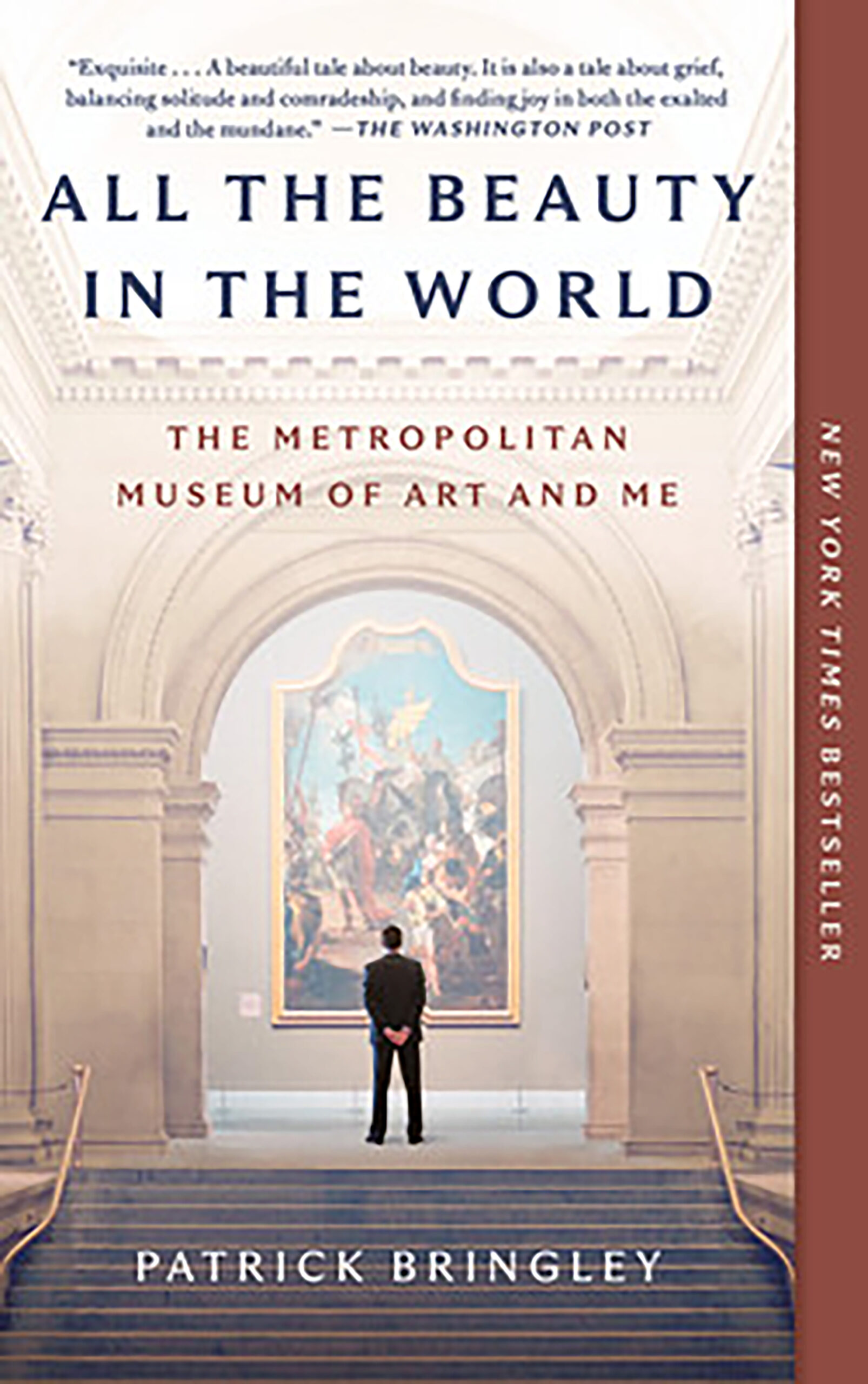





All the Beauty in the World
By Michael Attard ||
All the Beauty in the World: The Metropolitan Museum of Art and Me
By Patrick Bringley
240 pages, Simon & Schuster, 2023
The author, Patrick Bringley, is trying to escape from time, or at least to make it stand still. Yet his story in a chronological order, covers about ten years of his life from his mid-twenties to mid-thirties, including side trips into the world of art. The need to not move follows the death of his older brother Tom at the age of twenty-seven. “My heart is full, my heart is breaking, and I badly want to stand still awhile.”
The world of art provides his refuge, as he has grown up believing the world of art is “an entirely beautiful one.” What better place could there be for him to just stop and be? He was excited with the discovery of a loophole, allowing him to “drop out of the forward-marching world and spend all day tarrying in an entirely beautiful one” – this being a job as a security guard at the New York Metropolitan Museum of Art.
In the beginning he says, “I feel something like a traveler in a strange and distant land.” Reluctant to make friends, he enters into relationships with particular pieces of art. One such piece is the portrait of a young man by the artist Titianus, known in English as Titian. He describes it as “fluently executed, … it appears like a chance reflection on a sun-dappled pond.” Throughout the book, the author excels at translating the visual into poetic clarity.
While adoring his privacy, he often refers to the museum visitors, offering a somewhat lightness and humor to the book. He claims that there are three distinct types of lovers: “The Art Lover, quiet, intent looking … the face doesn’t move much but the mind is furiously churning.… Lover of the Met itself, a local who’s known it as a secular church…. Finally, there are the Lovebirds, who flutter through the galleries … where silences aren’t awkward.”
For the author, the world of art is not a parallel universe; it is very much of this world. But he is uncertain about the relationship. “I am sometimes not sure which is the more remarkable: that life lives up to great paintings, or that great paintings live up to life.” He finds what I think can be called a balance in Pieter Bruegel’s The Harvesters. The backdrop is a “deep landscape” with a church, harbor, and rolling fields. But the heart of the painting is in the foreground, where nine peasants “have broken from their labor to sit and sup beneath a pear tree.” This would have been such a commonplace scene in Bruegel’s time that it would have taken an effort to notice it. “But he [Bruegel] did notice it.”

Patrick Bringley. (Jason Wyche/Simon & Schuster)
The slow coming to terms with his brother Tom’s death is never far removed from the protection of art’s beauty. He understands that losing someone puts a hole in life, and he realizes that through his security guard job, he has seized the “opportunity to conflate my hole with a grand cathedral, to linger in a place that seemed untouched by the rhythms of the everyday.” He realizes that grief is a loss of rhythm, but as time passes, he says, “I don’t wish to stay quiet and lonesome forever.”
To be clear, the author’s story has nothing to do with depression. In fact, apart from his private struggles, his life is harmonious. He marries and has two children. But his family, and coworkers, while taking prominence in certain situations are not pertinent to the story. There is no need for character development, as this memoir is more like the sharing of an intimate diary.
The theme of a common place within art, as per Bruegel’s The Harvesters, is also expressed clearly through the author’s relationship with the statue of a young Greek male called a kouros. As he often does, the author piques the readers’ interest via a description of where he is in the museum. And often, as in this case, the reader is provided with a historical setting. Transported back in time, we land “about a hundred-fifty years after Homer and a hundred-fifty years before Socrates.” I for one, found the book’s historical contextualization to highlight not only the temporal movement of wonders on display but to emphasize the human link between then and now.
Kouros translates as “male youth,” and the one in the Metropolitan Museum of Art is made of marble, has a height of 1.84 meters, and dates circa 600 BCE. The author is struck by the beauty and the commonness: “But this young man is not a pharaoh, not a king, and not a god … the kouros was a grave marker, carved simply to say ‘This was a mortal man.’”
The time comes to leave the museum and to start another chapter of his life. The author’s story of his time as a security guard at the Met is much like that of a person in the hot desert coming across an oasis. The beauty within the museum nourishes him until he is ready to again venture forth. For art lovers and those uninitiated, being surrounded by All the Beauty in the World is a repose from all that hinders you.
The Reviewer
Michael Attard is a Canadian citizen but has lived in Gwangju for over twenty years. He has taught English as a second language in academies and within the public school system. He is officially retired and spends time reading, writing, hiking, and spending time with friends.
Cover Photo credit: (Simon & Schuster)