





The Beauty Inside: The Man with No Face
By Farrukh Anique ||
Title: The Beauty Inside (뷰티 인사이드)
Director: Baek Jong-yeol
Year: 2015
Genre: Fantasy, Romance, Drama
Cast: Han Hyo-joo, Kim Dae-myung, Park Seo-joon Where to watch in Korea: Disney+, Netflix
In 2012, Intel and Toshiba produced an unusual six-part “social film” called The Beauty Inside. Its central idea was simple enough to be explained in one sentence: A man wakes up every morning in a completely different body. His age, face, race, and even gender may change, while the person living somewhere inside that body remains the same. Three years later, Korean director Baek Jong-yeol took that premise and turned it into a feature film.
The question at its heart is one that human beings have probably asked in one form or another for centuries: When we say that we love someone, what exactly is it that we love? The face? The voice? The body? The familiar way someone walks into a room? Or is there somewhere beneath all this a person whom we would continue to recognize even if every visible sign by which we knew them disappeared?
Woo-jin is a furniture designer who has lived with a strange condition since his eighteenth birthday. Every time he falls asleep, he wakes in a different body. Today he may be a handsome young Korean man; tomorrow an elderly woman; the following morning a Japanese woman, a middle-aged man, or perhaps someone whose language he cannot even speak properly. There is no pattern and no cure. So, he builds his life around anonymity.
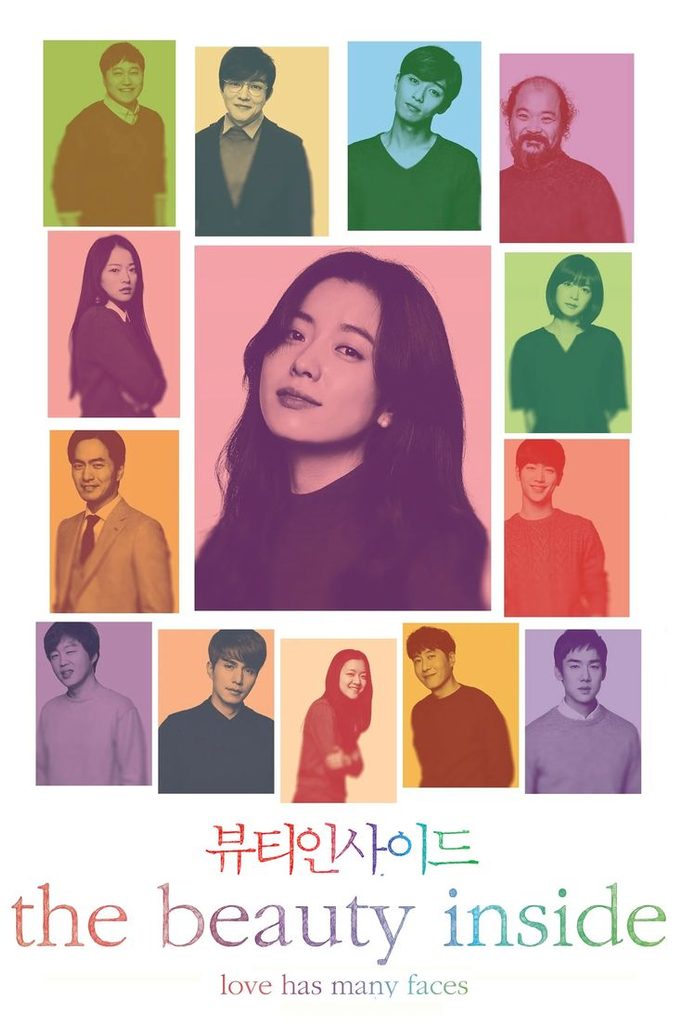
Official poster for The Beauty Inside. (Next Entertainment World)
He works from home, designs furniture, and keeps only one close friend, Sang-baek, who has known his secret for years. His computer contains countless photographs and videos through which he keeps a record of all the bodies he has inhabited. His identity survives not in a face but in memory: the furniture he has made, the people he loves, the things he knows, and the small habits that remain his no matter what reflection greets him in the mirror.
“When we say that we love someone, what exactly is it that we love?”
But then he meets Yi-soo. She works in a furniture store, and perhaps that profession is not accidental. Furniture occupies an interesting place in this film. A chair may be made from different pieces of wood, different fabrics, different joints and surfaces, yet what matters finally is whether the person sitting in it feels at home. Woo-jin is himself something like that: The exterior changes endlessly, while somewhere within all those changing materials, the same design remains.
Woo-jin begins visiting the store simply to see Yi-soo. The difficulty is obvious. A conventional lover can spend weeks gathering courage before asking someone to dinner. But Woo-jin must also worry about what face he will have when morning arrives. One day he wakes as an exceptionally handsome young man and decides that fate has finally given him his chance. He goes to the store, speaks to Yi-soo, invites her to dinner, and spends the next few days desperately avoiding sleep so that the same face will remain long enough for her to know him. It is a charming section of the film, and deliberately so. Woo-jin has momentarily been granted what every ordinary man takes for granted: continuity. Yesterday’s face will still be there tomorrow. The woman who smiled at him tonight will recognize him when she sees him in the morning.
Eventually, of course, his exhausted body gives in. He sleeps. The handsome young man disappears.
And Woo-jin must decide whether to let Yi-soo disappear with him or tell her something so absurd that no reasonable person could be expected to believe it. He chooses the truth. From this point onward, The Beauty Inside becomes much more interesting than its fantasy premise initially suggests. The real difficulty is not convincing Yi-soo that Woo-jin changes bodies. Once she sees the evidence, that part is relatively easy. The difficult question is whether knowledge can substitute for recognition. She may know intellectually that the stranger standing outside her workplace is Woo-jin. But knowing is not the same as recognizing. For the rest of us, love is built partly upon thousands of tiny repetitions. We learn a face. We recognize footsteps approaching a room. We identify a voice through a telephone before a name is spoken. In a crowd, our eyes automatically search for one particular shape. These things seem trivial until the film removes every one of them.
Yi-soo receives none of those comforts. Every morning she meets her boyfriend again for the first time. Some days Woo-jin is handsome. Some days he is old. Sometimes he is a woman. Sometimes he appears so different from the man she was holding the previous evening that even touching him requires her to overcome the instinctive hesitation one has before touching a stranger. This is where I think the film’s title acquires its real meaning. “The beauty inside” sounds at first like the familiar moral lesson that physical appearance does not matter and that true beauty lies within. But the film is more convincing when it refuses to make the issue that simple. Appearance does matter. Not because beautiful people deserve more love but because human relationships are embodied relationships. We do not love invisible souls floating in empty space. We love people through faces, voices, gestures, smells, hands, and physical memories.
Yi-soo’s struggle therefore does not make her shallow. On the contrary, it makes her human. Woo-jin has had years to become accustomed to his condition. Yi-soo is expected to reconstruct her entire understanding of intimacy almost overnight. Whenever she enters a restaurant, she does not know which stranger is waiting for her. When somebody approaches her affectionately in public, she must first ask herself whether this person is her lover. Even the simple act of introducing him to another person becomes nearly impossible.
Gradually, the strain begins to show. And this is one of the film’s more mature decisions. It does not pretend that love, simply because it is sincere, automatically cures every practical difficulty surrounding it. Yi-soo loves Woo-jin, yet loving him begins to exhaust her. Her anxiety grows until medication enters her life. Woo-jin, seeing what the relationship is doing to her, arrives at the conclusion many lovers reach for far less extraordinary reasons: Perhaps loving someone sometimes means leaving them alone.
There is another layer to Woo-jin’s condition that deepens this idea. He eventually learns that what he had considered his own private curse had existed before him as well. His father suffered from the same condition. The man had not simply abandoned his family, as Woo-jin had long believed. He had disappeared because he thought his absence would give the people he loved a more normal life. Suddenly the father’s disappearance no longer looks like desertion from quite the same angle. And Woo-jin finds himself standing in almost exactly the same situation. This is where the film’s fantasy begins to behave like a metaphor for far more ordinary relationships. Very few people wake up every morning with another person’s face. But people do change. Bodies age. Faces become wrinkled. Illness transforms people. Personalities shift under grief, work, parenthood, trauma, or time. The person one marries at thirty cannot possibly remain physically or psychologically identical at sixty.
Perhaps every long relationship therefore asks, in a far less dramatic form, the same question Yi-soo is asked: How much can this person change before I can no longer find the person I once loved?
Baek Jong-yeol handles the film with the polished visual sensibility of someone who came from art direction and advertising. The interiors are carefully designed, the furniture workshop is almost unnaturally beautiful, and the photography gives ordinary objects – wood, lamps, tables, fabric, windows – a soft tactile quality. Sometimes the film looks almost too elegant for the emotional disorder unfolding inside it. Yet that aesthetic works surprisingly well because Woo-jin himself is a designer. He cannot control the shape of his own body, so perhaps it is fitting that he spends his life creating objects whose shape he can control completely.
The film’s most difficult technical problem, however, was not visual. It was acting. Woo-jin is played by more than twenty actors. Ordinarily, when twenty actors play one character, the audience would naturally feel that it is watching twenty different people. Here the screenplay, editing, repeated gestures, voice-over, and the actors’ restraint somehow persuade us to accept the opposite. Not every Woo-jin feels perfectly identical, and perhaps that would have been impossible. But the film maintains enough continuity that after some time we stop asking which actor is playing him. We begin to simply think, Woo-jin woke up like this today.
That is an achievement.
Still, the film slightly weakens its own argument at times. Some of its most conventionally romantic moments are disproportionately entrusted to unusually handsome versions of Woo-jin. The choice is understandable commercially. A romantic film filled with well-known actors naturally uses their appeal. But thematically it is a compromise. A film arguing that the person beneath the face is what matters should perhaps have been even more fearless about giving its most intimate, seductive, and emotionally decisive moments to bodies cinema does not ordinarily present as romantic ideals.
Han Hyo-joo, therefore, has the hardest role in the entire film. Every actor playing Woo-jin can arrive, perform one fragment of his life, and disappear. Han Hyo-joo must provide the continuity against which all those changing faces become one person. The audience understands Woo-jin partly because Yi-soo’s eyes tell us that the stranger before her is Woo-jin. Her strongest work comes not during the overtly romantic portions but in the gradual exhaustion that follows. She has to show affection and unfamiliarity simultaneously – to look at a face she has never seen before while behaving as though she has loved the person behind it for months. That contradiction is the emotional engine of the film, and she carries it with considerable restraint.
There are two moments I especially like. One comes when Yi-soo is forced to confront how helplessly dependent ordinary love is upon recognition. Woo-jin is somewhere nearby, but she cannot find him simply by looking. Imagine that for a moment. The person you love is standing somewhere in a room full of people. He can see you. He knows everything about you. Perhaps he is only a few steps away. Yet unless he comes forward and identifies himself, you have absolutely no way of knowing which person he is.
What kind of loneliness is that?
The other is connected to Woo-jin’s mother and the truth about his father. For years, Woo-jin has carried the wound of believing that his father left them. Then he understands that his father lived under the same strange law of existence and had made the same calculation Woo-jin is now making about Yi-soo. The son who once judged the father finally arrives at the exact point from which the father had made his decision. Very few things make us understand our parents as completely as becoming old enough to face the choices for which we once judged them.
The Beauty Inside is not flawless. Its premise is stronger than some portions of its screenplay, its visual polish occasionally drifts toward advertisement-like prettiness, and its casting sometimes retreats from the radical implication of its own message. Yet underneath all that is a surprisingly thoughtful love story. We spend enormous energy searching for the right face: the face that attracts us, comforts us, excites us, and eventually becomes so familiar that seeing it feels like returning home. This film asks a rather cruel question: What if one morning that face disappeared, while everything you loved behind it remained? Would you still know how to find the person?
The Author
Farrukh Anique, originally from Pakistan, is a PhD student at Chonnam National University. He’s got a real love for the performing arts, culture, literature, and languages. In his spare time, he dives into Korean culture and history, and stories that spark his curiosity. Oh, and he absolutely loves strawberries. Email: farrukh.ask@gmail.com
Cover Photo: The many faces of Woo-jin. (Next Entertainment World)