

Notes from the Emergency Room: The Breath of a Stranger
By Reeti Roy ||
There are words you learn out of curiosity, and then there are words you learn because your body leaves you no choice.
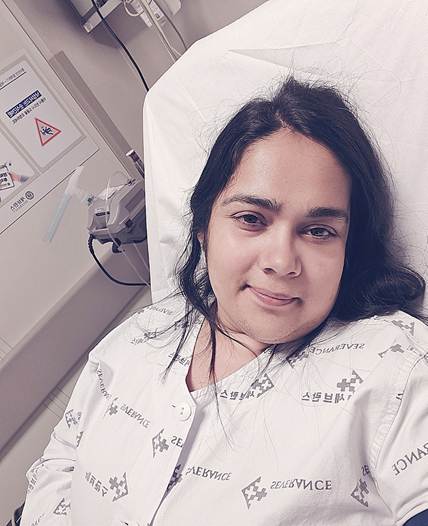
Imsin (임신, pregnancy) – I heard the word over and over again in an emergency room in Seoul, in a language I was still learning, as doctors and nurses tried to make sense of what was happening to me. I kept shaking my head: No.
What I did not yet have the words for was something far less visible: a severe asthma attack, most likely triggered by pollen. My lungs were tightening, but the questions being asked belonged to an entirely different story. The body, it seemed, was being translated into the wrong narrative.
Earlier that evening, a 119 ambulance had refused to take me. Only later did I learn about eunggeup-sil ppaeng-ppaengi (응급실 뺑뺑이), the phenomenon of ambulances moving round and round from one hospital to another because emergency departments have no available beds for the patient being carried.
I was suspended in another kind of uncertainty as well. My residence card had not yet arrived. I carried only my passport. It was remarkable how quickly a missing document could make you feel as though you had not yet fully entered the system.
The waiting room was full, though it did not immediately announce itself that way. Pain has a way of folding inward, becoming private even in crowded spaces. It surfaced in fragments: a low cry, a sharp intake of breath, the restless shifting of bodies that could not find comfort.
The nurses moved quickly, their attention divided but never careless. They asked questions I struggled to answer, their eyes searching my face for clarity I could not provide. Forms were placed in front of me. Identification. Insurance. Medical history. The ordinary paperwork that anchors a person within a healthcare system. I had never realized how vulnerable those ordinary things could become when they were suddenly absent.
Beside me, steadying everything, was my friend. I remember her hands first: calm, certain, covered in delicate lotus tattoos that seemed almost impossibly serene beneath the fluorescent lights. A flower that insists on blooming through murky water.
She translated when she could, answered questions when I couldn’t, and stayed beside me as I drifted in and out of awareness. There is a particular kind of love that exists without performance. It simply remains.
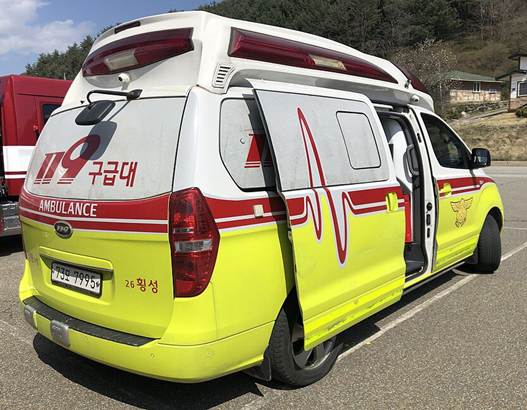
The 119 ambulance, familiar with the hospital to hospital to hospital runaround.
Sometime after two in the morning, a doctor decided to admit me. I never learned how difficult that decision may have been. I only know that, after hours of nebulizers and oxygen had slowly begun to loosen my breathing, he returned to check on me. He looked at me and asked one simple question: Gwaenchanayo? (괜찮아요? Are you okay?) It was an ordinary sentence. Yet nothing had ever sounded more extraordinary.
Looking back, I have often wondered whether that decision changed the course of my night. Perhaps more than that. What I remember most clearly is not the medication or the machines, but the feeling of being seen – not as paperwork, not as an administrative complication, not as a foreigner struggling to explain her own body. Simply as someone who needed help.
I have been single for a long time, and somewhere in that emergency room I realized something with surprising clarity: This was the quality I admired most in another human being. Not charm. Not brilliance. Not even kindness in the abstract. But the quiet willingness to take responsibility when no one would have blamed you for looking away.
Sometimes I catch myself looking at doctors in hospital corridors and wondering whether one of them is him. Sometimes it is not even a doctor. Just a man walking through the city with a coffee in his hand, entirely absorbed in his own day.
My friend still laughs when I tell her this. The lotus flowers on her hands move as she gestures, no longer just symbols of resilience but reminders of the night she stayed when I could not hold myself together.
Living abroad teaches you many things. You learn a language. You learn how to navigate unfamiliar streets, unfamiliar customs, and unfamiliar bureaucracies. Occasionally, if you are fortunate, you learn something else: that systems are experienced not as policies, but as moments. That compassion is rarely dramatic.
More often, it arrives quietly, asks whether you are alright, and waits for the answer. Long after I forgot most of the medical terminology from that night, one question remained.
Gwaenchanayo? (괜찮아요?)
Sometimes that is all another person needs to hear in order to begin breathing again.
The Author
Reeti Roy is a cultural commentator and the founder of Aglet Ink. A graduate of Jadavpur University and the London School of Economics, she is currently based between Korea and India, investigating Indo-Korean social architectures through an anthropological lens.