
Romanizing Hangeul: Towards a System Korean Speakers Can Read Back
By Shin Gyeonggu ||
Most visitors meet the Korean language first through Roman letters: on road signs, subway maps, and bus stops.
How we write Korean in the Latin alphabet therefore shapes one’s first impression of the language. In 2000, the national standard of Korean romanization was issued by the Ministry of Culture and Tourism, now the Ministry of Culture, Sports, and Tourism. A quarter of a century later, it is worth asking how well it serves both Koreans and foreigners.
International practice offers yardsticks. The United Nations Group of Experts on Geographical Names (UNGEGN) works from four basic principles for romanizing geographical names:
- Transcription or transliteration: Choose whether to represent the pronunciation (transcription) or the original spelling (transliteration).
- Reversibility: Ideally, the original script should be recoverable from the romanized form.
- Simplicity: Use clear, easy-to-type Roman letters and avoid unnecessary special symbols.
- One standard system: Each language should have one official system to prevent confusion.
The UN has pressed these points for decades. Its first resolution on the subject (I/9, 1967) warned against the confusion caused by systems “based on the phonetic structure of the receiver languages” and called for a single system “based on scientific principles.” In 1977, the UN adopted China’s Hanyu Pinyin as the international standard for Chinese (III/8), a phonemic system built for Mandarin speakers.
The RR 2000 System
Chapter 1 of the Korean 2000 Revised Romanization System (RR 2000) lays down two general principles: (a) Korean is romanized according to its standard pronunciation, and (b) symbols other than Roman letters are avoided as far as possible. The first makes the system a transcription; the second rules out diacritics such as the breves of the former McCune–Reischauer romanization system. Four out of eight special notes in Chapter 3 show how these principles work in practice.
Note 1: Sound changes are written as pronounced. – This reverses the logic of Korean orthography itself, which is morphophonemic: 강북 is spelled the same whether it stands alone or takes a particle. The romanization, however, must change with the sound: 강북 is Gangbuk, but 강북에 becomes Gangbuge; 집 is jip, but 집에 becomes jibe. The unique word form disappears inside the pronunciation.
Note 2: A hyphen may be used where pronunciation could be confused, as in 중앙 jung-ang (not jun-gang).
Note 3: A hyphen is placed before administrative units, and sound changes across it are not reflected. – Thus 인왕리, pronounced [이놩니], is written Inwang-ri, not Inwang-ni. This openly departs from the first principle. It is a quiet admission that for names, writing the word in transliteration is better than writing the sound in transcription.
Note 8: For academic work requiring reconstruction of Hangeul, the spelling itself is transliterated. – Accordingly, ㄱ, ㄷ, ㅂ, ㄹ are always g, d, b, l; the silent ㅇ before a vowel is marked by a hyphen except at the beginning of a word (see Table 1).
Table 1. Transliteration Under Note 8
| 집 | jib | 짚 | jip |
| 값 | gabs | 붓꽃 | buskkoch |
| 독립 | doglib | 먹는 | meogneun |
| 굳이 | gud-i | 밖 | bakk |
Problems of the RR 2000 System
Hangeul is widely praised as one of the most scientific alphabets in the world: Each letter represents a phoneme, and the shapes of the consonants reflect the articulators that produce them. Its romanization (RR 2000) is far less scientific, largely because it was designed from the viewpoint of English-speaking listeners rather than Korean speakers, precisely the “receiver language” approach the UN cautioned against.
1. One letter, two spellings
The same Hangeul consonant is romanized differently by position: ㄱ, ㄷ, ㅂ are g, d, b before a vowel but k, t, p at the end of a syllable, and ㄹ is r or l. Phonetically this is defensible, since Korean final stops are unreleased. Yet Korean speakers do not perceive them as different letters, just as English speakers do not notice that the p in “spin” lacks the puff of air in “pin,” and English does not spell them differently. The RR 2000 system is also inconsistent with itself: if ㄱ is g, its tense counterpart ㄲ should be gg, not kk.
2. No way back
Because spellings in the RR 2000 system follow sound changes, the one-to-one link between Hangeul and Roman letters is lost. Neither a learner nor a computer can reliably recover 강북에 from Gangbuge. A system that cannot be read back teaches foreigners the sound of a place name but not the name itself.
3. Exceptions weaken the standard
The rules of RR 2000 allow personal names and established company names to keep earlier spellings, so Lee, Park, Hyundai, and Samsung coexist with the official I, Bak, Hyeondae and and Samseong. China, by contrast, converted place and personal names to Pinyin across the board, and the result is a single, predictable spelling.
4. Inconsistent and colliding vowels
Since 어 is eo, 워 must be weo. But RR 2000 writes 수원 as Suwon instead of the consistent Suweon, and won but not weon for 원. More seriously, the system has no syllable-boundary marker for vowels. Seoul is regularly read as three syllables, se-o-ul by text-to-speech voice apps. Ae may be pronounced as both ㅐ as in 개 gae and ㅏ + ㅔ (가에 gae). 바다에 badae reads back as 바대; 우이동 and 의동 are spelled the same, as Uidong.
Learning from Other Systems
1. German: Letters need not sound like English
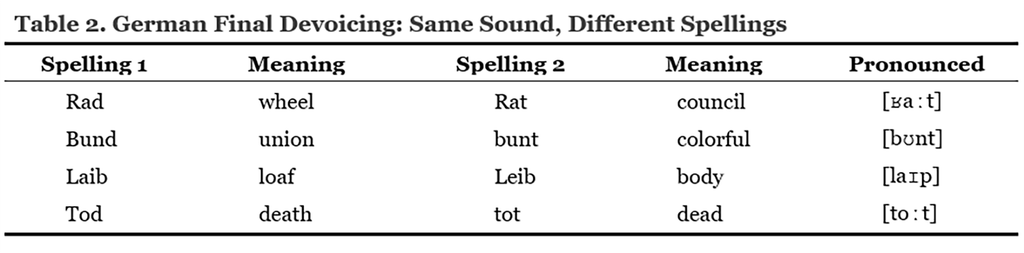
German uses the Roman alphabet with its own values: ch is [x], v is [f], z is [ts], chs is [ks], and eh is a long [eː]. Nobody finds this unscientific. German also devoices final consonants, yet it may spell differently two words with the same phonetic sound (see Table 2 at the end).
The spelling pays off as soon as an ending is added: Rad becomes Räder with a clear [d], while Rat becomes Räte with [t]. Korean works in exactly the same way: 집 jib and 짚 jip sound alike alone but differ in 집에 jib-e and 짚에 jip-e. We need the Note 8 spelling system for everyone, not only for scholars.
2. Hanyu Pinyin: One phoneme, one symbol
Approved in 1958, Pinyin assigns Roman letters to Mandarin sounds without regard for English speakers: q, x, c, z, zh, and ch all have Chinese values. Korean newspapers once rendered q as “k,” but readers soon learned. Pinyin’s b, d, g are, in its own description, pronounced with no vibration of the vocal cords, which is close to Korean ㅂ, ㄷ, ㄱ. Its e stands for a vowel close to [ə], and i is written the same in si [sɨ] and qi [ʧi] since Mandarin speakers recognize them as i in both contexts. Pinyin also has a syllable-boundary marker, the apostrophe, placed before a syllable beginning with a, o, or e (see Table 3).
Table 3. The Pinyin Apostrophe
Chinese Pinyin Syllables Meaning
| 西安 | Xī’ān | xī + ān | Xi’an City |
| 先 | xiān | one | first, before |
| 皮袄 | pí’ǎo | pí + ǎo | leather coat |
| 飘 | piāo | one | to float |
3. Russian: A sign for a boundary
The Library of Congress Russian table renders the hard sign ъ with the double prime ʺ, preserving a boundary that affects pronunciation: подъезд, “entrance,” is written podʺezd and pronounced [pɐdˈjest]. A single, simple mark keeps the word both readable and reversible.
Proposing New Principles and a New System
The following five principles may well be accepted to find solutions to the problems caused by the RR 2000 system of Hangeul romanization:
- Morpho-phonemic, not phonetic: Like Hangeul itself, the romanization should represent phonemes. 밥 is always bab, never bap; 강북 is Gangbug, and 강북에 is Gangbug-e, which reads back into Hangeul without loss.
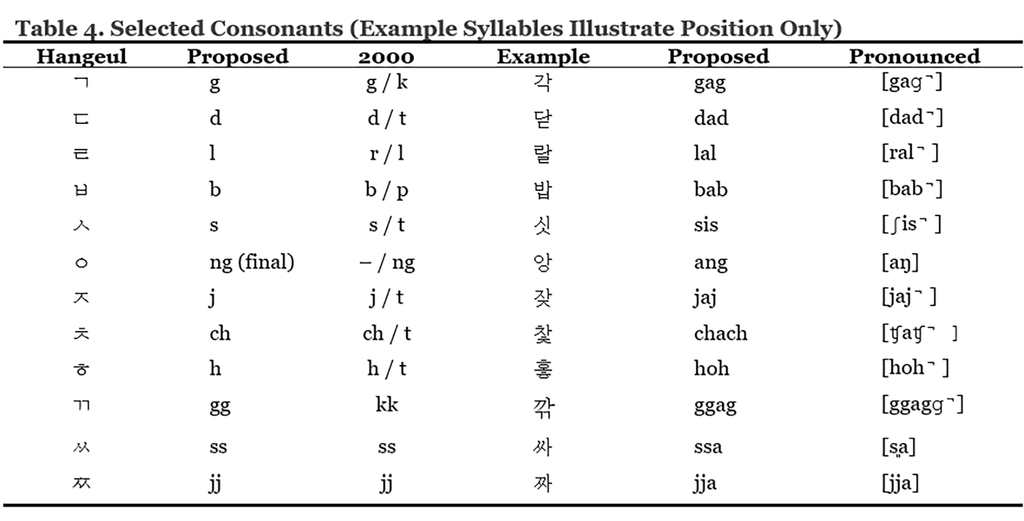
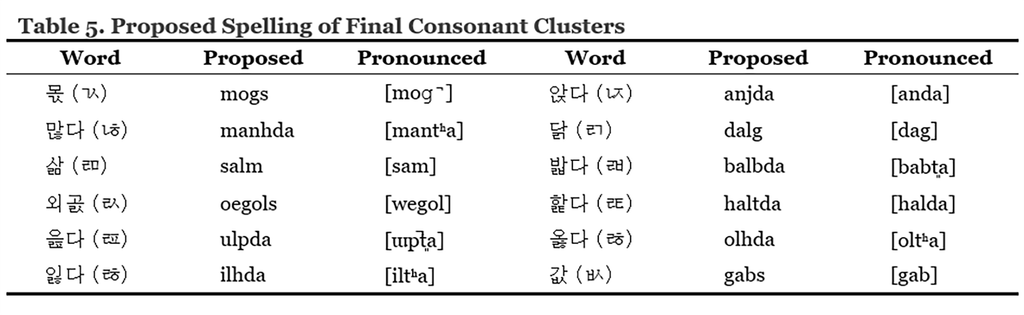
- One Hangeul letter, one symbol, in every position (see Tables 4 and 5).The apostrophe marks syllable boundaries between vowels; the hyphen separates morphemes only: Seo’ul, Gwangju-si.Pronunciation guidelines, not spelling changes, explain how letters sound in context.
- All government documents and signage follow the system, without exceptions.
Vowels keep their RR 2000 values, except that ㅝ becomes weo (원 weon, 수원 Suweon) for consistency with ㅓ eo. A short set of pronunciation guidelines then cover what the current RR 2000 system forces into the spelling:
- Final stops are unreleased: gag is [gaɡ̚ ] and bab is [bab], while dad, sis, jaj, chach, tat and hoh all end in [ t ̚]. Final n, m, ng, and l are pronounced in full, as in nan [nan], mam [mam], ang [aŋ], and lal [ɾal].
- b, d, g, j are voiceless at the beginning of a word and voiced between vowels, as in Pinyin.
- s is pronounced [ʃ], close to “sh,” before i.
- Regular Korean sound changes (doglib read [동닙], johda read [조타]) are taught as rules.
- The apostrophe separates vowels that would otherwise merge: Seo’ul, a’i, ga’e, ga’e, bada’e, U’idong, ui’in.
Conclusion
The UN has also urged countries not to revise romanization systems once adopted (IV/15, 1982), and any change carries a real cost in signs, maps, and habits. That is exactly why the next reform, if there is one, should be the last – a system built on the logic of Hangeul rather than on the ear of English. A romanization that Korean speakers find natural, that learners can read back into Hangeul letter by letter, and that admits no exceptions would be the shortest path for foreigners into the Korean language. Hangeul deserves a romanization system as scientific as itself.
References
Library of Congress (2012). Russian Romanization Table. https://www.loc.gov/catdir/cpso/romanization/ russian.pdf
Ministry of Culture, Sports, and Tourism (2014). Romanization of Korean. https://korean.go.kr/ kornorms/regltn/regltnView.do?regltn_code=0004#a
Princeton University Press (2014). Hanyu Pinyin Romanization System. https://assets.press.princeton.edu/chapters/i10279.pdf
UNGEGN (2017). Romanization Guidelines. https://unstats. un.org/unsd/ungegn/documents/RES_UN_Korean_1-11_CONF.pdf
The Author
Shin Gyeonggu is executive director of the Gwangju International Center, senior policy advisor on human rights and international affairs for the city of Gwangju, professor emeritus of English at Chonnam National University, and chair of the Global Steering Committee of the World Human Rights Cities Forum.