



Do Bullies Have Human Rights? What Teach You a Lesson Gets Us Talking About
By Luis Andrés
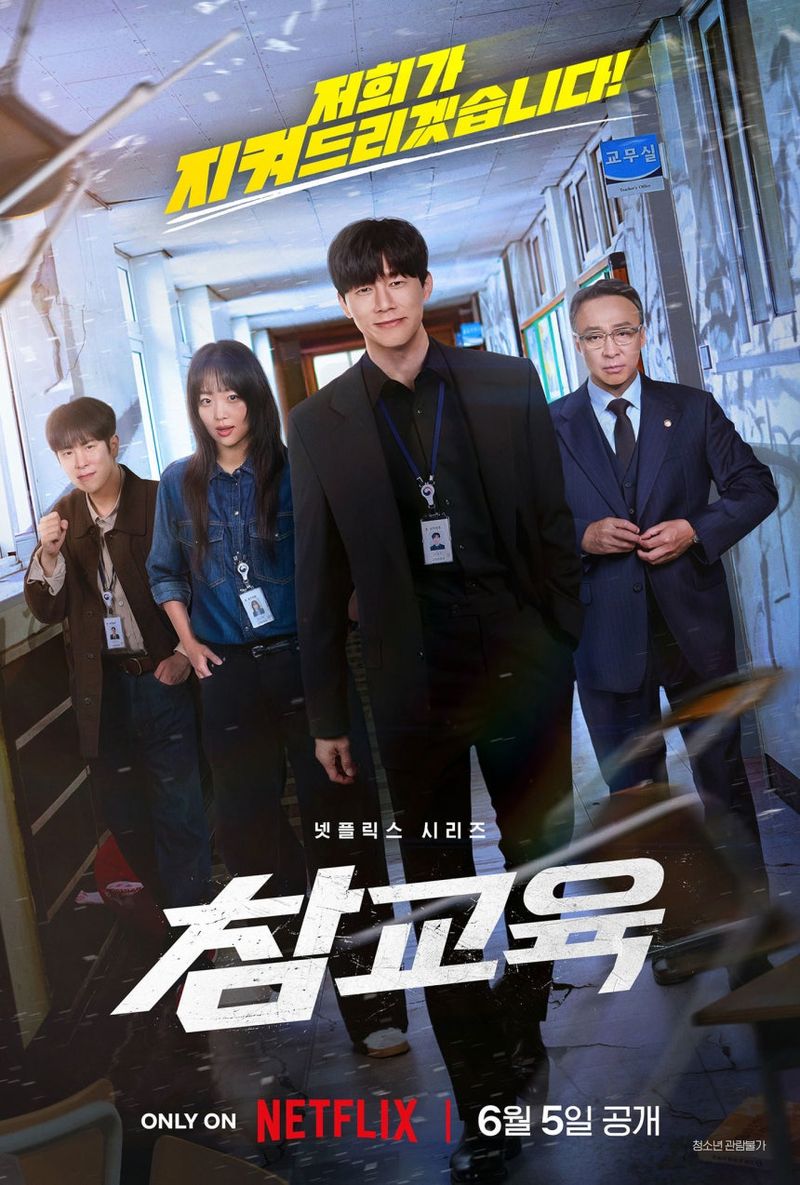
Netflix’s recent Korean series Teach You a Lesson (참교육) has attracted attention with a premise that is simultaneously interesting, uncomfortable, and perhaps deliberately excessive: What if someone could finally do something about school bullying?
The series follows the Educational Rights Protection Bureau, a fictional government agency established to intervene when students, teachers, or parents cross the line. Its inspectors are not exactly subtle. Netflix itself describes their methods as “unconventional,” which is a polite way of saying that these are definitely not just filling out a report.
Behind the action sequences and the cathartic pleasure of watching seemingly untouchable people finally face consequences, however, Teach You a Lesson raises a surprisingly complicated question: Do people who violate the rights of others still deserve their own rights? The short answer is yes. The longer answer is also yes, but it is considerably less straightforward.
The first episode of the drama introduces a school terrorized by the son of a powerful politician. His bullying has devastating consequences, while the adults around him appear incapable of stopping him. His father’s political influence has made accountability nearly impossible. Then inspector Na Hwa-jin arrives.
Without spoiling exactly what happens, the Educational Rights Protection Bureau does not operate through politely worded administrative notices and afterschool detention. They use far more hurting and humiliating methods. The following episode consequently opens another debate: If intimidation, humiliation, and physical force are being used against violent people in order to protect their victims, are those methods justified?
Within the series, the political controversy surrounding the bureau is strategically manufactured by its opponents. But the question underneath it is real, and it appears constantly in discussions about crime, punishment, terrorism, bullying, and public safety. Why should we care about the rights of someone who clearly did not care about anybody else’s? This is where human rights become difficult.
It is relatively easy to defend the rights of people we like. The actual test of a human rights system is whether those protections remain meaningful when applied to people we dislike, fear, or even consider reprehensible. But human rights are not prizes for good behavior.
This important distinction gets somewhat lost in the drama because it is an action-drama series rather than a human rights seminar. However, it is worth diving into a little: Under international human rights law, states have three broad obligations: to respect, protect, and fulfill human rights. States must avoid violating rights themselves, protect people from abuses committed by others, and take positive measures that allow people to exercise their rights. The Office of the United Nations High Commissioner for Human Rights explicitly describes these as fundamental responsibilities of governments. That changes how we should frame the dilemma.
Imagine a student being violently bullied. The state has a responsibility to protect that student. Schools, educational authorities, police, courts, and other institutions cannot simply watch serious abuse happen and decide that it is a private disagreement between two teenagers. But the state does not fulfill that responsibility by abusing the bully instead. The alleged perpetrator retains rights too: bodily integrity, due process, protection from cruel or degrading treatment, and other legal guarantees depending on the circumstances.
This can sound frustrating because we instinctively imagine a scale: the victim on one side, the perpetrator on the other. Protecting one appears to require taking something away from the other. But human rights do not work particularly well as a scale.
For starters, the state’s responsibility is precisely to protect both. It must protect the victim from the perpetrator, while simultaneously protecting everyone involved from arbitrary state power. That distinction becomes particularly important when the person administering punishment is not another student but an official carrying the authority of the government. Giving public officials permission to suspend someone’s basic rights because that person is considered sufficiently bad creates a rather obvious problem: Someone, then, has to decide who is bad enough; and history suggests we should probably not hand governments that particular blank check.

(GN with ChatGPT)
There is a second issue that Teach You a Lesson invites us to consider. Human rights are universal because they derive from human dignity rather than individual merit. The basic principle of the Universal Declaration of Human Rights is remarkably straightforward: Human beings are born free and equal in dignity and rights.
That includes wonderful people. It includes annoying people. And, while hard to accept for some people, it includes people who have done terrible things. However, this does not mean abandoning accountability. Protecting the rights of perpetrators does not mean ignoring victims, forsaking repair, or pretending that violence did not happen. It means distinguishing justice from vengeance.
Justice asks what is necessary to protect victims, establish responsibility, repair harm where possible, prevent repetition, and reintegrate people into society. Vengeance asks how much suffering someone deserves in return. Those are very different questions, and punitive systems can make us feel that vengeance is necessary for achieving justice.
This distinction is not easy for victims, including myself. I was bullied in school, and there is an uncomfortable reality about bullying that no satisfying television finale can solve: Some things cannot be undone. You cannot retroactively give someone back the days they were afraid to go to school. You cannot completely erase humiliation, isolation, or the strange little ways those experiences sometimes follow people into adulthood. Consequences matter. Accountability matters enormously. But suffering is not arithmetic.
If something terrible happens to the people who bullied me, my own experiences do not disappear. Their pain does not subtract from mine. What I can hope is that they grew up. I can hope that they are no longer violent people. That they learned something. That they became productive members of their communities and that nobody else had to experience from them what I experienced. And, realistically, we make that outcome considerably less likely if our response to violence is simply institutionalized violence in the opposite direction. The objective of justice should be fewer victims, not a more equitable distribution of suffering.
There is perhaps no better city in Korea to have this conversation than Gwangju.
This is a city whose contemporary identity is deeply connected to democracy, resistance to state violence, and the protection of human dignity. Human rights here are not merely an attractive phrase printed on conference banners. They are connected to a historical understanding of what can happen when institutions decide that certain people no longer deserve ordinary protections.
That history also offers Gwangju an opportunity. A human rights city should be capable of defending victims fiercely without reproducing the logic of humiliation and violence that created victims in the first place. That applies to schools, prisons, migration, policing, gender-based violence, discrimination, and every other type of structural violence. Human rights cannot become a scoreboard where one violation earns us permission to commit another.
Victims deserve protection, recognition, accountability, and justice. Perpetrators must be stopped and held responsible. Institutions that ignore abuse must also be questioned. But none of this requires abandoning human dignity.
Perhaps that is the lesson underneath Teach You a Lesson that is considerably harder to dramatize. Justice sometimes feels disappointingly restrained. It does not always provide the primal emotional outlet that revenge seems to offer. But that restraint is precisely the point of living in a peaceful society.
If human rights belong only to people we believe deserve them, they are no longer human rights. They are privileges.
The Author
Luis Andrés González is a Mexican GKS scholar and master’s student in cultural anthropology at Chonnam National University. He advocates for LGBTQ+ rights and gender equality, and explores global affairs through pop culture. He is the founder of Erreizando, a digital magazine. Instagram: @luisin97 / @erreizando
Cover Photo: Teach You a Lesson (참교육) series. (Netflix)