
From Gwangju to Bangkok: Reflections on Peace Festival Week 2026 at Mahidol University
By Shin Gyonggu ||
A Regional Hub for Human Rights Education
Mahidol University, founded in 1888, is one of Thailand’s leading research universities. It is internationally recognized for its strengths in medicine, public health, and the life sciences, while also offering undergraduate through doctoral programs across seventeen faculties, colleges, and institutes on campuses in Bangkok, Salaya, and Kanchanaburi.
Within this broad academic ecosystem, the Institute of Human Rights and Peace Studies (IHRP), based on the Salaya campus outside Bangkok, has established a distinct regional reputation. It is widely regarded as one of Asia’s leading centers for human rights education, research, and peace studies.
IHRP took its present form through the merger of two earlier institutions: the Center for Human Rights Studies and Social Development, established in 1998, and the Research Center for Peacebuilding, founded in 2004 to support conflict transformation in Thailand’s southernmost provinces. In 1999, it started Southeast Asia’s first graduate program in empirical human rights studies. Since then, IHRP, supported by a faculty of twelve full-time professors and lecturers, has developed a comprehensive range of graduate programs, taught largely in English, offering a Master of Arts in Human Rights and an interdisciplinary Doctor of Philosophy in Human Rights and Peace Studies.
Over more than two decades, IHRP has educated students from more than twenty countries, many of whom now serve as academics, human rights defenders, and officials in NGOs, governments, and international organizations across Asia and beyond.
Linking May 18 Gwangju and October 6 Bangkok
From August 17 to 19, 2026, IHRP convened Peace Festival Week 2026 at its Salaya campus. The three-day program opened with a press conference and a special lecture by Professor Thongchai Winichakul, a distinguished historian. Thongchai was himself a student leader at Thammasat University in the mid-1970s. Following the massacre of October 6, 1976, he was imprisoned, to be released only under the 1978 amnesty.
The Festival’s central theme “From Gwangju, South Korea, to the 50th Anniversary of 6 October 1976: Democracy, Human Rights and Justice – Transitioning Towards a Peaceful and Just Democratic Society” placed the Gwangju Uprising of May 1980 in direct conversation with the Thammasat massacre.
Through panel discussions, a policy roundtable, and public sessions, academics, activists, students, and policymakers from Thailand and other parts of the region examined how two societies, separated by geography but linked by comparable experiences of state violence, have struggled to turn historical trauma into democratic renewal.
Thailand’s democratic movement has important similarities with South Korea’s democratization struggle. In both countries, students, workers, labor unions, intellectuals, religious communities, civic organizations, and ordinary citizens have mobilized against authoritarian rule and demanded dignity, constitutional government, and justice for victims of repression.
Thailand’s youth-led protests of 2020–21, the electoral rise of the progressive Move Forward Party in 2023, and the constitutional reform process of 2026 demonstrate that the nation’s democratic movement remains vibrant and resilient. This enduring energy is what makes events like Peace Festival Week possible, dedicated to commemorating the history of the pro-democracy movement and honoring the victims of state violence.
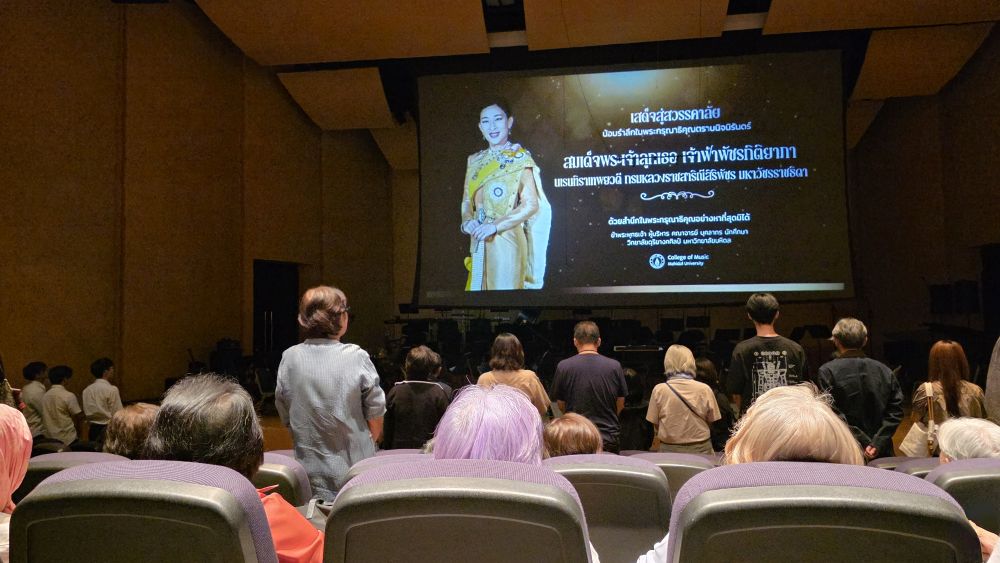
Nevertheless, the movement continues to confront deeply entrenched military, judicial, and conservative elite vetoes that challenge popular electoral mandates. This underlying authoritarianism remains visible in everyday public life. For instance, individuals are still obliged to stand before portraits of Queen Suthida, and representations of King Maha Vajiralongkorn remain ubiquitous throughout Bangkok.
Against this long and unfinished historical backdrop, Peace Festival Week invited a Korean perspective on what democratic transition can achieve over time.
From Democracy to Creativity
I was privileged to speak at the Festival about how the Gwangju Uprising has shaped not only Korea’s democratization but also, less obviously, the country’s subsequent cultural boom.
In May 1980, paratroopers were sent to suppress student protests in Gwangju. Ordinary citizens joined the resistance and defended their city for ten days before the uprising was brutally crushed. For years afterward, the events were officially distorted and the victims were stigmatized.
“Political freedom and cultural creativity draw from the same well of human energy.”
This, however, ignited a grass-root movement toward South Korea’s long democratic transition, culminating in the restoration of direct presidential elections in 1987 and fully civilian governments in 1993 and 1998. The Gwangju Special Law of 1995 and other subsequent measures made the truth publicly acknowledged. The dead were honored at what is now the May 18th National Cemetery, and the archives of the Gwangju Uprising were inscribed on UNESCO’s Memory of the World Register in 2011.
My central message was simple: When democracy and human rights are denied, a society wastes its most valuable resources – the energy, idealism, and talent of its young people. They are forced to devote their lives to securing basic rights: the right to speak, organize, assemble, and be heard.
Every hour a young activist spends resisting censorship or evading surveillance is an hour not spent writing, composing, filming, building a business, conducting research, or developing new ideas. When democracy and human rights protections take root, however, that same human energy can be redirected to drive national development in culture, technology, education, and the economy.
Korea’s experience illustrates this vividly. The generations that once organized underground against censorship and martial law helped create the social and political conditions in which Korean film, television, music, and technology could flourish locally and globally. Directors could make films such as Parasite; producers could support globally influential dramas such as Squid Game; and K-pop entertainment agencies could develop artists whose work reached audiences across the world.
“When democracy and human rights are denied, a society wastes its most valuable resources – the energy, idealism, and talent of its young people.”
This does not mean that democracy alone explains Korea’s cultural and economic success. Many other conditions also mattered: investment in education, industrial development, technological capacity, entrepreneurship, and international exchange. Yet political freedom created essential space for people to criticize, create, experiment, and imagine without constant fear. Political freedom and cultural creativity draw from the same well of human energy. When people are not exhausted from pushing back against political pressures, they can contribute more fully to everything a society hopes to build.
Lessons from Gwangju for the Region
Peace Festival Week 2026 was more than a commemorative gathering. Discussions over the three days led to concrete policy recommendations concerning transitional justice, democratic safeguards, and reconciliation.
Participants shared the conviction that genuine peace cannot be built by concealing historical wounds. It must rest on truth, accountability, and the meaningful participation of those most affected by violence and repression.
Among the commitments proposed at the policy roundtable were the following:
- Constitutional protections against extra-democratic seizures of power.
- An independent and transparent truth-seeking body to document past political violence.
- An end to impunity for state actors responsible for human rights violations.
- Holistic reparations combining restorative justice with public acknowledgment and official apology.
- Reform of the military, security services, and police to ensure democratic civilian oversight.
- Memorial sites and public-memory spaces to prevent historical amnesia.
- Stronger decentralization and local-government capacity for conflict prevention and early warning.
- Education in peace, democracy, human rights, and political history at every level.
- Greater responsibility by media organizations and digital platforms in countering disinformation and incitement.
Gwangju’s own path, from a city under martial-law siege in May 1980 to an internationally recognized center for democracy, human rights, and peace, was repeatedly invoked as evidence that these principles are not merely aspirational. Over four decades, Gwangju has shown that historical trauma can be transformed into institutions that safeguard democracy: truth-seeking processes, a national cemetery, a national commemoration day, museums and memorial parks, and a substantial body of scholarship and civic education centered on what Koreans call the “Gwangju Spirit.”
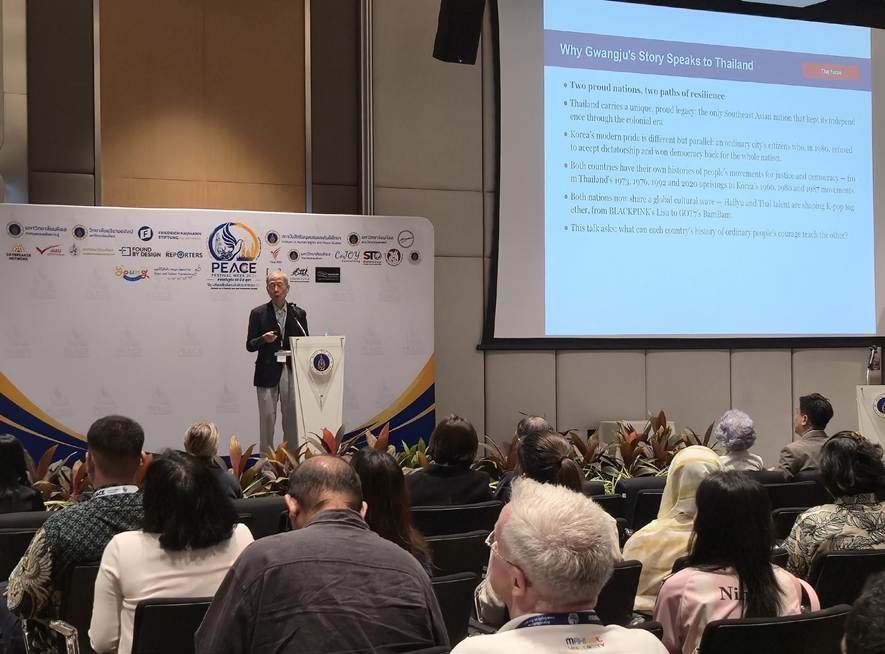
Dr. Shin Gyonggu presents on lessons from Gwangju’s May 18 at Peace Festival Week in August.
Speakers also noted Gwangju’s continuing regional role through platforms such as the World Human Rights Cities Forum, which brings together cities, civil-society organizations, and human rights practitioners from around the world. For Thailand and the wider region, Gwangju offers practical lessons as they confront the unresolved legacy of October 6, 1976.
For a Thai public still debating how to establish an effective truth-seeking mechanism for events that occurred half a century ago, Gwangju’s experience is not a distant historical curiosity. It is a working case study in how truth, remembrance, and accountability can eventually take root.
What Gwangju Can Learn from Mahidol and FNF
The Peace Festival was made possible in part through support from the Friedrich Naumann Foundation for Freedom (FNF), a German political foundation established in Bonn in 1958 at the initiative of Theodor Heuss, the first Federal President of the Federal Republic of Germany. It was named after Friedrich Naumann, a German liberal thinker.
Today, FNF works internationally to promote freedom, human rights, democracy, civic participation, and liberal values. According to its financial plan for 2025, the Foundation projected total expenditure of approximately €88 million, largely financed through German federal grants. In 2024 alone, it reported holding more than 2,300 international events that reached over 155,000 participants.
As Thekla Ebbert, FNF’s regional project advisor and project lead for Thailand, noted in her message of support for the Festival, the Foundation remains committed to advancing freedom and human rights in sustainable ways around the world.
FNF’s model offers a useful lesson for South Korea, and particularly for Gwangju. Korea’s international development cooperation has been carried out largely by the Korea International Cooperation Agency (KOICA), whose work has understandably focused on poverty reduction, quality of life, inclusive development, grant aid, technical cooperation, training, volunteer programs, humanitarian assistance, and partnerships.
“Gwangju’s experience is a working case study in how truth, remembrance, and accountability can eventually take root.”
However, Korea could strengthen its international engagement in democracy and human rights. Gwangju, whose sacrifice made a major contribution to Korea’s democratization, is especially well placed to support human rights activists, researchers, educators, and civic organizations in other countries through training, fellowships, exchanges, and modest but sustained funding.
Rather than relying on one-off gestures, Gwangju could develop long-term regional partnerships that support truth-telling, civic education, peacebuilding, and democratic resilience. Possible initiatives could include co-funding projects in neighboring countries confronting unresolved histories of violence, including Thailand’s October 6 legacy and Myanmar’s ongoing crisis; establishing fellowships for young activists and scholars to study the Gwangju experience firsthand; and developing the World Human Rights Cities Forum into a year-round platform for regional cooperation, exchange, and joint action. In this regard, the Global NGO Master’s Program (GNMP) at Chonnam National University’s May 18 Institute should be expanded with more funding and with better management.
Sitting in the audience at Mahidol and later speaking from the stage, I was struck by how naturally the conversation moved between Gwangju and Bangkok, between May 1980 and October 6, 1976. It was as if the two cities were comparing notes on the same unfinished project.
That may be the truest measure of Peace Festival Week 2026’s success: It did not offer easy answers, but it made two societies’ most difficult histories more legible to one another – and left both better equipped to continue the work.
The Author
Shin Gyonggu is executive director of the Gwangju International Center, senior policy advisor on human rights and international affairs for the city of Gwangju, professor emeritus of English at Chonnam National University, and chair of the Global Steering Committee of the World Human Rights Cities Forum.
(Photographs courtesy of the author)
Cover Photo: At the beginning of the concert, a royal tribute was shown on screen; Thais customarily stand for the Royal Anthem.