


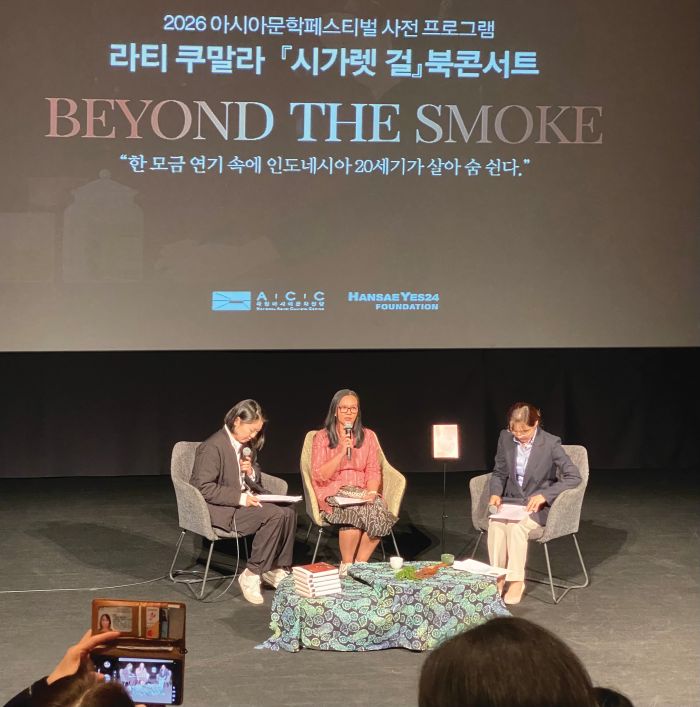
The Scent of Cloves: Indonesian Author Ratih Kumala Brings Cigarette Girl to Gwangju
By Vibhanshu Maurya ||
The scent of cloves greeted visitors even before they entered Theater 3 at the Asian Culture Center (ACC). At a welcome table outside the venue, small piles of cloves and leaves were arranged beside pamphlets and tickets for the afternoon’s book concert. Inside each pamphlet, organizers had attached a single clove – an invitation for visitors to experience the fragrance that lies at the heart of Indonesian author Ratih Kumala’s celebrated novel Cigarette Girl.
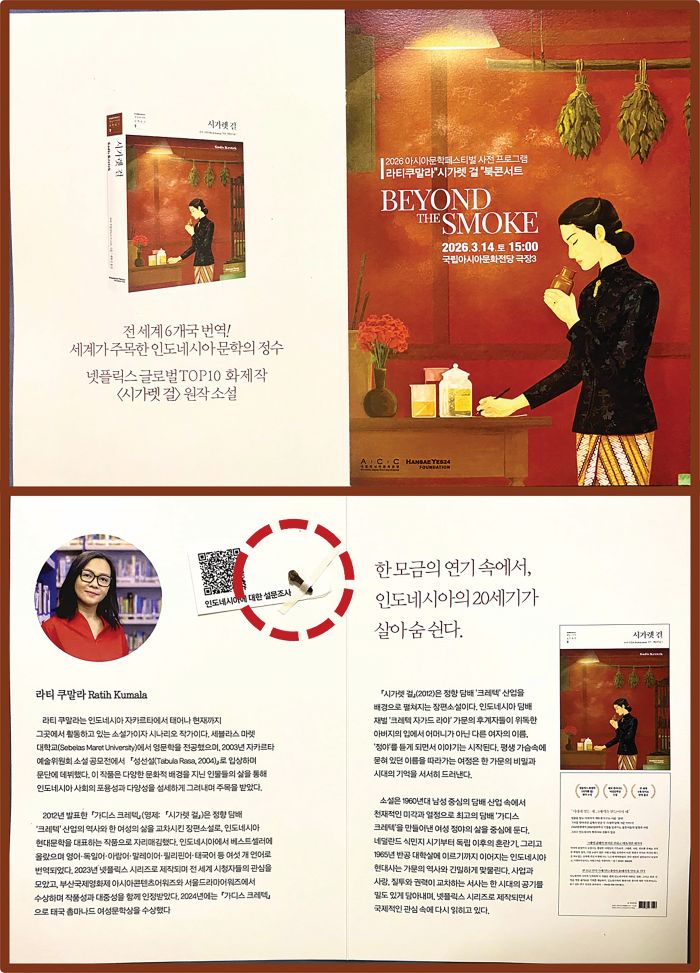
Visitors received informational pamphlets, each attached with a real clove to evoke the aroma central to Ratih Kumala’s novel Cigarette Girl.
The carefully designed sensory detail set the tone for Beyond the Smoke, a book concert held on March 14 as part of the pre-programming for the 2026 Asia Literature Festival at the ACC. The event introduced Korean audiences to Kumala’s internationally acclaimed novel, originally titled Gadis Kretek, which blends romance, family history, and the cultural significance of Indonesia’s clove cigarette industry.
Visitors arriving early were greeted by cheerful organizers distributing informational pamphlets about the author and her work. Even before stepping into the theater, the gentle aroma of cloves lingered in the air, subtly connecting guests to the world of the novel.
Inside the theater, warm lighting illuminated a simple stage setup: three chairs arranged around a low table decorated with cloves and leaves. Several copies of Cigarette Girl were stacked neatly beside the microphones. The thoughtful arrangement reflected the themes of the novel while creating an intimate atmosphere for the discussion.
By the time the event began at 3 p.m., more than a hundred attendees had gathered in the hall. The audience consisted largely of readers in their forties and older, many appearing excited and curious to hear from the Indonesian author. Though the hall was not completely full, the crowd filled much of the seating area and listened attentively throughout the program.
Ratih Kumala entered the stage wearing a traditional batik outfit – a modern interpretation of Javanese attire consisting of a kebaya-style top and batik cloth skirt. She was joined by a Korean host and a translator who helped convey the conversation between the Indonesian author and the Korean-speaking audience. The audience welcomed her with warm applause as the discussion began.
First published in 2012, Cigarette Girl quickly gained recognition for its unique storytelling and vivid portrayal of Indonesian social history. The novel follows the story of Dasiyah, a woman whose remarkable talent for blending cloves and tobacco transforms a family’s kretek cigarette business while entangling her life in a complex web of romance, rivalry, and historical change.
For Kumala, however, the origins of the story were deeply personal. “My grandfather was a clove cigarette (kretek) businessman back in the 1960s and 1970s in a small town in Central Java,” she explained in an interview after the event. “He used his house as a home industry where he kept piles of tobacco leaves. Every day, workers – mostly women – would hand-roll each stick of kretek skillfully. This memory became the basic idea of my novel.”
The novel also became a way for Kumala to explore her own family history. “This is also my way to get to know the root of my family from my mother’s side,” she said.
Kretek cigarettes themselves carry deep cultural and economic significance in Indonesia. Made from a mixture of tobacco and cloves, they have long been associated with the country’s social and industrial life. “Kretek cigarettes are something very common in Indonesia,” Kumala said. “But many of us do not realize their real meaning. Kretek has been a very big industry in Indonesia – one that drives the economy – and in one era it was even used in political campaigns to gain people’s trust and votes.”
Through Cigarette Girl, Kumala hopes to introduce international readers to these aspects of Indonesian culture. “I hope the novel gives Korean readers a glimpse of Indonesia,” she said. “We have diverse cultures and customs that are interesting themes for fiction.”
The event also included a screening of the trailer from the Netflix adaptation of Cigarette Girl, which premiered in November 2023. The series has introduced the story to a global audience, drawing new attention to the novel and Indonesian literature more broadly.
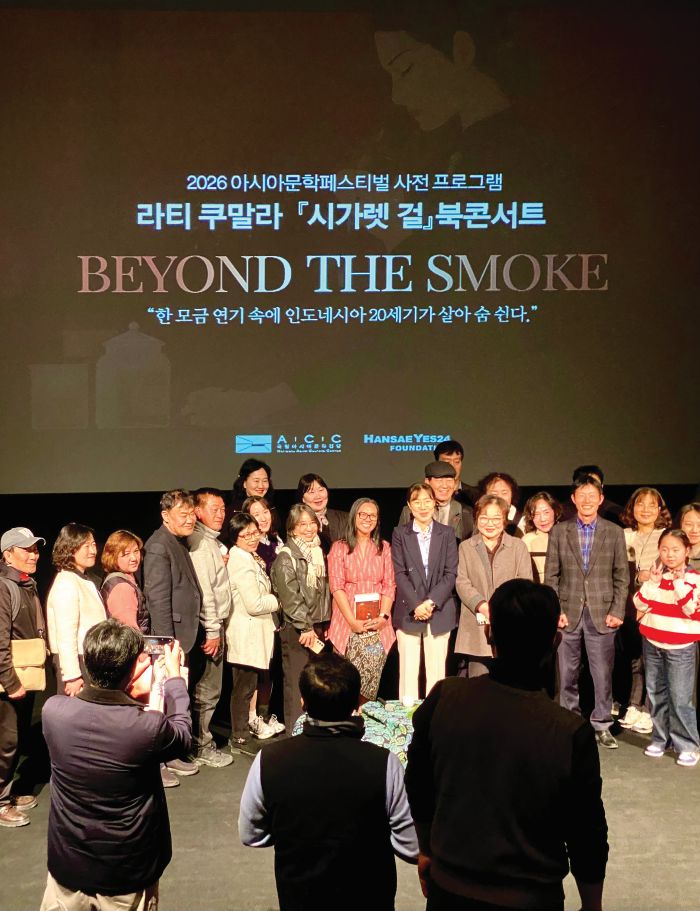
Audience members gather with Ratih Kumala (center) for photos after the discussion. The author stayed to sign books and speak with readers following the event.
For Kumala, seeing her work adapted into a visual medium has been both exciting and emotional. “I have mixed feelings,” she said. “Of course, I’m happy and proud that the story is now reaching a wider global audience. The series even converted viewers who once only liked watching movies into readers of the novel.”
At the same time, she acknowledged that adaptations require authors to share their stories with other creative voices. “I used to be the only person who owned it – I am its mother,” she said with a smile. “But now the family is getting bigger. It has aunties and uncles who care about it as well.”
During the event’s question-and-answer session, audience members asked about Kumala’s writing process, the historical background of the novel, and the relationship between literature and television storytelling. Despite the language barrier, the discussion felt lively and engaging, with many attendees raising their hands to ask questions.
Kumala herself seemed pleasantly surprised by the enthusiasm of the Korean audience. “It was really nice,” she later reflected. “I was actually surprised that so many people were very active during the Q&A session. Many of them raised their hands to ask questions, but unfortunately, we had limited time.”
One question even touched on the author’s outfit during the event. “Someone asked about the clothes I was wearing,” she said with a laugh. “It was a modern take on traditional Javanese clothing – a kebaya top and batik cloth.”
The visit also carried a personal connection for the author. It was her second time visiting Gwangju, and she expressed interest in exploring the city further. “I hope I’ll be able to come back again,” she said. “I haven’t had enough time to explore the city yet – especially because I read Human Acts, the novel by Han Kang.”
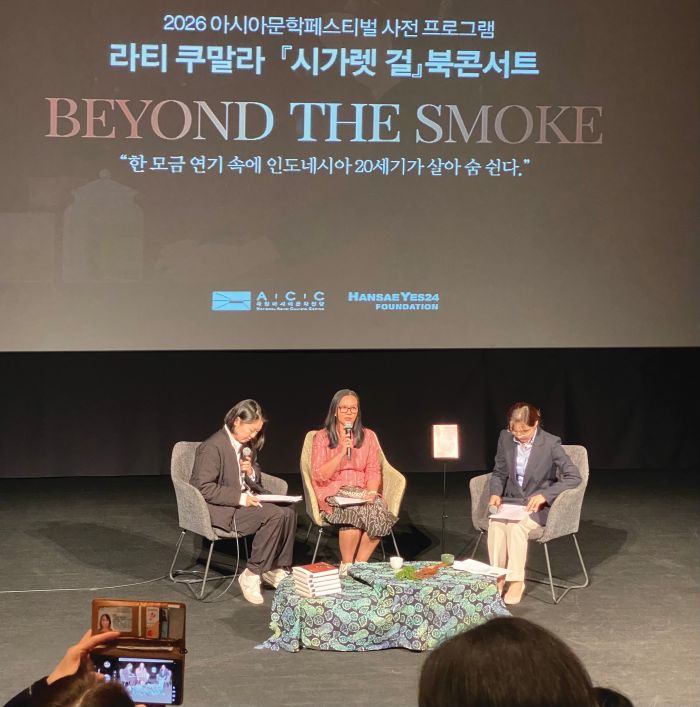
Indonesian author Ratih Kumala (center) speaks during the Beyond the Smoke book concert at the Asian Culture Center in Gwangju, joined by a Korean host and translator.
Events like this reflect the broader mission of the Asia Literature Festival: to connect readers with diverse voices from across Asia and encourage cultural exchange through storytelling. Although Indonesian and Korean cultures may appear different at first glance, Kumala believes readers will find common ground in the universal themes of her novel. “Even though we come from different cultural backgrounds,” she said, “I’m sure Korean readers will find familiarity in the story’s themes – family drama, romance, and the search for one’s roots.”
As the formal discussion ended, the atmosphere shifted into a more relaxed gathering. Audience members lined up for book signings and photographs, while others approached the stage to speak briefly with the author. Kumala greeted visitors warmly, signing copies of the novel, posing for selfies, and chatting casually with readers. Small groups gathered for photos, capturing the moment of meeting the writer behind a story that has traveled from Indonesia to readers around the world.
Slowly, the audience began to leave the theater. Yet even as the event concluded, the faint scent of cloves lingered in the air – a subtle reminder of the cultural world that had been shared that afternoon. For a few hours in Gwangju, the aroma of cloves carried the story of Indonesia across borders, showing how literature can connect histories, cultures, and readers far beyond where a story begins.
The Author
Vibhanshu Maurya, originally from India, is pursuing his PhD at CNU. He leads a vibrant lifestyle, driving his motorbike across the Korean Peninsula. He directed the Gwangju Hikers group and created podcasts that explored the challenges of residing in Korea and strategies for overcoming them.
Photographs by the author.