
Artists Emerging from Gwangju: An Interview with Kang Sooji & Lee Haeyoung
By Luis Andrés & Ame Min-Venditti ||
During February and March, the Asian Culture Center hosted “ACC Next: Emerging Asian Artists,” an exhibition designed to spotlight individuals and collectives shaping the future of Asian art. Featuring both Korean and international artists, it brought together a wide range of media, from video and sound to installations and performance.
Among them, Gwangju-based artists Kang Sooji and Lee Hayoung presented two works that, at first glance, seem to belong to entirely different worlds: Fandom-ing Democracy and Der Giftpilz. One recreates the aesthetics of a K-pop birthday café; the other cultivates mushrooms on books tied to histories of resistance. And yet, together, they form a shared inquiry into how people connect, organize, and endure.
Fandom-ing Democracy takes the form of a birthday café – complete with photocards, lightsticks, flowers, cake, and music – dedicated to members of a fictional idol group, Kisses. Through this familiar and almost playful setting, the work reframes fandom as something more than entertainment: a structure of collective feeling, coordination, and ultimately, political potential.
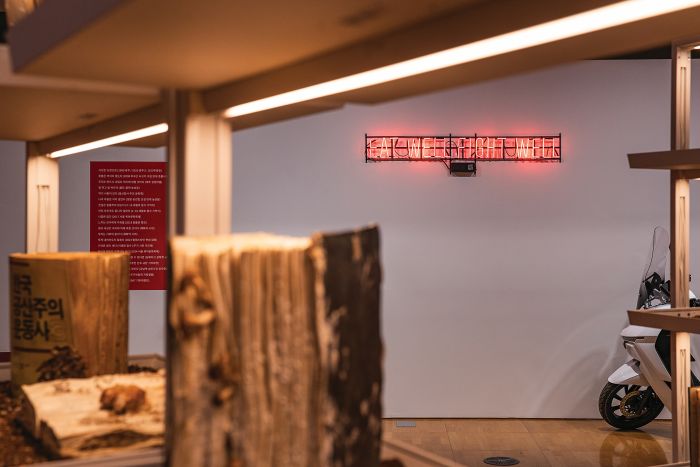
“Eat well, fight well,” in Der Giftpilz. (Courtesy of the artists)
Meanwhile, Der Giftpilz draws an unexpected parallel between mushrooms and contemporary systems of circulation. Just as fungi grow through neglected spaces and form vast underground networks, the artists compare their spread to Korea’s highly efficient delivery systems: fast, connected, and often invisible.
Speaking with the artists, it becomes clear that these are not simply metaphors. They are ways of understanding how ordinary people move, gather, and sustain one another, especially in moments of crisis.
Luis: How does it feel to be recognized as emerging artists in Asia and to present your work in Gwangju?
Sooji: Among the five participating artists or teams, we are the only ones based in Gwangju. Many people, including our peers, often say that to pursue “real art,” you have to move to Seoul. But every time we hear that, we find ourselves asking whether there might be stories that can only be told from Gwangju. Through this exhibition, and by seeing how audiences have responded to our work, we have gained confidence that this belief is not wrong.
Ame: What were the main inspirations behind your exhibitions? Did each work begin from a different starting point?
Hayoung: Because this exhibition focused on emerging artists, it was important for us to present works that clearly reflect our practice. Fandom-ing Democracy, which draws from our experiences in public squares after the 2024 martial law, and Der Giftpilz, which builds on our ongoing research into memory and commemoration, complement each other in that sense. Although they begin from very different points, K-pop fandom and mushrooms grown on books, both works trace the stories of ordinary people who have tried to make the world a better place.
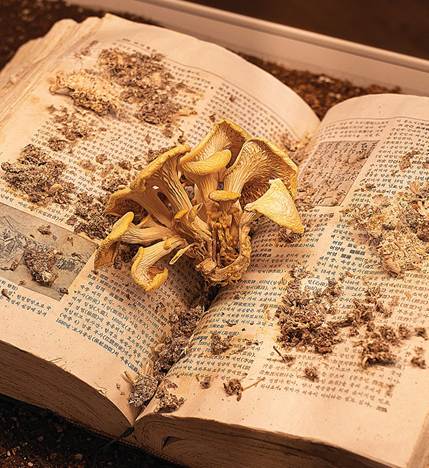
Mushrooms that grow in books, in Der Giftpilz. (Courtesy of the artists)
Luis: In Fandom-ing Democracy, Kisses is the name of a fictional idol group. What does that name represent?
Hayoung: During the protests against the martial law declaration, we were struck by how people referred to protestors wrapped in silver thermal blankets, even in heavy snow, as the “Kisses Brigade,” because they resembled Hershey’s Kisses chocolates. Watching them stand their ground, we felt a mixture of gratitude, guilt, sadness, and anger. We imagined a fictional idol group as a way of “fandom-ing” those emotions, and we chose the name “Kisses,” inspired by that moment.
Ame: In Der Giftpilz, you compare mushrooms with delivery services. Why that connection?
Sooji: While working on the piece, we visited many sites of protest. In most cases, police were present, and access was restricted by barriers. What stood out to us was that delivery workers were almost the only ones who could move freely across these boundaries. That made us think about delivery systems as one of the fastest and most pervasive ways that things circulate today, capable of reaching anywhere. From there, we began to imagine delivery itself as a potential tool of resistance: a system that could nourish today’s so-called “poisonous mushrooms.”
Luis: In that regard, the phrase “Eat Well, Fight Well” appears as a powerful statement. What does it mean to you?
Hayoung: We first encountered that phrase in a photograph documenting a protest by laid-off workers. Later, we heard similar expressions in many places, like “let’s eat first,” or “you have to eat to keep fighting.” We were deeply moved by scenes of people cooking together or sharing meals in solidarity. It made us realize that the force that sustains resistance may come less from grand ideologies and more from these small, concrete acts. For us, “Eat well, fight well” reflects the belief that caring for one another and sustaining everyday life can itself be an act of resistance.
⁂ If food sustains resistance, connection sustains movement. Across both works, Kang and Lee return to a shared question: How do people come together, especially when their forms of connection are dismissed as trivial?
Ame: Your work connects fungi, fandom, and community. How do these ideas intersect?
Hayoung: At first, fungi and K-pop fandom seem completely unrelated. But in many ways, they are similar. Both exist everywhere, spread quickly, and are connected through networks that are not easily visible. More importantly, both are often dismissed as insignificant or even undesirable. Through our work, we wanted to highlight the potential of these overlooked forms of connection.
Luis: In Gwangju, May is deeply tied to memory, democracy, and civic resistance. How does your work engage with that context?
Sooji: When we talk about events like May 18, we are less interested in how many people died or how brutal the violence was, and more interested in how ordinary people cared for and saved one another. Rather than turning certain figures into heroes, we want to listen to stories of people who made choices they believed were right in their own positions.
For example, beyond the armed citizen militias, we are drawn to less visible acts, like grandmothers who gave bloodied students clothes to change into when they sought refuge. We hope our work allows people to feel those choices and emotions, and to connect them to the present.
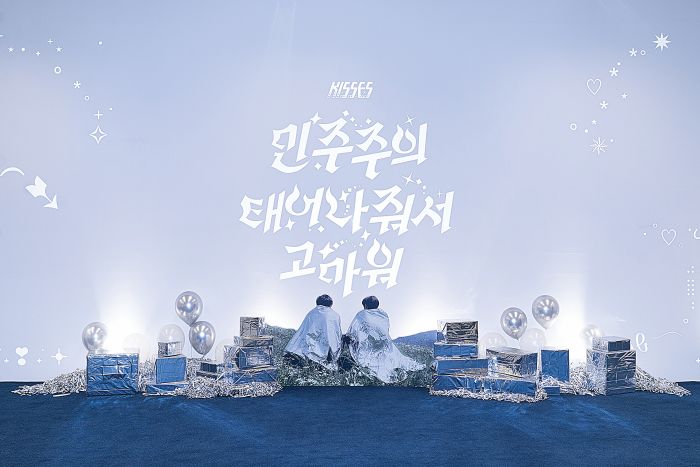
“Kisses, thank you for giving birth to democracy.” In Fandom-ing Democracy. (Courtesy of the artists)
Luis: Across both works, what do you hope audiences take with them?
Sooji: We hope people can feel that the power to change the world comes from the resilient hope and solidarity built by ordinary people.
Hayoung: In Fandom-ing Democracy, we wanted to invite everyone, even those unfamiliar with fandom culture, into the space as “fans of democracy.” And in Der Giftpilz, we wanted to create a space where stories of people treated as “poisonous” can still be heard and supported. As one phrase in the work suggests, “It’s okay to be called a poisonous mushroom.” What matters is that we continue to love what we value.
⁂ Their work does not simply revisit histories of resistance; it reshapes how they are felt.
Ame: Looking ahead, what can we expect next?
Sooji: In May, we will present both works again in different spaces and formats. Fandom-ing Democrac yis planned to be shown at the Jeonil Building and Der Giftpilz at G.MAP. We will publish the details on our Instagram: @kangsoojileehayoung
Hayoung: We are also working between Gwangju and Hongdong Village, a rural community centered on shared living through agriculture. This year, we began farming collectively with local residents, and we are preparing a project based on that experience.
Sooji: We want to continue exploring how everyday experiences connect people and how those connections can grow into broader forms of solidarity.
The Interviewers
Luis Andrés González is a Mexican GKS scholar and master’s student in cultural anthropology at Chonnam National University. He advocates for LGBTQ+ rights and gender equality, and explores global affairs through pop culture. He is the founder of Erreizando, a digital magazine. Instagram: @luisin97 / @erreizando
Ame Min-Venditti is a Korean-American scholar, artist, and PhD candidate in sustainability at Arizona State University. Their work traces water as a living, relational force across hydrosocial territories, weaving personal narrative, Indigenous and local knowledges, and critical approaches to infrastructure, memory, and environmental change. Web: min-venditti.com